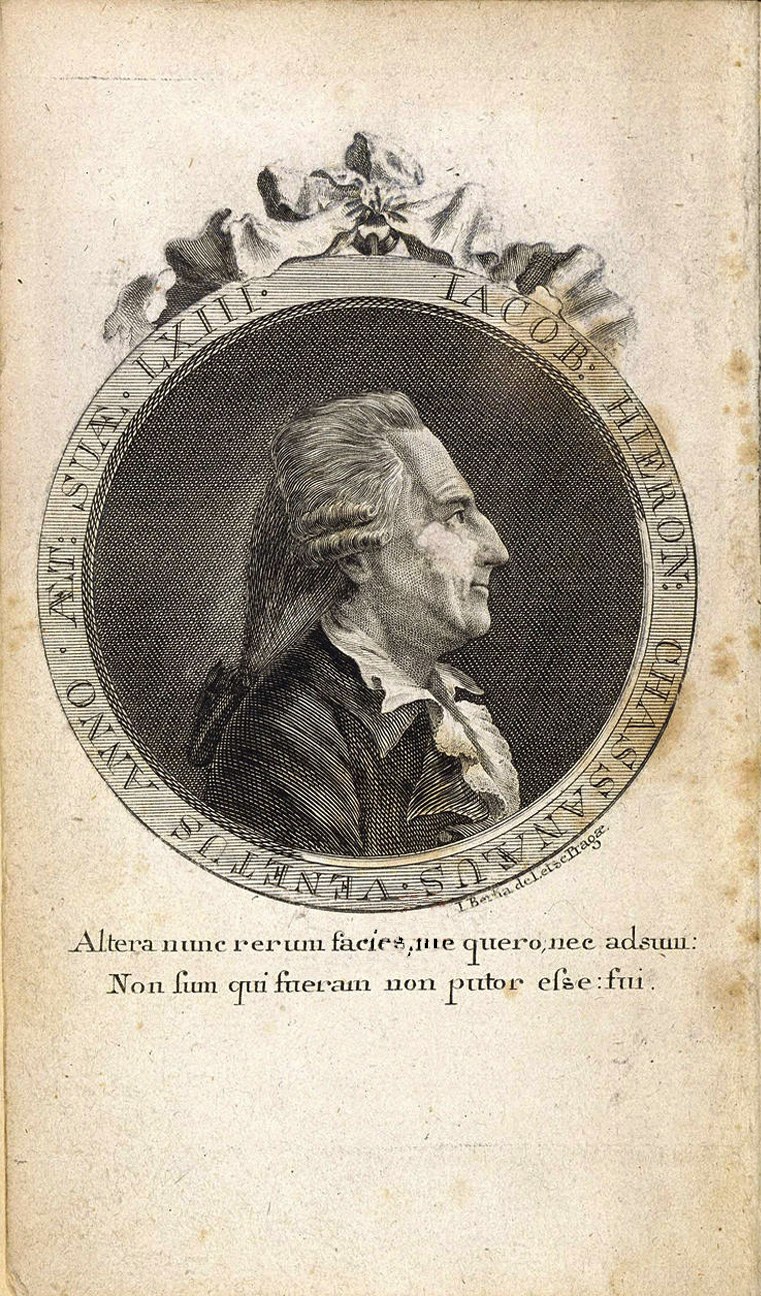
Giacomo Casanova
The Venetian adventurer who wrote one of the great memoirs of the eighteenth century — documented, dated, and honestly sourced.
Giacomo Girolamo Casanova (2 April 1725 – 4 June 1798) was a Venetian adventurer, gambler, writer, and librarian whose posthumously published memoirs, Histoire de ma vie (Story of My Life), are among the most detailed first-person accounts of eighteenth-century European life. This site is a strictly factual reference: every quotation is verbatim and cited, disputed claims are flagged as disputed, and the few genuine portraits are identified as such.
The essentials
- Born: 2 April 1725, Venice, Republic of Venice.
- Died: 4 June 1798, Dux (Duchcov), Bohemia — then in the Habsburg domains; today the Czech Republic.
- Known for: Histoire de ma vie, a manuscript of some 3,700 pages written between 1789 and 1798, covering his life only through 1774.
- The escape: arrested in Venice on 26 July 1755 by the Inquisitori di Stato; he broke out of the Piombi — the lead-roofed prison cells of the Doge’s Palace — on the night of 31 October to 1 November 1756 with the renegade priest Marino Balbi. The escape is documented in his memoirs and corroborated by Venetian archival records.
- The title: “Chevalier de Seingalt,” which he used from about 1757, was a self-styled name, not a Venetian title.
- The name in language: “Casanova” has entered several languages as a common noun for a libertine or practiced seducer.
Portraiture: a necessary warning
Authentic likenesses of Casanova are scarce. The one certain lifetime portrait is an engraving by Johann Berka, drawn from life in March 1788 and used as the frontispiece to Casanova’s novel Icosameron (1788) — it shows him in his 63rd year. Other images circulating under his name are engravings after a presumed bust or unattributed likenesses; where this site uses them, the attribution is labeled exactly as the archives label it. No portrait here is invented, and no AI-generated image ever shows his face.
Where to go next
- New to the subject? Read Start here, then the Biography and the Timeline.
- Interested in the book itself? See The memoirs and the Publication history.
- For the prison break, the Venice background, and the final years: Escape from the Piombi, Venice in the 18th century, Dux: the last years.
- For the character behind this site: Meet the character gives the Vizlings card description verbatim, with an honest note on what is and isn’t known.
How this site stays honest
Every page ends with Source notes. Quotations are verbatim from Arthur Machen’s 1894 English translation of the memoirs (itself made from the expurgated 19th-century text — flagged where that matters), or from the French of Histoire de ma vie with translation. Dates on the timeline carry certainty labels; contested claims carry their attribution. See Methodology for the full editorial policy.
Source notes
- Vital dates (2 April 1725 – 4 June 1798) and the Dux burial are the standard scholarly consensus (e.g., the Bibliothèque nationale de France’s “Fonds Casanova” records and the modern Pléiade edition of Histoire de ma vie, 2015, ed. Gérard Lahouati and Marie-Françoise Luna).
- The Berka engraving’s details (drawn from life, March 1788, frontispiece to Icosameron) follow the Wikimedia Commons file record for “Portrait of Giacomo Girolamo Casanova.jpg,” sourced from the original print.
- Arrest and escape dates follow Casanova’s own account (Gutenberg ebook 2960, “under the Leads”) and Venetian state archives as summarized in the scholarly literature.