Hero Design
Why the "star violet girl" works — the archetype, the flaws, the voice, and the coming-of-age engine at the center of Neris Sen.
The concept in one line
A prodigy with a star in her chest who is allowed to be seventeen. That’s the whole design thesis of Neris Sen, and everything else — the powers, the suit, the rival — is scaffolding around it.
The archetype: the prodigy, honestly written
Prodigy characters fail in two directions: they become invincible (boring) or they become victims of their gift (miserable). Neris is engineered to dodge both:
- Powerful but costly. The Starheart Core gives her stellar-scale output, but every technique burns her. The story never lets power be free, so it never gets boring.
- Gifted but unfinished. Her raw output exceeds her mentor’s; her control, judgment, and self-knowledge lag years behind. The gap between what she can do and what she understands is the engine of the whole arc.
- Chosen but not special. The Core “chose her, not the other way around” — and she resents it as often as she embraces it. Her most quoted line is about holding the light for the next kid, not owning it.
The coming-of-age structure
Neris’s story is deliberately staged as a coming-of-age arc mapped onto space opera:
- The marked child (Kindling → Awakening): the gift arrives before understanding.
- The year of hiding (1162): the world tries to decide what she is for her.
- The refusal (Reckoning): she decides for herself — by standing on a dock and not moving.
- The training (1165): learning that power is a practice, not a property.
- The test (Eclipse Siege): the first adult-scale choice, with adult-scale costs.
- The aftermath (Quiet Years): living with the choice, and with the rival it made.
The arc is mid-flight. That’s intentional: a coming-of-age hero who has finished growing isn’t one anymore.
Her flaws (the honest list)
- Impulsivity. She volunteered for the corona run before Veyne finished the briefing. She would do it again. Everyone knows it.
- Pride in the work. Not arrogance about being special — pride about doing the job. It makes her take missions she should delegate and injuries she should report.
- Control issues with control. She hates being managed, even by people who are right. Osei is the only one who can order her to stand down; Veyne is the only one who can talk her into it.
- Survivor’s guilt, star-sized. She held the docks and lived. The colony lost eleven people that day anyway. She knows their names.
- A temper with a blast radius. Literal, in her case.
Her voice
Neris talks like a bright seventeen-year-old who has seen too much: quick, wry, allergic to ceremony. She deflects with jokes, lands with sincerity, and saves her poetry for the moments that earn it. Her dialogue signature is the punchline-then-truth rhythm — “Training doesn’t end. It just gets prettier” is funny until you realize she’s describing a lifetime of war.
She never monologues about her feelings. She races Lyra, bickers with Flick, lets Jax fuss, and writes unsent messages to her parents. The writing trusts the audience to read the silence.
Relationships as design
Every major relationship is a different answer to the question “what is she for?”:
- Veyne: a hero, not a weapon. (The thesis.)
- Jax: a kid, not a casualty. (The stakes.)
- Lyra: a rival, not a rival for. (The normalcy.)
- Flick: a person with limits, not an engine. (The care.)
- Osei: a patient, not a project. (The history.)
- Drax: a person, not a prize. (The moral line — the one he keeps trying to erase.)
The visual design
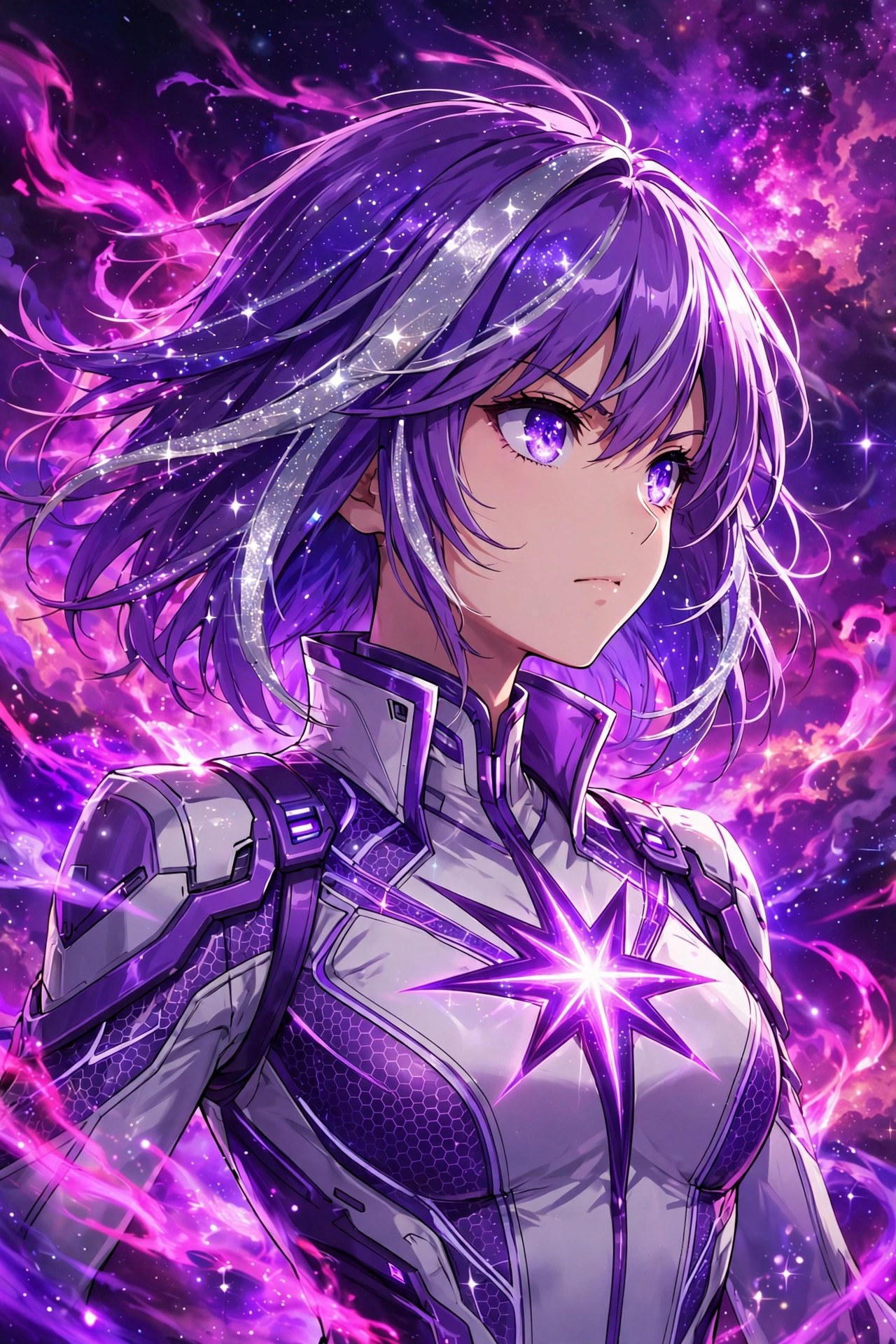
Violet is doing triple duty: it’s her energy color, her hair, and her emotional register (the design notes call violet “the color of becoming”). The silver streaks in her hair are starlight-bleach from the Nova States — a visual record of cost. The energy-weave suit’s starburst emblem is her own drawing, from the trainee year; Flick digitized it and never told her it was crooked. It still is.
See Costume and Gear and Behind the Design for the full visual breakdown.
Why she endures
Prodigy characters usually cool off once the origin story ends. Neris doesn’t, because her design never confused power with character. The Starheart Core is the hook; the seventeen-year-old deciding what to do with a star is the story. As long as she keeps deciding, she keeps working.
Source notes
This page is a fan reference for a fictional character. All design analysis describes the invented in-world character from the Vizlings “Neris Sen” character concept. No real people are depicted. Images are AI-generated dramatization art produced in-house .