Timeline
Sixty-plus years, twenty milestones — from a boarding school in Kentucky to the center of the AI economy.
1963 — Born in Tainan
Jen-Hsun Huang is born on February 17, 1963, in Tainan, Taiwan.
Late 1960s — Thailand
The Huang family moves to Thailand, where his father works as a chemical engineer.
1972 — Sent to America
At about age nine, Huang and his older brother are sent to the United States for schooling. They attend the Oneida Baptist Institute, a boarding school in rural Kentucky.
Late 1970s — Oregon and Denny’s
The family settles in Oregon. Huang works at Denny’s — dishes, bussing, waiting tables, graveyard shifts — while finishing high school.
1984 — Oregon State
Graduates from Oregon State University with a B.S. in electrical engineering. Meets Lori Mills, his future wife, as an engineering lab partner.
1984–1990 — LSI Logic
Joins LSI Logic as a chip designer; rises to director of the CoreWare business unit.
1990–1993 — AMD and Stanford
Works as a microprocessor designer at AMD while completing an M.S. in electrical engineering at Stanford University (1992).
April 1993 — NVIDIA is founded
Huang, Chris Malachowsky, and Curtis Priem found NVIDIA. The founding meeting takes place at a Denny’s in San Jose. Early venture backing comes from Sequoia Capital and Sutter Hill Ventures.
1995 — NV1: the wrong bet
NVIDIA’s first chip, the NV1, ships — built around quadrilateral texture rendering, just as Microsoft’s DirectX standardizes on triangles. The product fails. Near-death event #1.
1996–1997 — The Sega crisis
A contract to build the graphics chip for Sega’s next console collapses when NVIDIA can’t deliver on the required standard. Huang asks Sega to release NVIDIA from the deal; Sega’s CEO reportedly pays NVIDIA around $5 million anyway — reported, not confirmed — funding survival. The company lays off staff and bets everything on RIVA 128.
August 1997 — RIVA 128
RIVA 128 ships and reportedly sells over a million units in its first four months, pulling NVIDIA back from the edge. An internal mantra from this era, repeated by Huang ever since: “Our company is thirty days from going out of business.”
January 1999 — IPO
NVIDIA goes public.
October 1999 — GeForce 256
NVIDIA launches the GeForce 256, which it markets as “the world’s first GPU” — a claim historians debate (see mythology), but a product that defined the modern graphics processor.
2007 — CUDA
NVIDIA launches CUDA, a platform for general-purpose computing on its graphics chips. It is a commercial disappointment for years — and the most important strategic decision in the company’s history.
2012 — The deep-learning turn
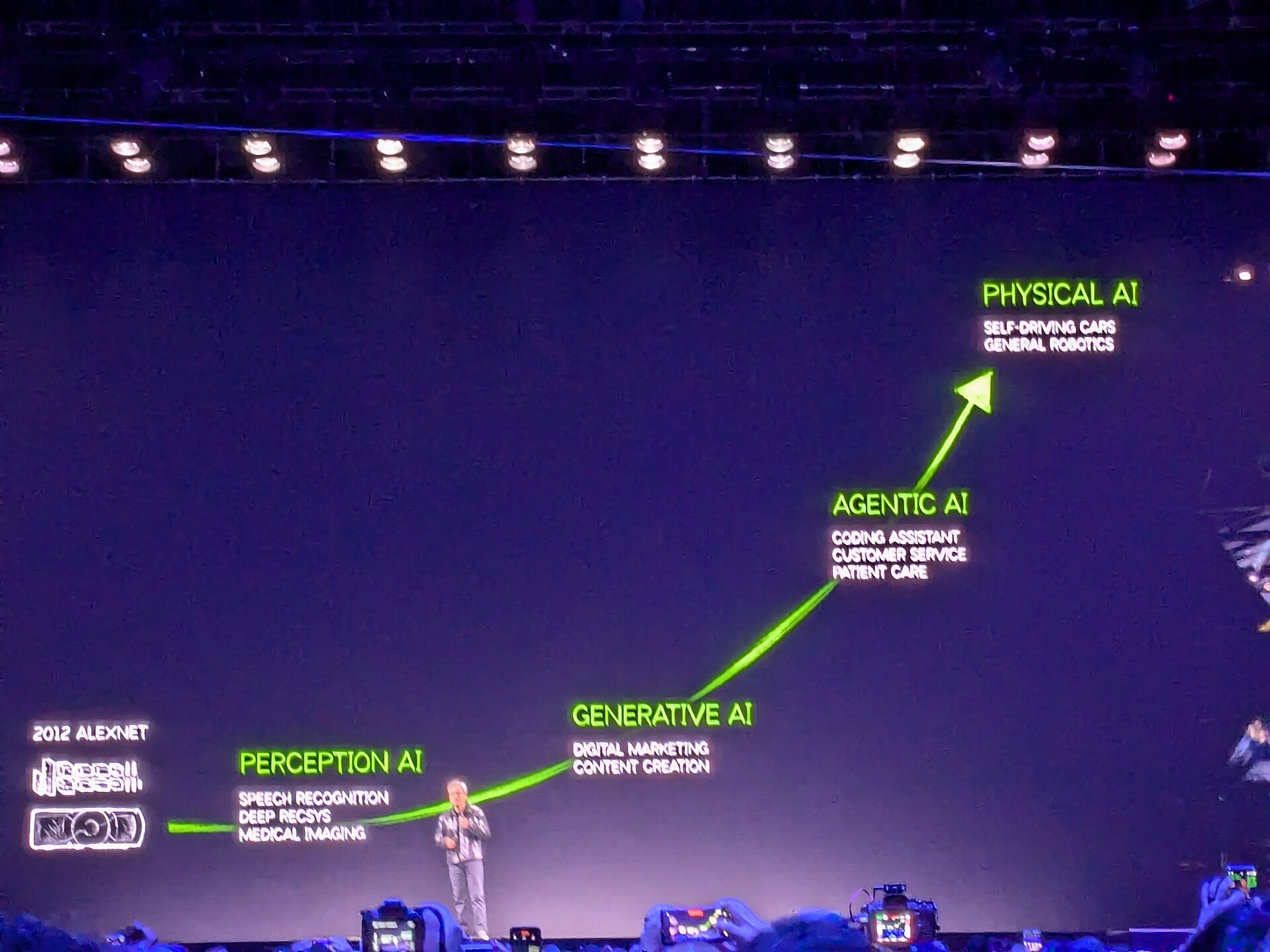
Researchers train the landmark AlexNet neural network on NVIDIA GPUs, demonstrating that graphics chips are ideal for AI. CUDA, built for a market that didn’t exist, suddenly has one.
2017 / 2020–2021 — The crypto booms
Cryptocurrency miners buy GPUs by the pallet, creating shortages and windfall revenue — and controversy. In 2022 NVIDIA settles with the U.S. SEC for $5.5 million over disclosures about the impact of crypto mining on its gaming revenue.
November 2022 — ChatGPT
The launch of ChatGPT ignites a global scramble for AI computing. NVIDIA’s data-center business explodes.
October 2022 — The $50M gift
Jensen and Lori Huang donate $50 million to Oregon State University, the school’s largest gift at the time, funding a collaborative research complex bearing their names.
May 2023 — Trillion-dollar company
NVIDIA becomes the first chipmaker to reach a $1 trillion market valuation, on data-center AI demand.
March 2024 — GTC and Blackwell
At GTC 2024 in San Jose, Huang unveils the Blackwell GPU architecture to a sold-out arena — the keynote widely covered as the “Woodstock of AI.”
June 2024 — “Pain and suffering”
Huang delivers the commencement address at Stanford’s Institute for Economic Policy Research: “I wish upon you ample doses of pain and suffering” — arguing that resilience, not intelligence, produces greatness.
2024–2026 — The AI buildout
NVIDIA ships Blackwell, announces the Rubin platform, and remains the central hardware supplier of the global AI infrastructure buildout, while navigating export controls, sovereign-AI deals with governments, and intense competition.
Source notes
Timeline dates draw on NVIDIA’s corporate history, SEC filings (for the 2022 settlement), Stanford and Oregon State University records, and contemporaneous press coverage of keynotes and product launches. Dollar figures attributed to Sega and RIVA 128-era events are reported in profiles and interviews, not confirmed in filings, and are flagged as such.