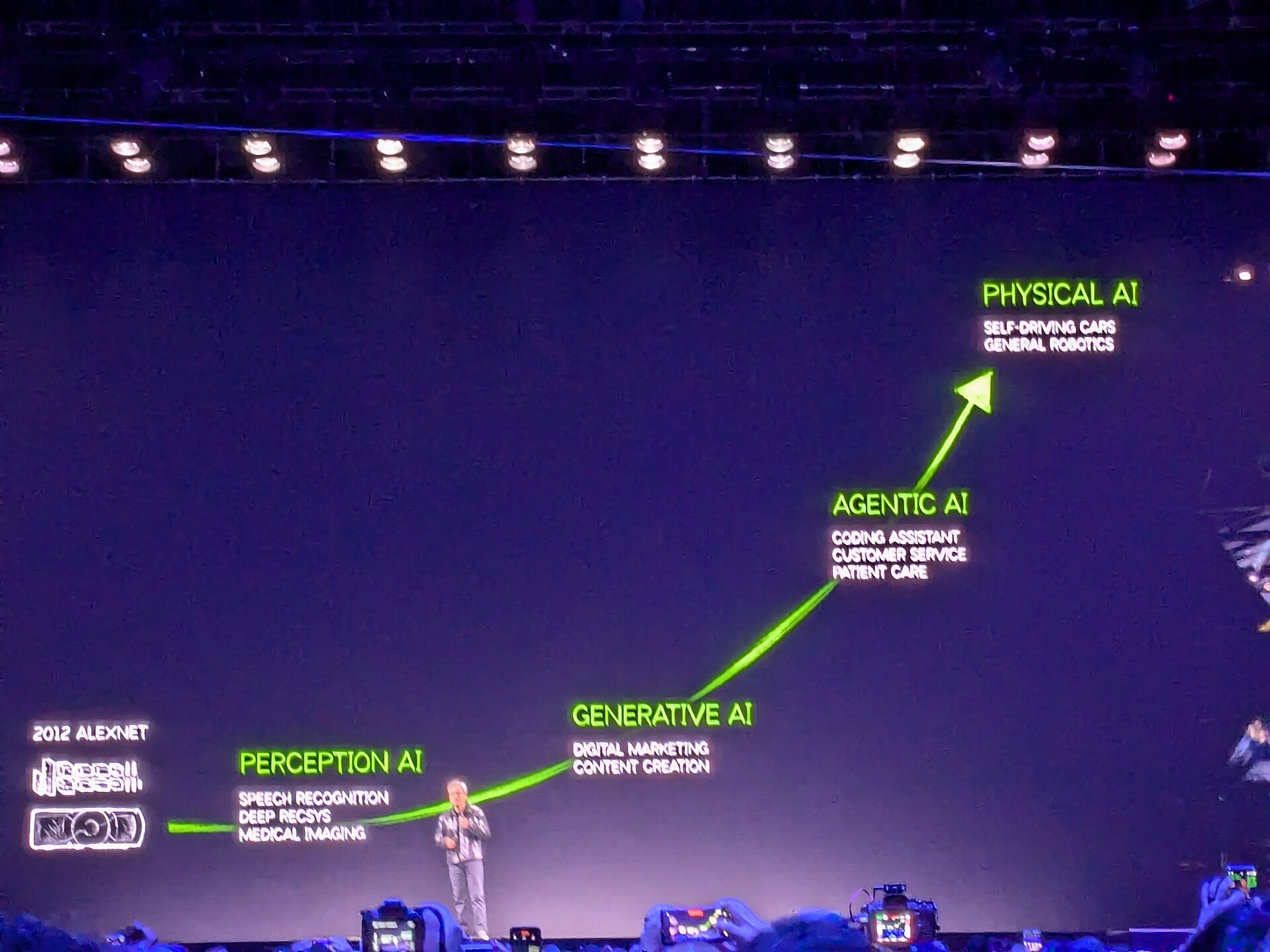
The keynote
Two hours, one leather jacket, and the most-watched product launch in enterprise tech.
What it is
Once or twice a year, Jensen Huang takes a dark stage — usually in San Jose — and talks for two-plus hours about chip architecture to thousands of engineers in the room and millions watching online. This is the GTC keynote, and it has become the tech industry’s most-watched enterprise event: part product launch, part developer revival, part economics lecture.
The formula
The keynotes follow a script Huang has refined for a decade:
- The state of the union. Computing is at an inflection point (it always is); accelerated computing is the answer (it always is).
- The reveal. A new architecture — Hopper, Blackwell, Rubin — unveiled with theatrical props. (He has literally pulled chips from a kitchen oven on stage.)
- The chart. Performance-per-dollar graphs showing the new generation dwarfing the old — the setup for “the more you buy, the more you save.”
- The ecosystem. Partners, demos, robots, digital twins — proof that the platform has an army.
- The vision. AI factories, sovereign AI, physical AI — the world according to Jensen, five years out.
Why it works
- He’s the founder. Keynotes by hired CEOs are marketing; keynotes by the engineer who built the company are testimony.
- He teaches. The keynotes are genuinely educational — architecture explained clearly enough that students watch them as lectures.
- He sells without apology. “The more you buy, the more you save” gets laughs because it’s honest: yes, this is a sales pitch, and yes, the math checks out.
- Scarcity. He does few of them, and each one moves markets. Analysts parse the slides like scripture.
The “Woodstock of AI”
GTC 2024’s keynote — the Blackwell unveiling to a sold-out SAP Center — was widely covered under that nickname. The image stuck: thousands of developers treating a chip launch like a cultural event. Whether the analogy flatters or embarrasses depends on your view of the AI boom; the attendance figures don’t.
The critique
The keynote is also a machine for manufacturing inevitability: every chart says NVIDIA wins, every demo says the future needs more NVIDIA. Competitors’ keynotes tell different stories. The keynote is evidence of NVIDIA’s position, not proof of its permanence — and this site treats its claims the way it treats all company claims: documented as said, evaluated as claims.
Source notes
Keynote descriptions draw on contemporaneous live coverage (Engadget, Tom’s Hardware, and others) of GTC 2020, 2024, and 2025. Attendance and market-reaction characterizations are reported in financial and tech press.