Early life
Three countries before high school — and a boarding school that taught him to fight.
Tainan (1963)
Jen-Hsun Huang was born February 17, 1963, in Tainan, Taiwan’s old southern capital. His father was a chemical engineer; the family was comfortable but not wealthy. Taiwan in the 1960s was still a developing economy, and like many ambitious families of the era, the Huangs looked outward.
Thailand
The family moved to Thailand, where Huang’s father worked. Huang’s childhood memories of the period, as shared in interviews, are fragmentary — the move matters less for what happened there than for what it established: a family willing to relocate across borders for opportunity, and a child growing up between cultures and languages.
The decision (c. 1972)
When Huang was about nine, his parents made the defining decision of his childhood: they sent him and his older brother to the United States for their education. The boys’ uncle lived in America, and the plan — as Huang has described it — was that they would live with relatives and attend American schools.
What actually happened was rougher. The boys ended up at the Oneida Baptist Institute, a boarding school in rural Kentucky — a long way, culturally and geographically, from anything they’d known.
Oneida Baptist Institute
Oneida in the early 1970s was not a gentle landing. Huang has described a tough environment: physical fights, a student body with little patience for outsiders, and the daily work of being a small Asian kid in Appalachia who spoke accented English. He has spoken of learning to stand his ground — lessons in resilience he still cites, decades later, in commencement speeches about “pain and suffering.”
It was also where he discovered table tennis, playing competitively as a junior. Profiles describe him winning junior tournaments; the specifics are reported rather than documented (see The myth machine), but the broad fact — that the sport mattered to him — is consistent.
Oregon
The family eventually reunited in Oregon, where Huang finished high school. The Oregon years were the Denny’s years: dishwashing, bussing tables, waiting tables on the graveyard shift, studying between shifts. He has described cleaning toilets without complaint and getting orders wrong in halting English — the origin stories of his “no task is beneath you” philosophy.
He entered Oregon State University and finished a B.S. in electrical engineering in 1984 — in three years, by the university’s account.
What the childhood explains
Three threads run from Oneida and Oregon straight into the CEO:
- Comfort with being the outsider. A Taiwanese kid in Kentucky, an engineer among MBAs — he has spent his life walking into rooms where he doesn’t belong and staying.
- Resilience as identity. The “pain and suffering” commencement speech of 2024 is, in substance, the Oneida story retold as philosophy.
- Work as dignity. The Denny’s years surface constantly — not as trauma, but as credential. The dishwasher became the founder, and he never lets anyone forget the order of operations.
What we don’t know
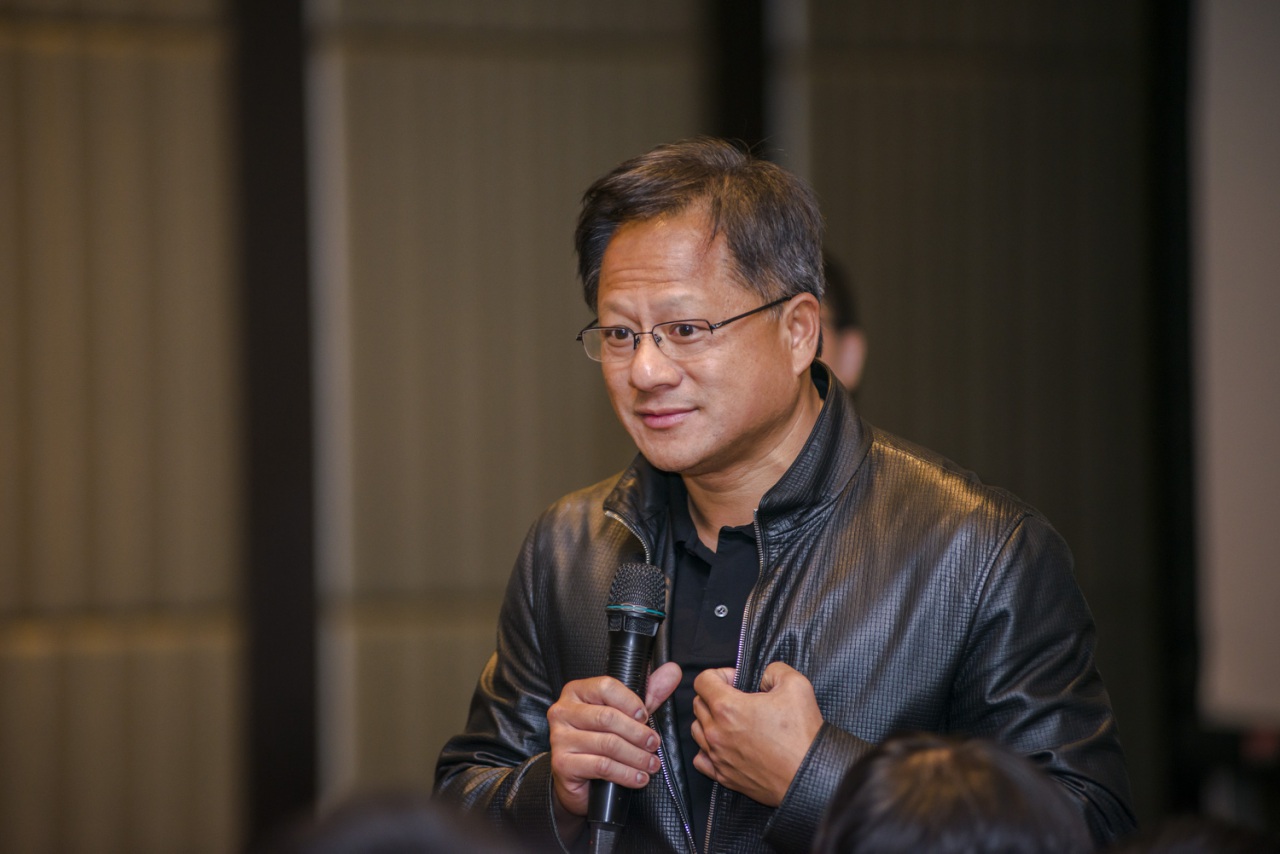
No freely licensed photographs of Huang’s childhood are known to exist, and this site will not invent them. The image above shows Huang at Computex 2016 — the earliest era for which quality open-licensed photographs were located. Childhood details come from his own interviews; independent documentation of the Oneida years is thin, and the page says so rather than filling gaps with color.
Source notes
Childhood facts draw on Huang’s interviews (including the Sequoia oral history and commencement addresses) and Oregon State University’s biographical materials. Specific junior table-tennis titles are reported, not documented. Photographic evidence for the childhood years could not be located in open-licensed archives.