Glossary
Every technical term on this site, explained in plain language.
GPU
Graphics Processing Unit. A chip designed to perform many calculations in parallel — originally for rendering images, now for AI. NVIDIA’s GeForce 256 (1999) was marketed as “the world’s first GPU.”
CUDA
Compute Unified Device Architecture. NVIDIA’s platform (launched 2007) for running general-purpose programs on its GPUs. The software moat behind NVIDIA’s AI dominance: millions of developers learned it, and AI frameworks are built on it.
Data center
A facility housing large numbers of servers. In the AI era, data centers filled with NVIDIA GPUs are where AI models are trained and run — what Huang calls AI factories.
AI factory
Huang’s metaphor (prominent from GTC 2024–2025): a data center conceived as a factory that takes in electricity and produces “intelligence” — tokens, predictions, models — as its output. A framing device, not a technical term.
Fabless
A chip company that designs chips but doesn’t manufacture them. NVIDIA is fabless; TSMC in Taiwan fabricates its chips. The model lets NVIDIA focus on design while TSMC focuses on manufacturing.
Foundry
A company that manufactures chips designed by others. TSMC is the world’s dominant foundry and NVIDIA’s manufacturing partner since the 1990s.
GeForce
NVIDIA’s consumer graphics brand, launched with the GeForce 256 (1999). The product line that built the company before AI did.
RIVA 128
NVIDIA’s 1997 graphics chip — the product that saved the company from its first near-death crisis, reportedly selling over a million units in its first four months.
NV1
NVIDIA’s first chip (1995), built around quadratic texture rendering — incompatible with Microsoft’s DirectX triangle standard. A commercial failure and the cause of near-death event #1.
DirectX
Microsoft’s graphics standard, which standardized on triangle-based 3D rendering. NVIDIA’s NV1 bet against it and lost; RIVA 128 embraced it and won.
Deep learning
The branch of AI behind the modern boom: neural networks with many layers, trained on vast data. The 2012 AlexNet result — trained on NVIDIA gaming GPUs — proved GPUs were ideal for it.
Inference
Running a trained AI model to produce answers (as opposed to training it). Huang’s recent keynotes emphasize inference as the next great demand driver for GPUs.
Hopper / Blackwell / Rubin
Successive NVIDIA GPU architectures, named for scientists and mathematicians: Hopper (Grace Hopper), Blackwell (David Blackwell), Rubin (Vera Rubin). The cadence of new architectures — roughly every two years — is central to NVIDIA’s strategy.
GTC
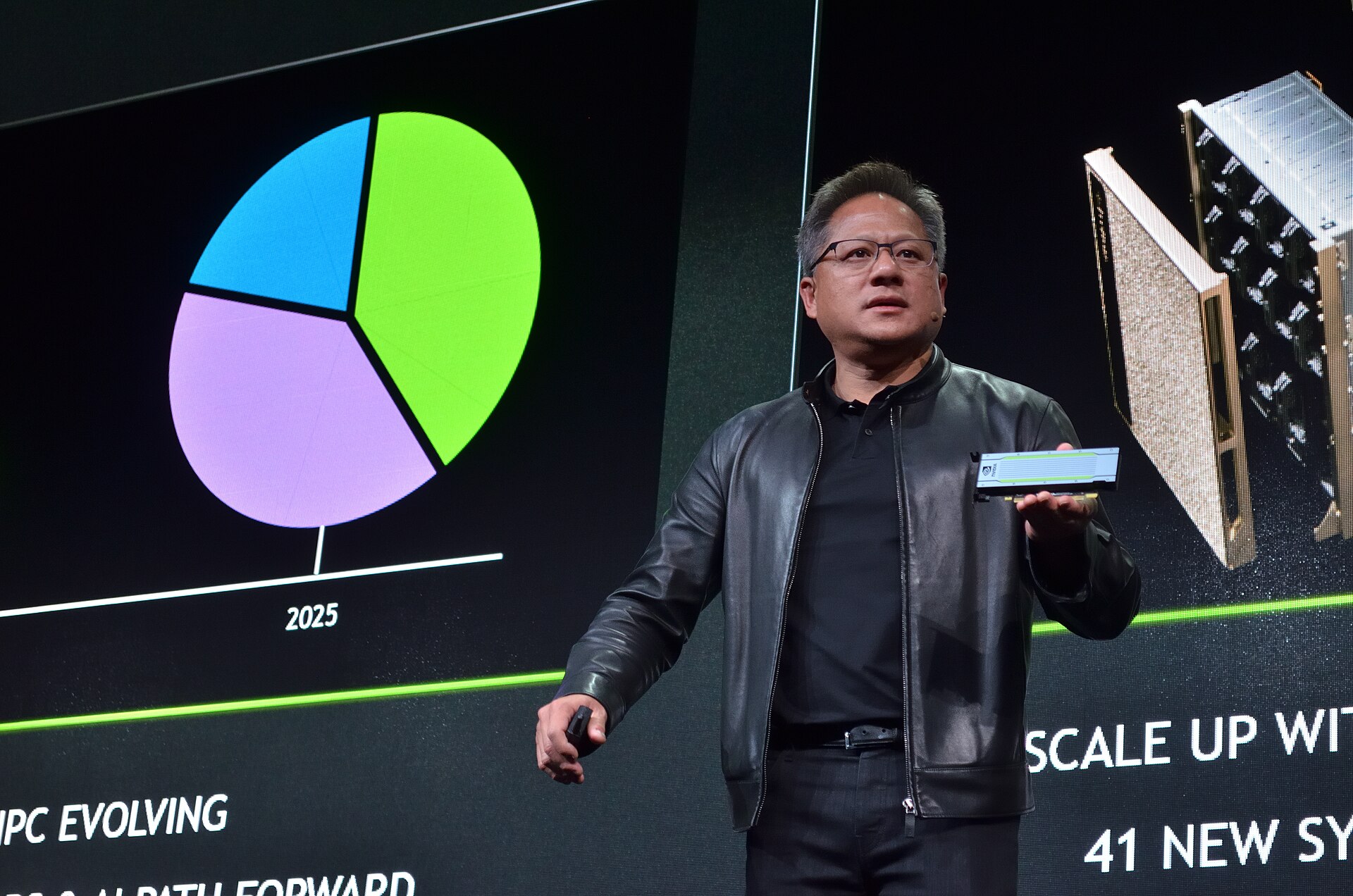
GPU Technology Conference, NVIDIA’s annual developer conference. Huang’s leather-jacketed keynote is its centerpiece — part product launch, part revival meeting.
Sovereign AI
Huang’s pitch to governments: nations should build their own AI infrastructure (data centers, models, talent) rather than renting intelligence from abroad. He has carried this message to leaders in India, Vietnam, the Gulf states, the UK, and elsewhere.
DGX
NVIDIA’s line of AI supercomputers for enterprises and researchers — the product behind the “the more you buy, the more you save” keynote line (GTC 2020).
LHR (Lite Hash Rate)
A 2021 NVIDIA technology that limited the cryptocurrency-mining performance of gaming GPUs — an attempt to steer cards toward gamers during the crypto boom. Part of the long, awkward NVIDIA–crypto relationship (see The crypto booms).
Moore’s Law
The 1965 observation (Gordon Moore) that transistor counts double roughly every two years. Its slowing is Huang’s core justification for accelerated computing: when general CPUs stop getting faster cheaply, specialized chips like GPUs take over.
Denny’s
The American diner chain where Huang worked as a teenager — and where, in April 1993, he and his co-founders held the meeting that founded NVIDIA. Both facts are documented; the symbolism is Huang’s own.
Source notes
Definitions are standard industry usage, cross-checked against NVIDIA’s documentation and technical references. Huang-specific usages (AI factory, sovereign AI) are attributed to his keynotes and interviews.