Biography
A boy sent across the world at nine, a dishwasher who became a chip designer, and a 30-year-old who bet everything on graphics.
Early life: Tainan and Thailand (1963–1972)
Jen-Hsun Huang (黃仁勳) was born on February 17, 1963, in Tainan, Taiwan. His family later moved to Thailand, where his father worked as a chemical engineer. When Huang was about nine, his parents made a decision that shaped everything after: they sent him and his older brother to the United States for schooling, believing American education would give them better chances.
Oneida, Kentucky (1972–~1976)
The boys landed not in a leafy suburb but at the Oneida Baptist Institute, a boarding school in rural Kentucky. Huang has described it in interviews as a rough place — he has spoken of fistfights, of being one of very few Asian students, and of learning to fend for himself. It was also where he picked up competitive table tennis, at which he became accomplished as a junior player (profiles describe him winning junior tournaments; the exact titles are reported, not independently documented — see The myth machine).
Oregon (late 1970s–1984)
The family eventually settled in Oregon, where Huang finished high school. To support himself he worked at Denny’s — washing dishes, bussing tables, and waiting tables, including graveyard shifts. He has returned to this period constantly in speeches: the toilets he cleaned, the orders he got wrong, the discipline of working nights and studying between shifts.
In 1984 he graduated from Oregon State University with a bachelor’s degree in electrical engineering, completing the degree in three years according to university accounts. At OSU he met Lori Mills, an engineering student who became his lab partner and later his wife.
LSI Logic and AMD (1984–1993)
Huang joined LSI Logic, a Silicon Valley chip company, where he worked on chip design and rose to become director of its CoreWare business unit. He then spent time as a microprocessor designer at AMD. While working full-time, he earned a master’s degree in electrical engineering from Stanford University in 1992.
The pattern of this decade matters: nine years inside the semiconductor industry, on the design and business sides, before he ever started a company. He was not a student founder. He was a 30-year-old industry veteran.
Founding NVIDIA (1993)
In April 1993, Huang founded NVIDIA with two fellow engineers: Chris Malachowsky and Curtis Priem, both of whom he knew from the graphics-chip world. The founding meeting, retold ever since, happened at a Denny’s restaurant in San Jose — a deliberate echo of his dishwashing years.
The name: “NV” (for “next version”) combined with “invidia,” the Latin word for envy.
The bet: that 3D graphics — then a niche for workstations and games — would become essential to all computing, and that a company devoted entirely to the graphics processor could outrun the generalists.
See The founding of NVIDIA for the full story.
Building the company (1993–present)
The first years were brutal: the NV1 chip (1995) backed the wrong graphics standard, and a Sega game-console contract collapsed — the first of two near-death events Huang describes in interviews. RIVA 128 (1997) and the GeForce 256 (1999, marketed by NVIDIA as “the world’s first GPU”) established the company. NVIDIA went public in January 1999.
The decisive move came in 2007 with CUDA, a platform letting developers run general-purpose programs on NVIDIA’s graphics chips. It lost money for years — then the deep-learning revolution (2012 onward) made CUDA the foundation of AI computing, and NVIDIA the most important hardware company of the AI era.
Family and personal life
Huang married Lori Mills (now Lori Huang) in the 1980s; they have two children, a daughter and a son. The family has kept a relatively low profile. In October 2022, Jensen and Lori Huang donated $50 million to Oregon State University — the university’s largest gift at the time — to fund the Jen-Hsun Huang and Lori Mills Huang Collaborative Innovation Complex, a research facility named for them both.
The public persona
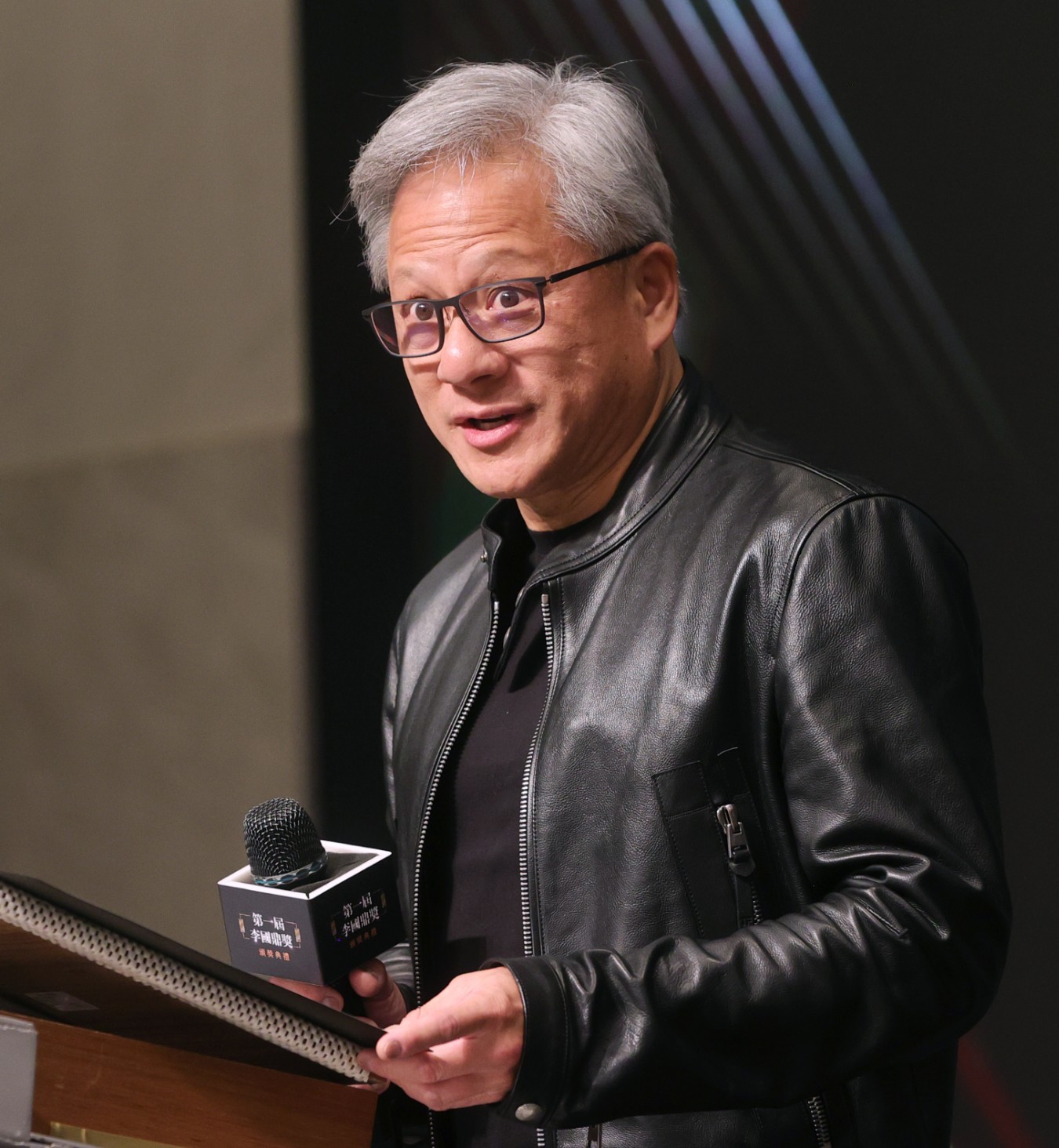
Since the 2010s, Huang’s public image has fused with his uniform: black leather jacket, jeans, and two-hour keynote performances at GTC that blend chip architecture, live demos, and salesmanship. He is known for blunt, aphoristic speaking — “I wish upon you ample doses of pain and suffering” (Stanford commencement, 2024) — and for an intense, ever-present management style. See Sayings and The leather jacket.

Source notes
Biographical facts draw on Huang’s interviews (including his Stanford addresses and the Sequoia Capital oral history), Oregon State University’s accounts of his education and the 2022 gift, NVIDIA’s corporate history, and profiles by major business outlets. Exact junior table-tennis titles and some Denny’s-era details are reported in profiles but not independently documented; they are flagged on The myth machine.