The LSI and AMD years
Nine years inside the chip industry before he ever started a company. This is the part the "overnight success" stories skip.
LSI Logic (1984–c. 1990)
Fresh out of Oregon State in 1984, Huang joined LSI Logic, a Silicon Valley company pioneering ASICs — application-specific integrated circuits, custom chips designed for particular customers.
He didn’t just design chips. He learned the business of chips: how custom silicon gets sold, how foundry relationships work, how a chip company makes money. He rose to become director of CoreWare, one of LSI’s business units — a management role, not just an engineering one, held by a man in his mid-twenties.
The LSI years gave him three things:
- Deep technical credibility in chip design.
- Business-unit leadership — P&L responsibility, customers, roadmaps.
- A front-row seat to the fabless model: LSI worked with outside foundries, the template NVIDIA would follow with TSMC.
AMD (c. 1990–1993)
Huang moved to AMD as a microprocessor designer, working on the CPUs that competed with Intel. The stint was shorter — a few years — but it put him inside the highest-stakes rivalry in semiconductors and deepened his understanding of the x86 world NVIDIA would pointedly not compete in. NVIDIA’s founding insight depended on this: while everyone fought over the CPU, the GPU was left open.
Stanford, at night (1992)
While working full-time, Huang earned an M.S. in electrical engineering from Stanford University in 1992. The night-school master’s is a small detail that says a lot: the pattern of his whole career is doing the extra thing — the extra degree, the extra shift — while holding down the main thing.
Why nine years mattered
The mythology of Silicon Valley loves the dropout founder. Huang is the opposite archetype: the apprentice founder. When he started NVIDIA at 30, he had:
- Designed chips at two companies, including a management role.
- Seen how venture-backed chip startups lived and died (LSI’s ecosystem was full of them).
- Built a network across the industry — including the relationships that would become NVIDIA’s early hires, investors, and partners.
- Studied the CPU wars from inside AMD, which taught him exactly where not to compete.
His co-founders matched the pattern: Malachowsky and Priem were industry veterans, not students. NVIDIA was founded by three men who had each spent a decade learning the business they were about to enter.
The lesson he took
Huang’s later management philosophy — deep technical engagement, flat information flow, reasoning from first principles — reads as a reaction to what he saw in big-chip-company bureaucracy: layers that filtered truth, planning cycles that substituted for thinking. He spent nine years inside the machine, then spent thirty years running the anti-machine.
Source notes
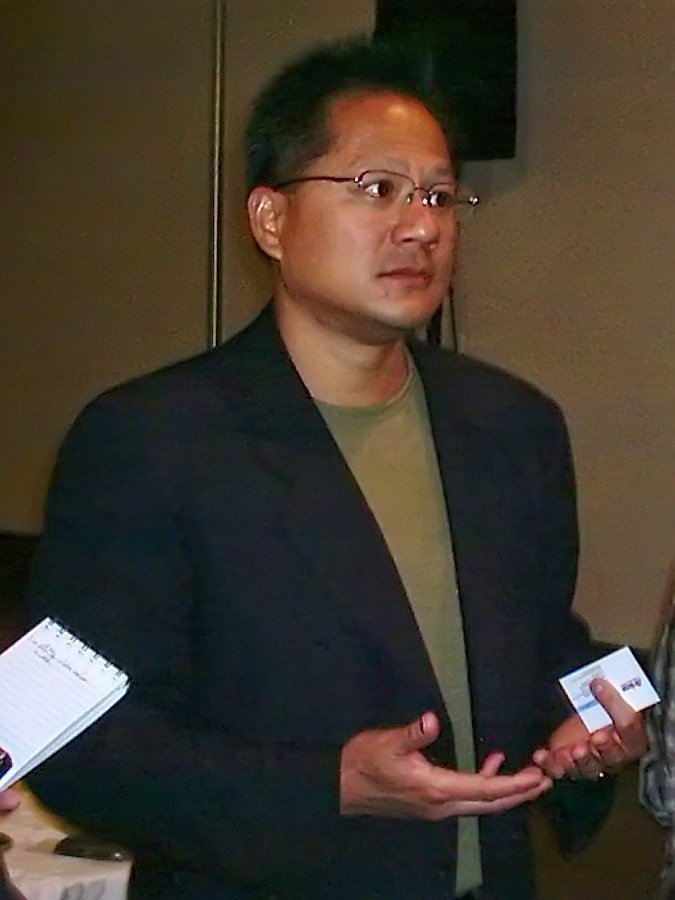
Employment history draws on Huang’s biographical interviews, NVIDIA corporate materials, and profiles. Exact role dates at LSI Logic and AMD are reported approximately in profiles; the sequence (LSI → AMD → founding, Stanford M.S. 1992) is consistently documented. The photograph shows Huang at a much later industry event; no open-licensed photographs from the LSI/AMD years were located.