Leadership
Sixty direct reports, no five-year plan, and every argument conducted in the open.
The flat structure
Huang has said in interviews that he has on the order of sixty direct reports — a span of control that management textbooks call impossible. His reasoning: information should flow to the CEO unfiltered, and the people closest to the work should have direct access. Layers, in his telling, are where truth goes to die.
The trade-off is obvious and he doesn’t hide it: the system depends entirely on a founder with three decades of accumulated context and trust. It is not a template other companies can copy.
Reasoning in public
Huang’s signature management practice: he reasons through problems aloud in meetings with his leadership team, rather than deciding in private and announcing verdicts. The point, as he’s described it, is that sixty people learn the reasoning, not just the decision — so the next hundred decisions get made correctly without him.
Strategy is what you say no to
A phrase widely reported from his interviews: “strategy is what you say no to.” NVIDIA’s version is extreme focus — essentially one architecture, scaled from gaming laptops to supercomputers, rather than a sprawling portfolio. The discipline shows up in the product cadence: a new GPU architecture on a relentless roughly-two-year rhythm.
No fixed planning cycle
Huang has said repeatedly that NVIDIA does not run on a conventional five-year plan. Strategy is re-derived from first principles as conditions change — the mission is fixed (accelerated computing), the plan is not. In his telling, planning cycles create the illusion of certainty; he’d rather re-decide continuously.
The speed-of-light standard
Another reported Huang principle: measure against what physics allows — the speed of light — not against competitors. If a competitor is the benchmark, you only have to beat them; if physics is the benchmark, the work is never done.
On people: “torture you into greatness”
Huang has said he dislikes firing people — and joked in interviews that he’d “rather torture you into greatness” than let someone go: intense, public feedback aimed at developing people rather than replacing them. It’s presented as a joke with a real philosophy behind it: criticism is precise and public, blame is assigned exactly, because — in a line widely reported from his Stanford talk — taking away someone’s fault takes away their ability to fix the problem.
Intensity and presence
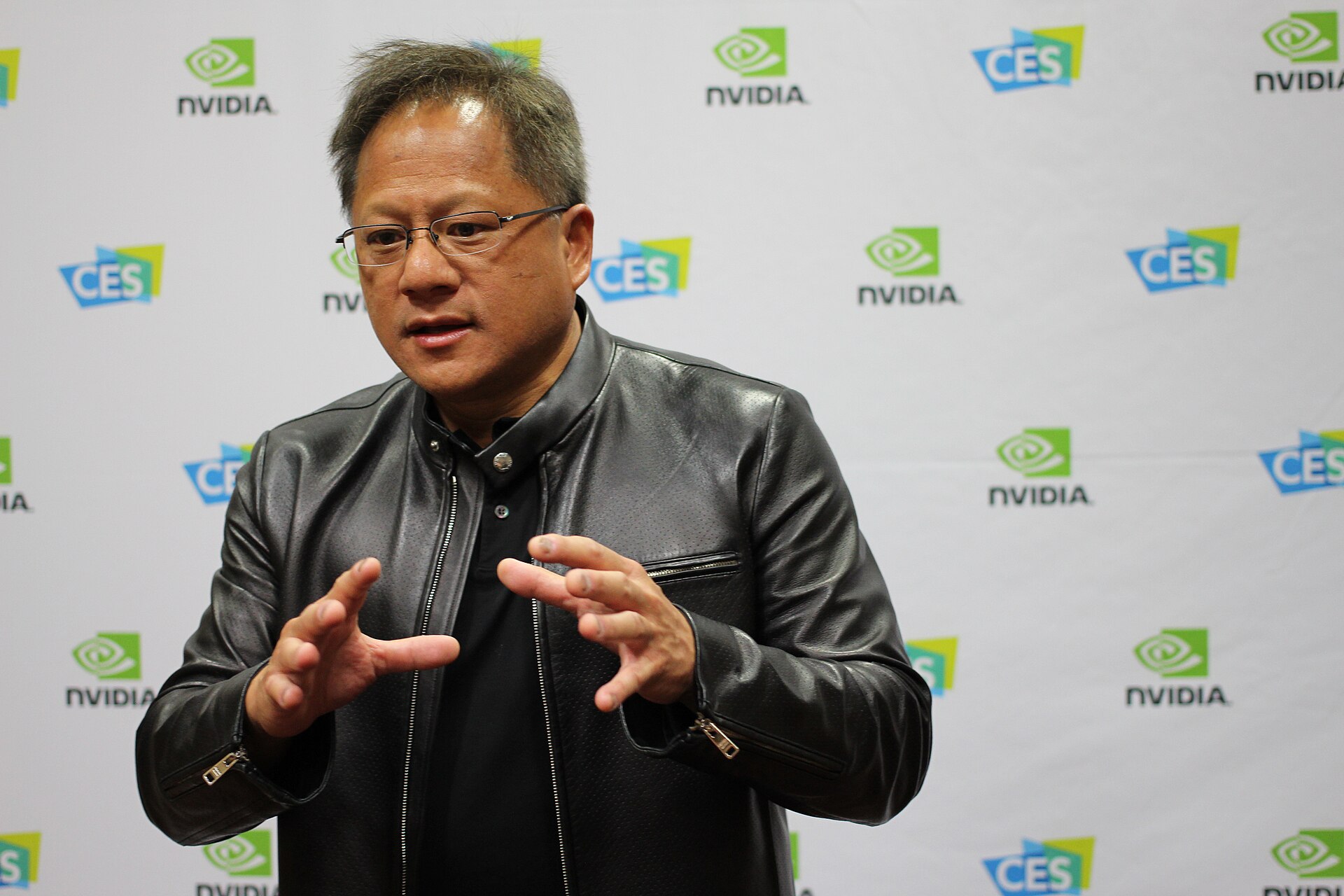
Profiles consistently describe an intense, ever-present CEO: long hours (he has spoken of working from morning to night, seven days a week), deep technical engagement in product reviews, and a hands-on role in keynotes down to the demos. The leather-jacketed keynote persona is the public face of a management style that is personal, centralized, and unrelenting.
The honest caveats
- Founder-dependent. Everything described here runs on Huang’s personal authority and context. NVIDIA’s board and investors have accepted concentration risk that most companies wouldn’t.
- Survivorship-tinted. The practices are described by the winner. Sixty direct reports and no planning cycle would be diagnosed as dysfunction at a failing company.
- Self-reported. Most of this comes from Huang’s own interviews and talks. Former-employee accounts in the press are broadly consistent on the intensity, but the philosophy is his framing.
Source notes
Leadership details draw on Huang’s interviews (including his Stanford GSB appearances and press interviews), the widely reported “60 direct reports” and planning-cycle remarks, and profiles by business publications. Direct-report counts and phrasings are reported, not audited; the caveats section states the limits explicitly.