The Cabaret
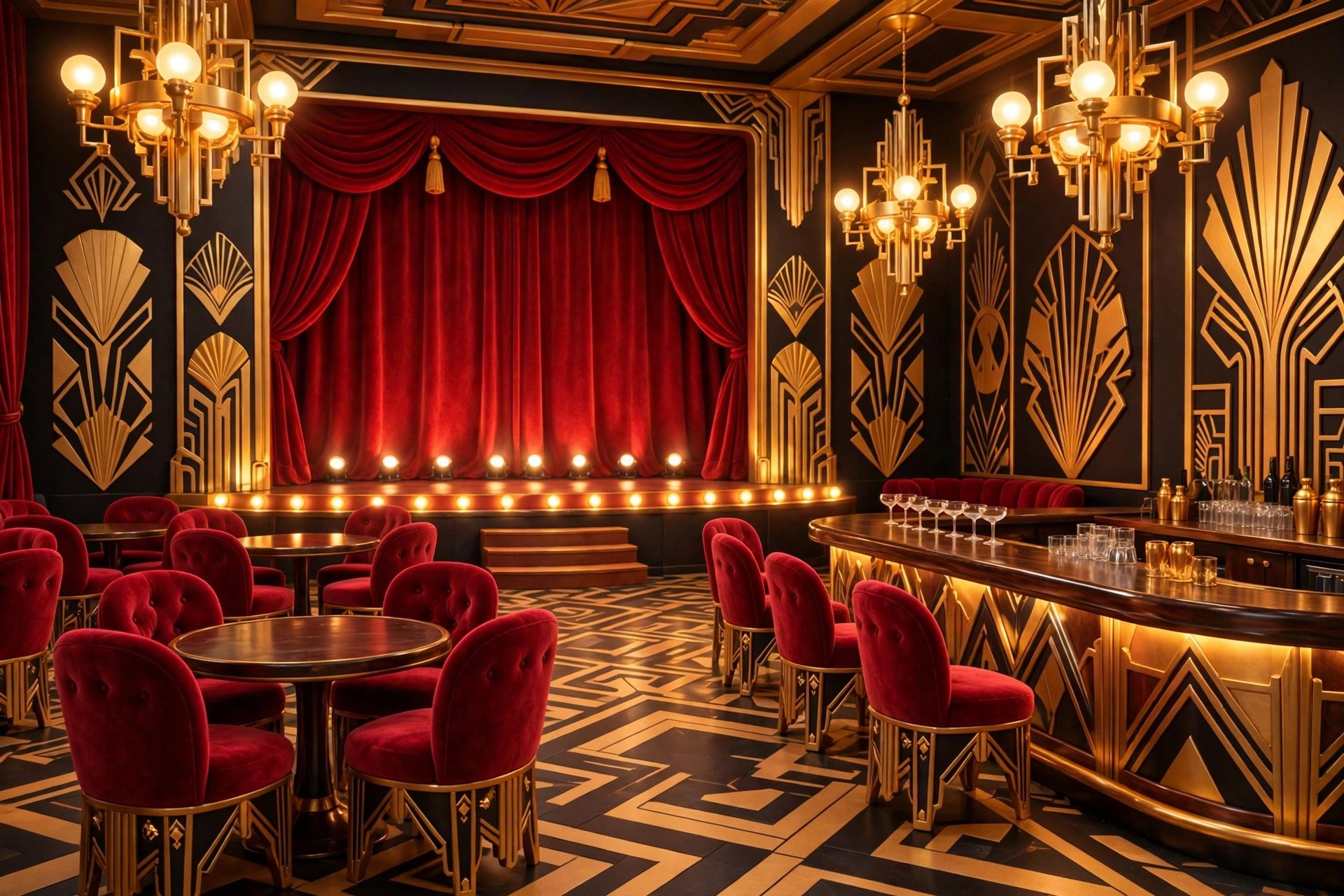
The Gilded Footlight — red velvet, gold leaf, and one very small proprietor.
The Gilded Footlight is the Imp’s cabaret, his courtroom, and his living room — in that order on weeknights, reversed on weekends. It seats two hundred, stands room for fifty more, and has never once been empty on a night the Imp remembers (he remembers all nights; the ledger says so).
The house
The room is a horseshoe of red velvet chairs around round black tables, under a ceiling painted with a gold-leaf sunburst that the Imp claims is “a portrait of applause.” Chandeliers hang low enough that tall patrons are advised — by a small brass plaque — to “duck for diamonds.” The walls are hung with framed showbills of every act that ever played the house, each annotated in the Imp’s handwriting with the night’s Applause Meter reading.
The stage
Twelve feet wide, eight deep, and — per the Imp — “the largest stage in the world, measured in ambition.” Red velvet curtains, a row of nine golden footlights (the ninth is decorative and, the Imp insists, load-bearing), and a single spotlight the Imp calls “the moon.” The boards are worn in a precise oval where seventy years of opening bows have landed. The Imp has forbidden refinishing: “The dents are reviews.”
The bar
The bar runs the length of the back wall and serves exactly one cocktail menu, printed nightly and contractually binding. The house pour is the Velvet Loophole — “champagne’s mischievous cousin.” The bartender, a towering silent figure the Imp calls “the Clause,” has never been seen to blink. Patrons are advised not to order anything “off-menu”; the off-menu is a separate contract.
The box seats
Four boxes, two per side, upholstered in deeper red than the house chairs — “for people who applaud in a lower register,” per the Imp. Box One is permanently reserved for the Skeptic in Row Three’s better-dressed cousin. Box Four is the Imp’s own, used for watching the audience watch the show, which he considers the real performance.
The door policy
Doors open at seven; the show starts at eight; the contract starts when you cross the threshold. The door policy is printed on the ticket, the ticket stub, the door, and — in microscopic type — on the door handle. Summary: everyone is welcome, everyone is seated, everyone applauds, and no one leaves during the fine print.
The greenroom (glimpsed)
Patrons do not enter the greenroom. The greenroom, however, enters the patrons’ conversations constantly — it is where the Imp claims every great idea in show business was born, including several he attributes to himself that predate his birth. See backstage for the authorized tour.
Source notes
- The Gilded Footlight, its rooms, staff, and policies are original fiction written for this site — part of the character’s invented world, labeled as such (see methodology).
- No real venue is depicted or referenced; all art is AI-generated dramatization.