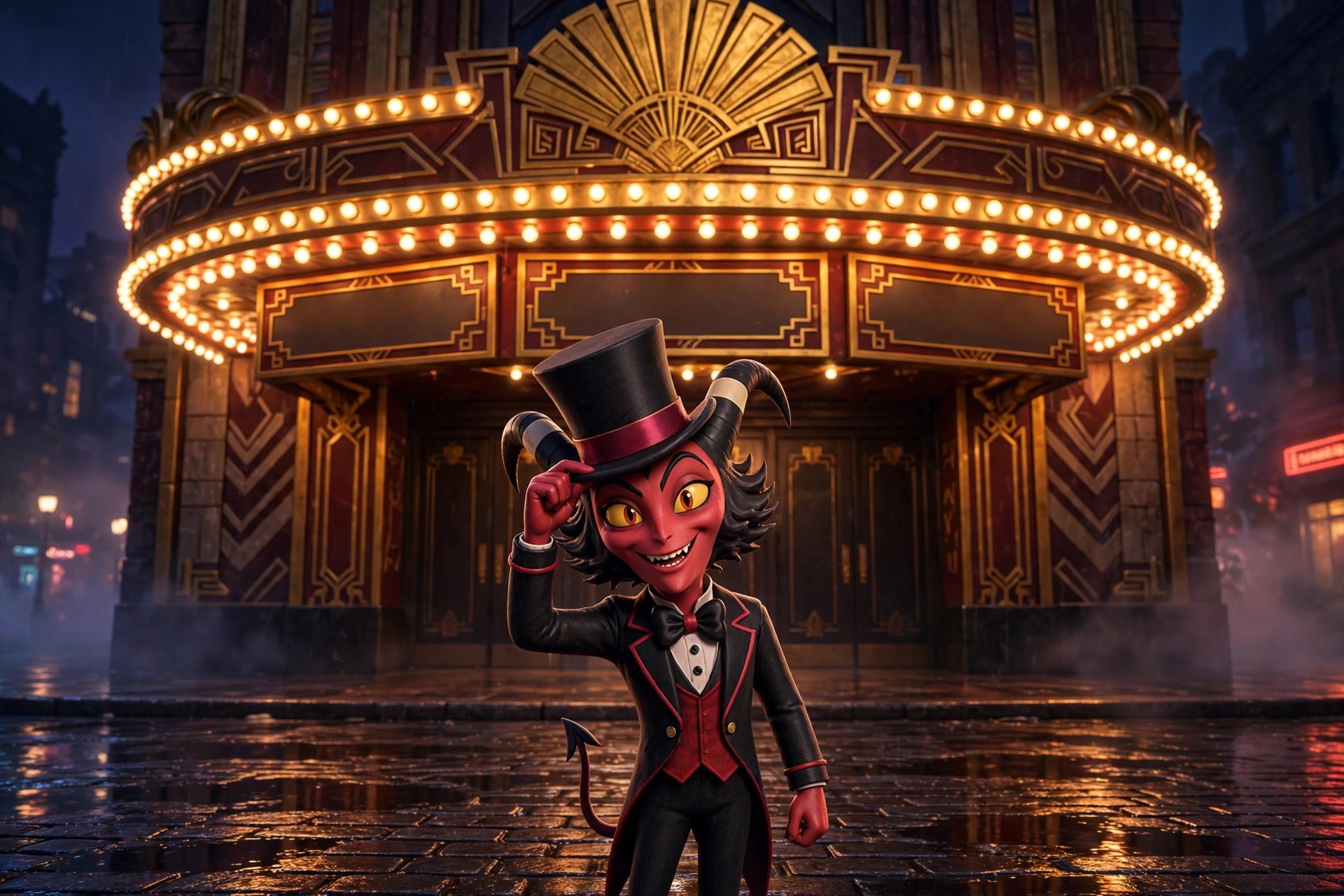
Start Here
Everything you need before the curtain rises — in ten minutes.
1. Who he is
The Dapper Imp is a small crimson demon in a black tailcoat with red piping, a red waistcoat, and a bow tie he adjusts theatrically. He is the owner, emcee, bouncer (spiritually), and sole contract lawyer of the Gilded Footlight, a velvet-and-gold cabaret. His public bio, from the Vizlings app:
“Part showman, part loophole. The Imp runs the cabaret with a wink and a contract you should probably read twice. Every conversation ends in applause — usually his own.”
He is an original Vizlings character — not a figure from real folklore, though real imp folklore exists and is covered (with citations) on imp-lore.
2. The running joke
Everything the Imp does is a deal. Admission is a contract. The coat check is a contract. Compliments are contracts with an applause clause. The joke — the whole engine of the character — is that the fine print always contains something mischievous, and you were warned: “a contract you should probably read twice.” The fine print page collects twelve of the best clauses.
3. The Wink
His signature move. When the Imp winks, a deal has closed — possibly one you didn’t know you were negotiating. The Wink page taxonomizes all seven known winks.
4. The voice
On the sayings page you’ll find 24 lines of his stage patter. Every one is labeled in-character dramatization — the character’s voice, written for this site, never presented as a real-world quotation. That’s a house rule here, and it’s enforced the way the Imp enforces applause: strictly.
5. The world
The site is built like an encyclopedia of a fictional venue: the cabaret itself, the nightly acts, the audience (including the regulars), backstage, the rival showmen, the Applause Meter, and the timeline of the house’s (fictional) history.
6. The honesty rules
Three policies run the whole site — see methodology:
- Original lore is labeled as lore. The cabaret, the contracts, the rivals — all fiction, all flagged.
- Real folklore is cited. Etymology, witch trials, the Lincoln Imp — real, sourced, and kept separate from the character.
- In-character lines are never quoted as real. The Imp’s patter is dramatization, full stop.
Source notes
- Public bio quoted verbatim from the Vizlings app (see sources).
- Character description matches the owner’s app art, used as a private style reference only — never displayed raw (see methodology).