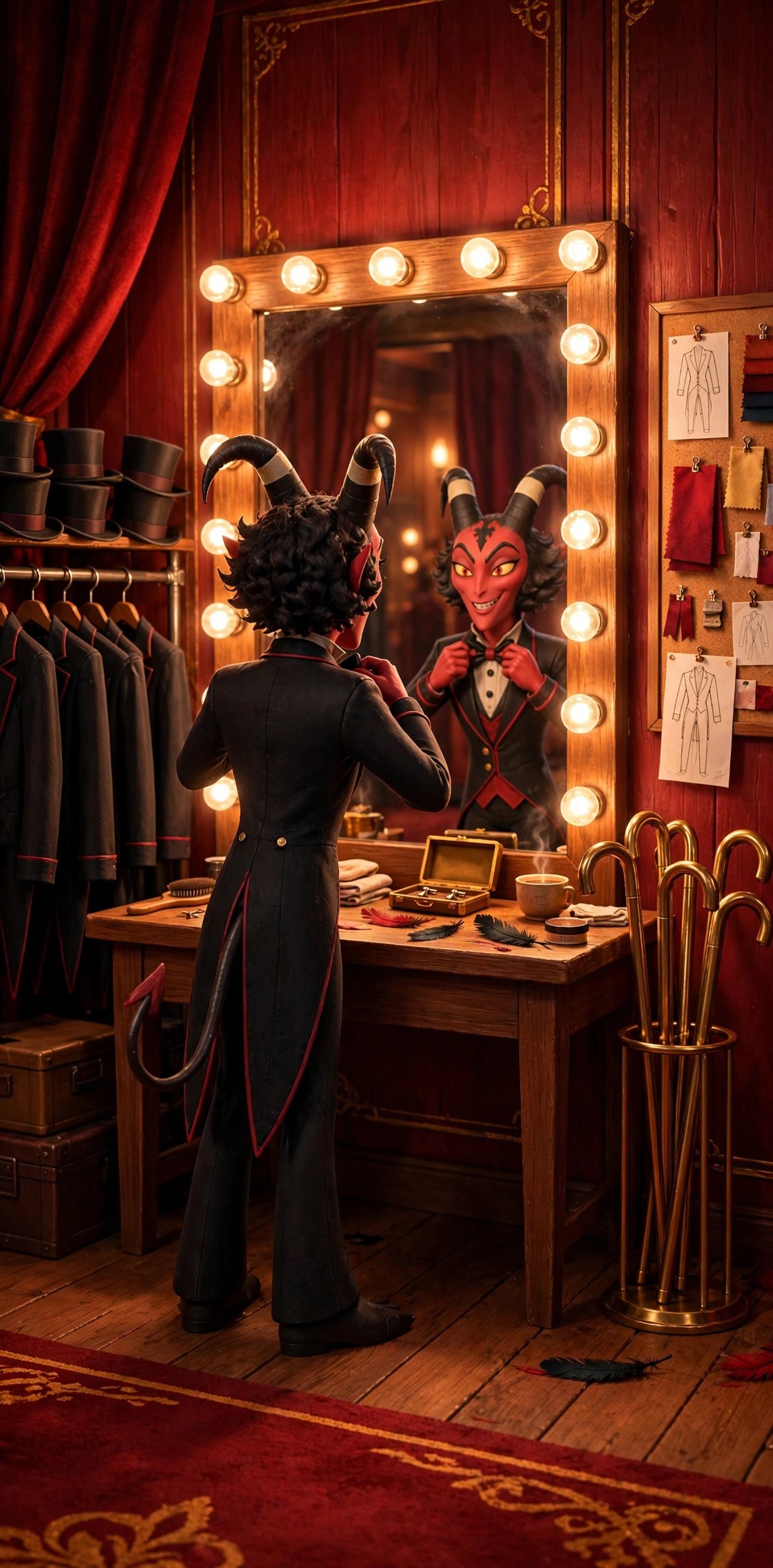
Backstage
Behind the curtain — where the bow tie gets its final adjustment.
Patrons do not go backstage. The Imp goes backstage, the acts go backstage, and the contracts — the contracts live backstage. This is the authorized tour.
The Dressing Room
A small room with a large mirror ringed in bulbs, one for each year of the house. The Imp adjusts his bow tie here before every entrance — the same adjustment, the same mirror, the same result. A brass plaque reads: “THE FACE IS FINE. THE TIE IS THE SHOW.”
The Costume Rack
Forty identical tailcoats, thirty identical waistcoats, and one coat the Imp refuses to discuss. The canes stand in a brass umbrella stand, ranked by seniority. The top hats are stacked by occasion: “Opening,” “Gala,” “Apology,” and “Funeral (Not Mine).”
The Contract Desk
A mahogany desk the size of a small stage, buried under parchment, quills, sealing wax, and a stamp that reads “READ TWICE.” This is where the evening’s contracts are drafted between acts. The Imp writes quickly and seals theatrically. The desk drawer labeled “MISCELLANEOUS” is, per the Imp, “where loopholes go to breed.”
The Mirror
The dressing-room mirror is rumored to talk back. The Imp denies this and then, nightly, is observed nodding at it thoughtfully. House position: the mirror offers “notes.” The Imp takes them under advisement and ignores them with great ceremony.
The Corkboard
Pinned with rival showbills (see rival-showmen), each annotated in gold ink. The annotations are not unkind. They are worse: they are accurate.
The Stage Door
The stage door opens onto an alley the Imp calls “the other red carpet.” Acts enter nervous and exit contractual. The door has a sign: “NO AUTOGRAPHS AFTER MIDNIGHT — the hand gets tired, the legend does not.”
Source notes
- All backstage areas, objects, and traditions are original fiction written for this site (see methodology).
- No real venue is depicted; all art is AI-generated dramatization.