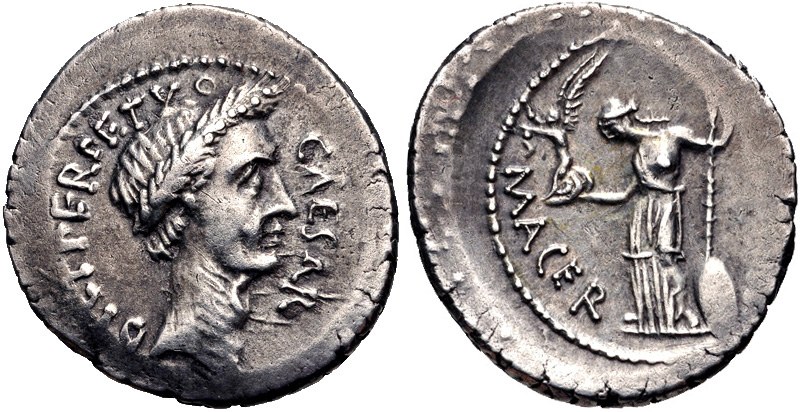
Timeline
The life in order — and the honesty labels. Dates in ancient history are rarely exact; each entry below carries its certainty so you know what is documented and what is reconstructed.
Certainty labels: certain — dated by multiple converging sources; attested — reported by an ancient source, no reason to doubt; probable — reconstructed from good evidence; disputed — scholars disagree; traditional — the conventional date, evidence thin.
100s–80s BC: youth
c. 12 July 100 BC — Birth in Rome
traditional
The conventional date. Some scholars argue for 13 July; a minority case exists for 102 BC. The dispute is explained in methodology.md.
85 BC — Death of his father
probable
Caesar becomes head of the family as a teenager. Reported by the biographical tradition.
84 BC — Marriage to Cornelia
attested
Daughter of Cinna, the Marian leader — a defiantly anti-Sullan match.
81–79 BC — Military service in Asia
attested
Serves under Minucius Thermus; wins the civic crown at the siege of Mytilene. Suetonius, Divus Julius 2.
70s–60s BC: the climb
69 BC — Quaestor; serves in Further Spain
attested
65 BC — Curule aedile
attested
Lavish public games; debts mount.
63 BC — Elected pontifex maximus
attested
Chief priesthood of Rome, won against senior rivals including Catulus.
62 BC — Praetor
attested
61 BC — Governor (propraetor) of Further Spain
attested
Successful campaigning; debts partly repaid.
60 BC — The First Triumvirate
attested
Informal pact with Pompey and Crassus. No ancient source uses the word “triumvirate”; the arrangement is reconstructed from their coordinated actions.
59 BC — Consul with Marcus Bibulus
certain
Land laws, ratification of Pompey’s settlement. Bibulus’s obstruction gives Romans the joke: “the consulship of Julius and Caesar.”
58–50 BC: Gaul
58–50 BC — The Gallic Wars
attested
Eight campaigning seasons; narrated in Caesar’s own Commentarii de Bello Gallico. See The Gallic Wars.
55 & 54 BC — Expeditions to Britain
attested
Crossings of the Channel; no permanent conquest.
52 BC — Siege of Alesia; surrender of Vercingetorix
attested
The climactic victory of the Gallic Wars.
49–45 BC: civil war
c. 10 January 49 BC — Crossing of the Rubicon
probable
The ancient sources give no exact day; “10 January” is a modern approximation (Beard, SPQR). See Crossing the Rubicon.
9 August 48 BC — Battle of Pharsalus
attested
Decisive defeat of Pompey. The traditional date; the pre-Julian calendar makes exact conversion uncertain.
September 48 BC — Murder of Pompey in Egypt
attested
48–47 BC — Alexandria; alliance with Cleopatra
attested
The Alexandrian War; Caesarion born 47 BC (paternity asserted, not proven). See Cleopatra and Caesar.
2 August 47 BC — Battle of Zela; “veni, vidi, vici”
attested
Five-day Pontic campaign against Pharnaces II. See Sayings.
6 April 46 BC — Battle of Thapsus
attested
Pompeian forces in Africa destroyed; Cato the Younger commits suicide at Utica.
46 BC — Calendar reform (“the last year of confusion”)
attested
A 445-day year to realign the calendar; the Julian calendar begins 1 January 45 BC. See The Calendar Reform.
17 March 45 BC — Battle of Munda
attested
Last battle of the civil war, in Spain, against Pompey’s sons.
44 BC: dictatorship and death
February 44 BC — Dictator perpetuo; the Lupercalia
attested
Named dictator for life. At the Lupercalia, Antony offers Caesar a diadem; Caesar refuses it publicly.
15 March 44 BC — Assassination on the Ides of March
certain
Stabbed 23 times by conspirators at a Senate meeting in the Theatre of Pompey’s complex. See The Ides of March.
42 BC — Deified as Divus Julius
attested
Official deification by the Second Triumvirate. See The Deification.
Source notes
- Date framework: T. R. S. Broughton, The Magistrates of the Roman Republic; P. A. Brunt and modern Caesar biographies (Goldsworthy 2006; Morstein-Marx 2021), via sources.md (2026-09-26).
- Birth-date dispute: 12 July 100 BC (traditional, e.g. Suetonius’ implied chronology) vs 13 July vs 102 BC — see methodology.md.
- Rubicon date: Mary Beard, SPQR (2015), p. 286 — ancient sources give no day.
- Pre-Julian calendar conversions: dates before 45 BC are approximate in Julian terms; the “last year of confusion” (46 BC, 445 days) is attested by Macrobius, Saturnalia 1.14 and Censorinus.
- 23 wounds: Suetonius, Divus Julius 82.2; ~60 conspirators: Eutropius, Breviarium 6.25 (figures flagged as ancient estimates).