Sources
Everything on this site rests on these. The ancient witnesses, what each one is worth, and how this site weighs them against each other.
Tier 1: Caesar himself
- De Bello Gallico (7 books, 58–52 BC; Book 8 by Hirtius). First-hand, contemporary — and self-serving. Trusted on logistics and geography; read skeptically on motives.
- De Bello Civili (3 books, unfinished). Caesar’s justification for the civil war. Invaluable and partisan in equal measure.
- Fragments of letters, speeches, De Analogia, Anticato — quoted by later authors. See Lost Writings.
Tier 2: contemporaries
- Cicero — letters and speeches (especially Letters to Atticus). The single best contemporary witness to late-Republican politics; brilliant, biased, and present.
- Sallust — Bellum Catilinae, Bellum Jugurthinum, Historiae (fragmentary). A Caesarian partisan turned moralist historian.
- The Corpus Caesarianum — Alexandrian, African, Spanish Wars by officers. Second-hand but close to events.
Tier 3: the biographers (1–2 centuries later)
- Suetonius, Divus Julius (c. AD 120). Anecdotal, gossipy, chronologically loose — and our fullest narrative of the life, with unique details (the 23 wounds, the physician’s report).
- Plutarch, Life of Caesar (c. AD 100). Moralizing biography, rich in anecdote; pairs Caesar with Alexander.
- Appian, Civil Wars 2 (c. AD 150). The best continuous narrative of the civil war period.
- Cassius Dio, Roman History 37–44 (c. AD 220). Senatorial hindsight; detailed on institutions and honors.
- Velleius Paterculus, Historiae (c. AD 30). Brief, pro-Tiberian, closer in time than the rest.
Tier 4: later and fragmentary
- Lucan, Pharsalia (AD 60s) — epic poetry, violently anti-Caesarian; evidence for reception, not events.
- Eutropius, Breviarium (4th c.) — the “~60 conspirators” figure.
- Macrobius, Saturnalia; Censorinus — the calendar reform.
- Nicolaus of Damascus — fragments on the assassination.
How this site weighs them
- Contemporary beats later; hostile and friendly sources are triangulated, not averaged.
- Agreement across independent sources = the solid core. Single-source anecdotes are labeled as such.
- Numbers in ancient sources (casualties, sums, crowds) are treated as order-of-magnitude at best.
- Omens, dreams, and deathbed speeches are literary conventions until corroborated.
Modern scholarship used
Goldsworthy, Caesar: Life of a Colossus (2006); Morstein-Marx, Julius Caesar and the Roman People (2021); Beard, SPQR (2015); Syme, The Roman Revolution (1939); Strauss, The Death of Caesar (2015); Riggsby, Caesar in Gaul and Rome (2006); Woolf, Becoming Roman (1998); Broughton, The Magistrates of the Roman Republic.
Image provenance
See the image captions for credits and context. Illustrated character art is a dramatization.
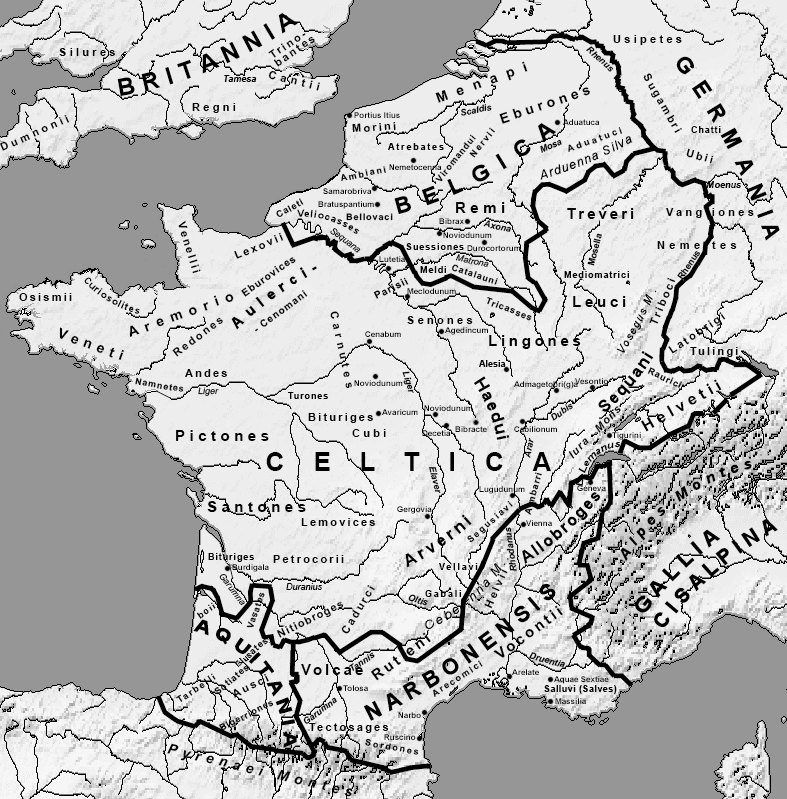
- Real artifacts (13): the Tusculum portrait (Turin), Farnese bust (Naples), Arles bust (attribution disputed — labeled), a 44 BC denarius, the Curia Julia, the Roman Forum, Largo di Torre Argentina, Gérôme’s Death of Caesar (1867), Royer’s Vercingetorix (1899), busts of Cleopatra VII and Pompey, a 1490 Birago miniature showing Caesar among the great warriors, and a map of Gaul.
- Owner-supplied character art (4): the owner’s stream banner and three character portraits from the Vizlings app — AI-generated character art, labeled as owner-supplied, not historical depictions.
- AI-generated dramatization art (12): character scenes and the 8-image social content pack — all in the style of the owner’s Vizlings “Julius Caesar” character sheet, all labeled as dramatization.
- The owner’s character sheet is a style reference only and is not displayed anywhere on the site.
Source notes
- Source tiers and weighing policy: methodology.md (2026-09-26).
- Image provenance: the image credits on this page (2026-09-26), generated by tools/fetch_images.py and tools/retry_images.py.
- Latin/Greek texts consulted via the Perseus Digital Library and Loeb Classical Library editions.