The Gallic Wars: Propaganda vs. Record
Eight years, a continent subdued, and a book that made its author the most famous man in Rome. The *Commentarii de Bello Gallico* are both our best source and Caesar's defense brief — read them as both.
What happened (the campaigns)
In 58 BC Caesar, proconsul of Gaul, intervened against the migrating Helvetii — and stayed for eight campaigning seasons. Year by year: the Helvetii (58), Ariovistus and the Germans (58), the Belgae (57), the Veneti and the Atlantic coast (56), the first crossings into Germany and Britain (55), the second British expedition (54), the revolts of Ambiorix (54–53), and the great pan-Gallic uprising under Vercingetorix (52), crushed at the siege of Alesia. Mopping-up operations ran to 50 BC.
The result: all of Celtic Gaul — modern France, Belgium, parts of Switzerland, Germany, and the Netherlands — under Roman control, and an enormous influx of wealth and slaves into Caesar’s war chest.
The book as propaganda
The Commentarii were published as annual dispatches, and every choice in them serves Caesar’s position in Rome:
- Third person. “Caesar” the character is calm, decisive, inevitable; the author never says “I.”
- Just wars. Every campaign begins with a Gallic provocation or a Roman ally in danger; Caesar never starts a war, he answers one.
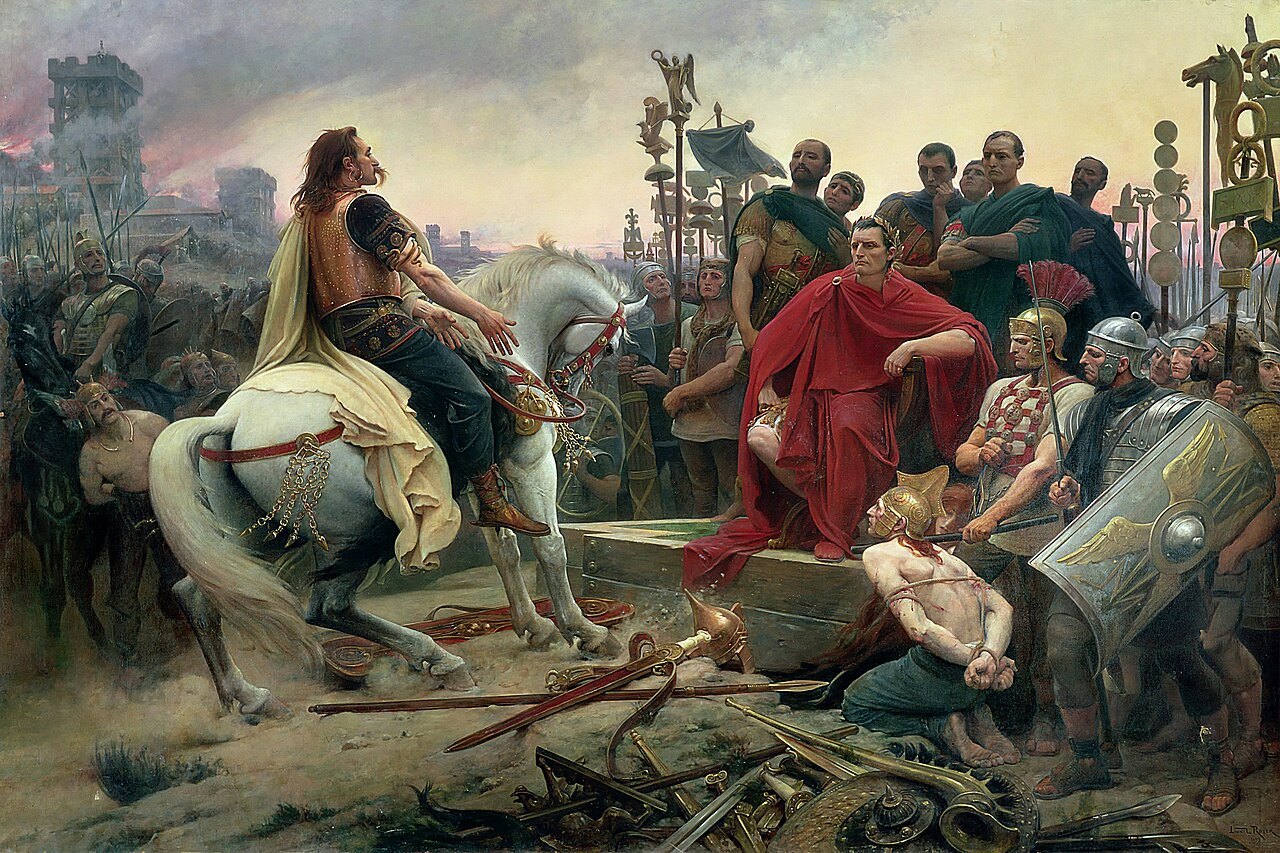
- The enemy’s nobility. The Gauls are brave — which makes beating them glorious. Vercingetorix gets a hero’s exit so Caesar gets a hero’s victory.
- Clemency as policy. Surrender is accepted, mercy is displayed — the brand Caesar would reuse in the civil war.
- Numbers. Plutarch (Life of Caesar 15.5) reports Caesar’s own claims: 800 towns taken, 300 tribes subdued, a million enemies killed and a million enslaved. Ancient victory figures are routinely inflated; modern historians accept the scale of conquest while discounting the arithmetic.
The book as record
Propaganda needs a skeleton of truth, and the Commentarii have one:
- Geography and logistics check out against archaeology with remarkable consistency — river crossings, siege works, marching distances.
- Ethnography (Book 6 on Gauls and Germans) is tendentious but remains a foundational source, written from direct contact.
- Alesia’s siege works have been located archaeologically at Alise-Sainte-Reine, matching Caesar’s description of the double circumvallation.
The rule of thumb: where Caesar describes what happened, he is usually our best witness; where he explains why it happened, he is his own lawyer.
The cost
The conquest devastated Gaul. Even discounted, the casualty and enslavement figures describe a catastrophe for the Celtic world — and a transfer of wealth that financed Caesar’s later political career. Modern scholarship (e.g., Woolf, Becoming Roman) stresses both the violence and the deep subsequent Romanization of Gaul.
Source notes
- Caesar, De Bello Gallico 1–7 (Hirtius, Book 8); Plutarch, Life of Caesar 15–27; Dio Cassius 38–40 (2026-09-26).
- Casualty figures: Plutarch, Caesar 15.5 — flagged as inflated per methodology.md.
- Alesia archaeology: excavations at Alise-Sainte-Reine (19th–21st c.); the identification is now consensus but was itself once disputed.
- Third-person analysis and propaganda reading: Riggsby, Caesar in Gaul and Rome (2006); Welch & Powell (eds.), Julius Caesar as Artful Reporter.
- Gallic aftermath: Woolf, Becoming Roman (1998).