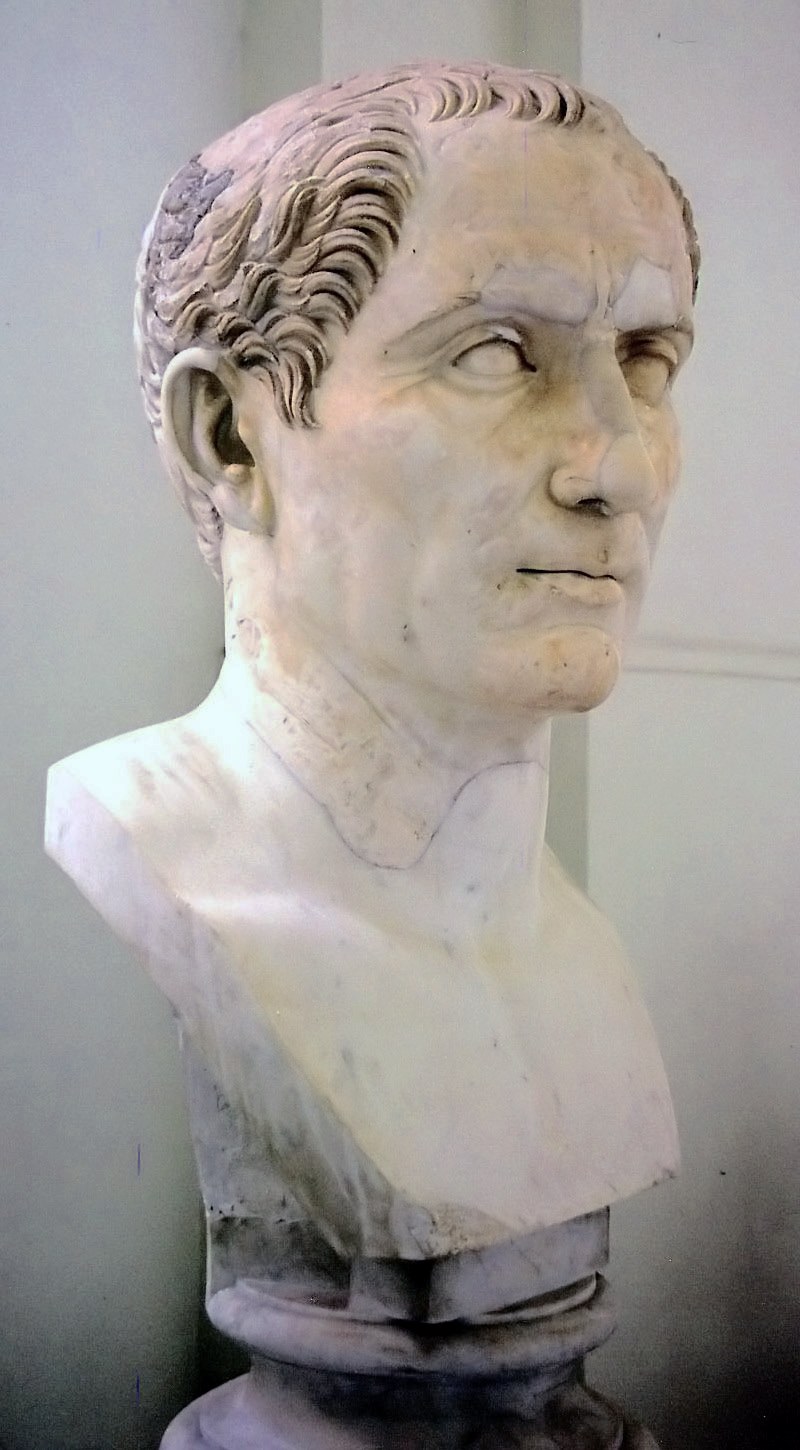
Biography
Born into an ancient but faded patrician family, Caesar borrowed his way to the top of Roman politics, conquered Gaul, won a civil war, reformed the Roman state — and was murdered by his fellow senators. The documented life, with the gaps marked.
Youth and family (100–81 BC)
Gaius Julius Caesar was born on 12 July 100 BC — the traditional date; some scholars argue for 13 July or even 102 BC (Timeline). His father, also Gaius Julius Caesar, was a praetor; his mother Aurelia Cotta came from a distinguished family. The Julii claimed descent from Iulus, son of Aeneas, and thus from Venus herself — a genealogy Caesar would exploit all his life.
His father’s death in 85 BC left the teenage Caesar as head of the family. In 84 BC he married Cornelia, daughter of the Marian leader Cinna — a political choice that put him on the wrong side of the dictator Sulla. Sulla reportedly demanded he divorce her; Caesar refused, and prudently left Rome for military service in Asia (81–79 BC), where he won the civic crown (corona civica) for saving a fellow soldier’s life at the siege of Mytilene — Rome’s second-highest military honor.
The climb (78–60 BC)
Back in Rome, Caesar built a career on borrowed money spent spectacularly: quaestor (69 BC, serving in Further Spain), curule aedile (65 BC, staging lavish games), pontifex maximus (63 BC, Rome’s chief priesthood — won against senior rivals), praetor (62 BC), then governor of Further Spain (61 BC), where successful campaigning paid off some debts and earned him a triumph (which he skipped to run for consul).
In 60 BC he formed the informal alliance with Pompey and Crassus now called the First Triumvirate — three men pooling money, troops, and influence to run the Republic around the Senate. As consul in 59 BC (with the obstructionist Bibulus, whose year Romans joked was “the consulship of Julius and Caesar”), he pushed through land reform and ratified Pompey’s eastern settlement. Then he took the prize: the governorship of Gaul.
The conquest of Gaul (58–50 BC)
For eight campaigning seasons Caesar subdued Celtic Gaul — modern France and Belgium — in a series of campaigns he narrated himself in the Commentarii de Bello Gallico. The war included the defeat of the Helvetii (58), the long struggle with the Belgae, two crossings into Britain (55, 54), the bridging of the Rhine, and the climactic siege of Alesia (52), where Vercingetorix surrendered.
The human cost was staggering — Plutarch claims a million Gauls killed and a million enslaved (Life of Caesar 15.5); modern historians treat the figures as inflated but the scale as real. In Rome, the Commentarii — published as annual dispatches — made Caesar the most famous man in the Republic. See The Gallic Wars.
The civil war (49–45 BC)
By 50 BC the Triumvirate was dead (Crassus killed at Carrhae in 53; Julia, Caesar’s daughter and Pompey’s wife, died in 54). The Senate, led by hardliners, demanded Caesar disband his army and return to Rome as a private citizen — to face prosecution. Instead, in January 49 BC, Caesar crossed the Rubicon with one legion and marched on Rome. Pompey and much of the Senate fled to Greece.
Caesar won the civil war with characteristic speed: Spain secured, then the decisive victory over Pompey at Pharsalus (9 August 48 BC). Pompey fled to Egypt and was murdered on arrival. Caesar followed, became entangled in the Egyptian dynastic war, and in Alexandria met Cleopatra VII — an alliance of politics and (probably) passion that produced a son, Caesarion. After the rapid Pontic campaign (“veni, vidi, vici,” 47 BC), victories in Africa (Thapsus, 46) and Spain (Munda, 45) ended organized resistance. See The Civil War Against Pompey and Cleopatra and Caesar.
Dictatorship and reform (46–44 BC)
Caesar was appointed dictator repeatedly, then in early 44 BC dictator perpetuo — dictator for life. He used the power for a sweeping reform program: the Julian calendar (with the Alexandrian astronomer Sosigenes), debt relief, land for veterans, expansion of the Senate, citizenship extended in Gaul and Spain, colonies for the urban poor, and reorganization of the courts and grain dole. He also rebuilt: the Forum Julium, the Basilica Julia, and the new Senate house that still stands — the Curia Julia (completed by Augustus). See Caesar’s Reforms and The Calendar Reform.
But the honors accumulated past republican tolerance: his statue among the kings, a gold chair in the Senate, his face on coins (a living Roman’s portrait — unprecedented), and the whispers of kingship. At the Lupercalia in February 44 BC, Mark Antony offered him a diadem; Caesar refused it — twice, before the crowd — but the suspicion stuck.
Assassination (15 March 44 BC)
A conspiracy of some sixty senators, led by Marcus Brutus and Gaius Cassius, decided Caesar had to die. Lured to a Senate meeting at the Theatre of Pompey on the Ides of March, Caesar was stabbed 23 times. He died at the foot of Pompey’s statue. See The Ides of March.
He was 55. In his will he adopted his great-nephew Octavian and made him his heir — the young man who would become Augustus, avenge him, and turn “Caesar” into the title of emperors for two millennia. In 42 BC the Senate deified him as Divus Julius. See The Deification.
What we don’t know
- His exact birthday. 12 July 100 BC is traditional; 13 July and 102 BC have scholarly defenders.
- His inner motives. Was the Republic’s destruction his plan or its accident? The sources give us actions and slogans, not a diary.
- Caesarion’s paternity. Claimed by Cleopatra, repeated by ancient sources, unprovable.
- What he would have done next. The planned Parthian campaign died with him; everything after is counterfactual.
Source notes
- Narrative backbone: Suetonius, Divus Julius; Plutarch, Life of Caesar; Appian, Civil Wars 2; Cassius Dio, Roman History 37–44 (2026-09-26).
- Civic crown at Mytilene: Suetonius, Divus Julius 2.
- “The consulship of Julius and Caesar”: Suetonius, Divus Julius 20.2.
- Plutarch’s casualty figures for Gaul: Plutarch, Life of Caesar 15.5 — flagged as inflated in methodology.md.
- Lupercalia diadem: Suetonius, Divus Julius 79.2; Plutarch, Life of Caesar 61; Appian, Civil Wars 2.109.
- Will and adoption of Octavian: Suetonius, Divus Julius 83.