People
The allies who made him, the enemies who unmade him, and the heir who finished his work. Each entry is documented, not dramatized.
Allies
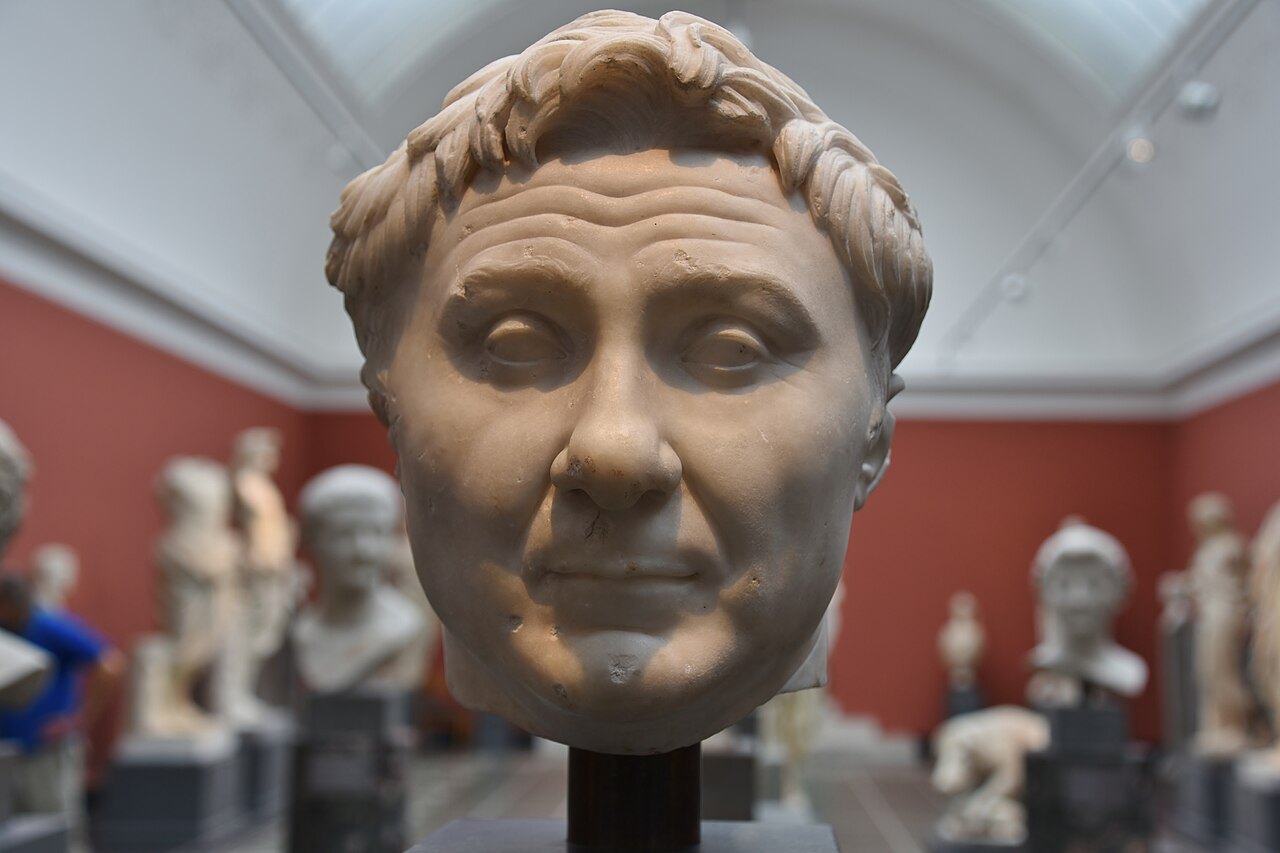
Gnaeus Pompeius Magnus (Pompey the Great, 106–48 BC)
Rome’s greatest general before Caesar — then his father-in-law (married to Caesar’s daughter Julia), triumviral partner, rival, and finally enemy. Their breach led to the civil war; Caesar defeated him at Pharsalus. Murdered in Egypt, 48 BC. Caesar reportedly wept at the sight of his head.
Marcus Licinius Crassus (c. 115–53 BC)
Rome’s richest man and the third triumvir. His money financed Caesar’s rise; his death at Carrhae (53 BC) broke the Triumvirate’s balance.
Marcus Antonius (Mark Antony, 83–30 BC)
Caesar’s loyal officer and later consul; offered Caesar the diadem at the Lupercalia; delivered the funeral oration that turned Rome against the conspirators. Later triumvir, then defeated by Octavian.
Gaius Octavius (Octavian / Augustus, 63 BC–AD 14)
Caesar’s great-nephew, adopted in his will. Avenged the assassination, defeated Antony, and became Rome’s first emperor — building his legitimacy on being Divi filius, son of the deified Caesar.
Aulus Hirtius (c. 90–43 BC)
Caesar’s officer and continuator: wrote Book 8 of the Gallic War and (probably) the Alexandrian War. Died at Mutina fighting Antony.
Gaius Asinius Pollio (c. 75 BC–AD 5)
Officer, historian, and patron of literature; a contemporary source for the civil war period, praised by later writers for his independence.
Enemies
Marcus Porcius Cato (Cato the Younger, 95–46 BC)
The Stoic senator who embodied republican resistance to Caesar. Filibustered, obstructed, and finally — rather than accept Caesar’s pardon — committed suicide at Utica after Thapsus. Caesar answered with the lost polemic Anticato.
Marcus Tullius Cicero (106–43 BC)
Rome’s greatest orator; vacillated between admiration and alarm at Caesar. His letters are an irreplaceable contemporary source. Proscribed and killed in 43 BC.
Marcus Junius Brutus (c. 85–42 BC)
Descendant (by adoption) of Rome’s founding Brutus; pardoned by Caesar after Pharsalus, made praetor, then led the conspiracy. Died at Philippi.
Gaius Cassius Longinus (d. 42 BC)
The conspiracy’s organizer and recruiter; brilliant republican general. Died at Philippi alongside Brutus.
Vercingetorix (d. 46 BC)
Chieftain of the Arverni who united Gaul against Caesar in 52 BC. Defeated at Alesia, held prisoner for years, then strangled after Caesar’s triumph. His surrender is the Gallic Wars’ iconic image.
Pharnaces II of Pontus (d. 47 BC)
Son of Mithridates VI; crushed by Caesar at Zela in five days — the occasion of “veni, vidi, vici.”
Family
Aurelia Cotta (d. 54 BC)
Caesar’s mother; a formidable manager of the family’s interests during his absences. Suetonius notes her strict supervision of his household.
Cornelia (d. 69 BC)
Caesar’s first wife, daughter of Cinna. He refused Sulla’s demand to divorce her. Her funeral oration (for a young woman) broke convention — Caesar used it politically.
Pompeia
Second wife (granddaughter of Sulla); divorced in 62 BC after the Bona Dea scandal — “Caesar’s wife must be above suspicion” (the reported remark; Plutarch, Life of Caesar 10).
Calpurnia
Third wife (from 59 BC); survived him. Ancient sources report her dream warning him against the Senate meeting on the Ides.
Julia (d. 54 BC)
Caesar’s daughter by Cornelia; married to Pompey — the personal bond holding the Triumvirate together. Her death in childbirth loosened it fatally.
Cleopatra VII (69–30 BC)
Queen of Egypt; allied with Caesar in the Alexandrian War (48–47 BC). Bore Caesarion, whose paternity she attributed to Caesar. Full account: Cleopatra and Caesar.
Caesarion (Ptolemy XV, 47–30 BC)
Cleopatra’s son, presented as Caesar’s child. Executed on Octavian’s order after Alexandria fell.
What we don’t know
- Brutus’s parentage rumors. Ancient gossip made Brutus Caesar’s son (via Servilia); chronology makes it unlikely, and no source proves it.
- The conspirators’ full list. Nicolaus of Damascus names names, but the complete roster of ~60 is not recoverable.
Source notes
- Prosopographical backbone: T. R. S. Broughton, The Magistrates of the Roman Republic; Suetonius, Divus Julius; Plutarch’s Lives of Caesar, Pompey, Cato, Brutus, Antony, Cicero (2026-09-26).
- Pompey’s head: Plutarch, Life of Pompey 80; Caesar’s tears reported by Plutarch and Appian — flagged as possibly conventional.
- “Caesar’s wife must be above suspicion”: Plutarch, Life of Caesar 10.9 (reported remark).
- Calpurnia’s dream: Suetonius, Divus Julius 81.3; Plutarch, Life of Caesar 63.8–10.
- Servilia/Brutus rumor: Suetonius, Divus Julius 50.2 (Caesar’s affair with Servilia noted); parentage unproven.