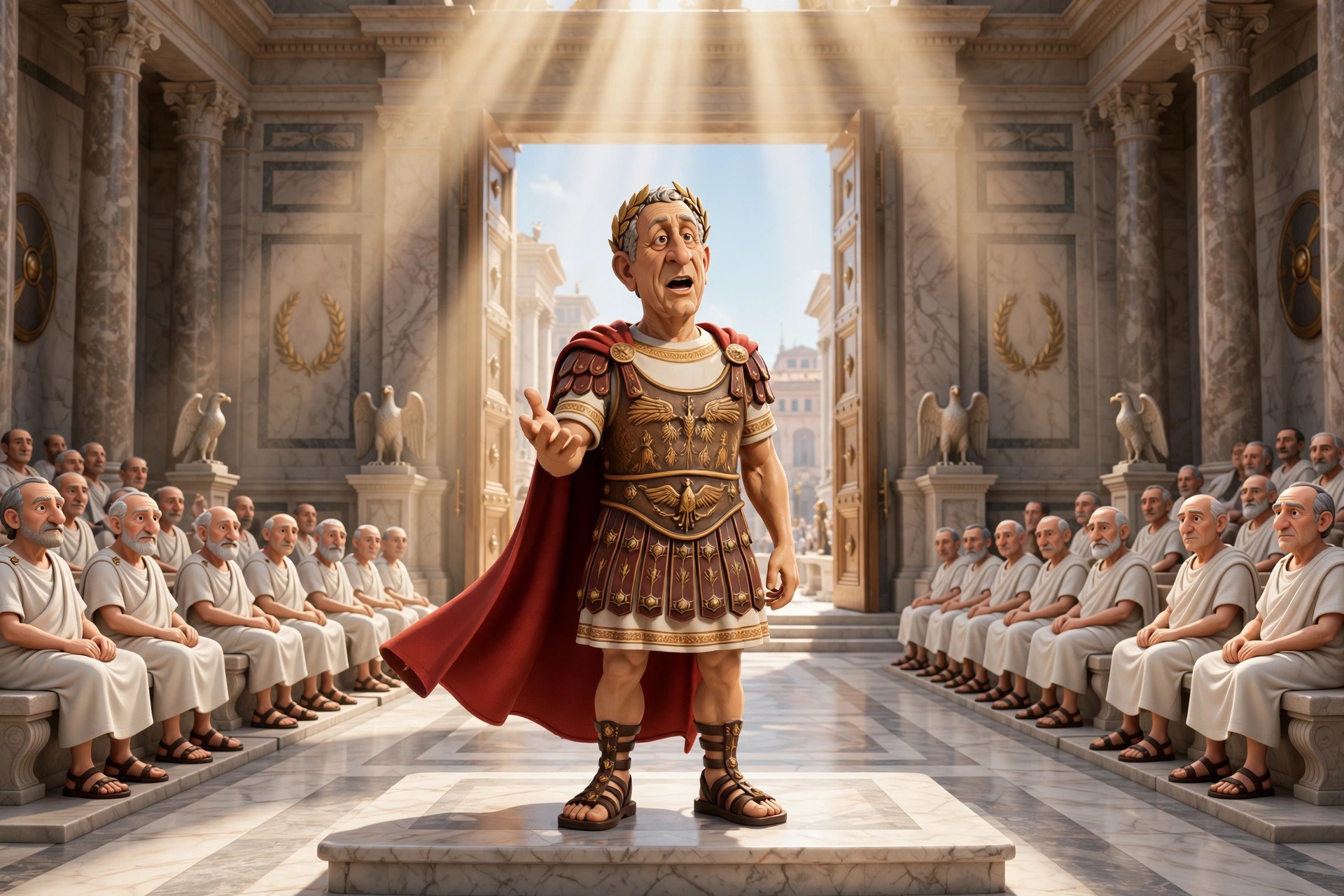
The Civil War Against Pompey
Four years, four continents, one outcome. How Caesar turned a treasonous river-crossing into unchallenged mastery of the Roman world.
The opening moves (49 BC)
Caesar crossed the Rubicon in January 49 BC with a single legion (Crossing the Rubicon). Italy collapsed without a battle: Pompey, the consuls, and much of the Senate evacuated to Greece, expecting — as in Sulla’s day — to return with an eastern army. Caesar seized Rome’s treasury, secured Italy in weeks, then turned to Spain, where Pompey’s legions surrendered at Ilerda after a maneuver campaign Caesar narrates as a masterpiece of clemency (Civil War 1).
Pharsalus (9 August 48 BC)
Pursuing Pompey to Greece, Caesar — outnumbered roughly two to one — destroyed the Pompeian army at Pharsalus in Thessaly. Pompey fled to Egypt, where he was murdered on the beach by Ptolemy’s ministers, who hoped to please Caesar. They misjudged him: Caesar reportedly wept and had the killers executed.
Alexandria (48–47 BC)
Entangled in Egypt’s dynastic war, Caesar — with a small force — survived months of street fighting in Alexandria (the famous episode of the burning of the harbor, and the debated fate of the Library’s collections). His alliance with Cleopatra VII secured Egypt as a client kingdom and produced Caesarion. See Cleopatra and Caesar.
Zela (47 BC)
Racing to Asia Minor, Caesar annihilated Pharnaces II of Pontus at Zela in a five-day campaign — the occasion of “veni, vidi, vici.” The speed was the message: no enemy, however distant, was safe.
Thapsus and Munda (46–45 BC)
- Thapsus (6 April 46 BC): the Pompeian army in Africa — led by Scipio and Juba of Numidia — was destroyed. Cato the Younger, rather than accept pardon, committed suicide at Utica.
- Munda (17 March 45 BC): the last stand of Pompey’s sons in Spain. Caesar’s hardest-fought battle; he later said he had often fought for victory, but at Munda for his life.
Why Caesar won
- Speed. Caesar moved faster than the Roman system could react — the central fact of the war.
- Clemency (clementia). Pardoned enemies were expected to become grateful clients. It worked on many (Brutus among them) — and embittered others.
- His army. Veterans of Gaul, personally loyal and battle-hardened, against hastily-raised Pompeian forces.
- Pompey’s mistakes. Abandoning Italy conceded the initiative; at Pharsalus his cavalry-heavy plan collapsed against Caesar’s improvised fourth line.
The cost
A generation of Roman aristocrats dead — at Pharsalus, Thapsus, Munda, and in the proscriptions and suicides around them. The Republic’s governing class did not survive its own civil war; what emerged was a system built around one man.
Source notes
- Caesar, De Bello Civili 1–3 (breaks off in Alexandria); Hirtius (?), Alexandrian War; African War; Spanish War (officer narratives) (2026-09-26).
- Plutarch, Life of Caesar 28–56, Life of Pompey 60–80; Appian, Civil Wars 2.35–116; Dio Cassius 41–43; Suetonius, Divus Julius 30–36.
- Pharsalus date: 9 August 48 BC pre-Julian — conversion approximate (see timeline.md).
- “Fought for his life at Munda”: reported remark, via Appian/Plutarch tradition — flagged as anecdotal.