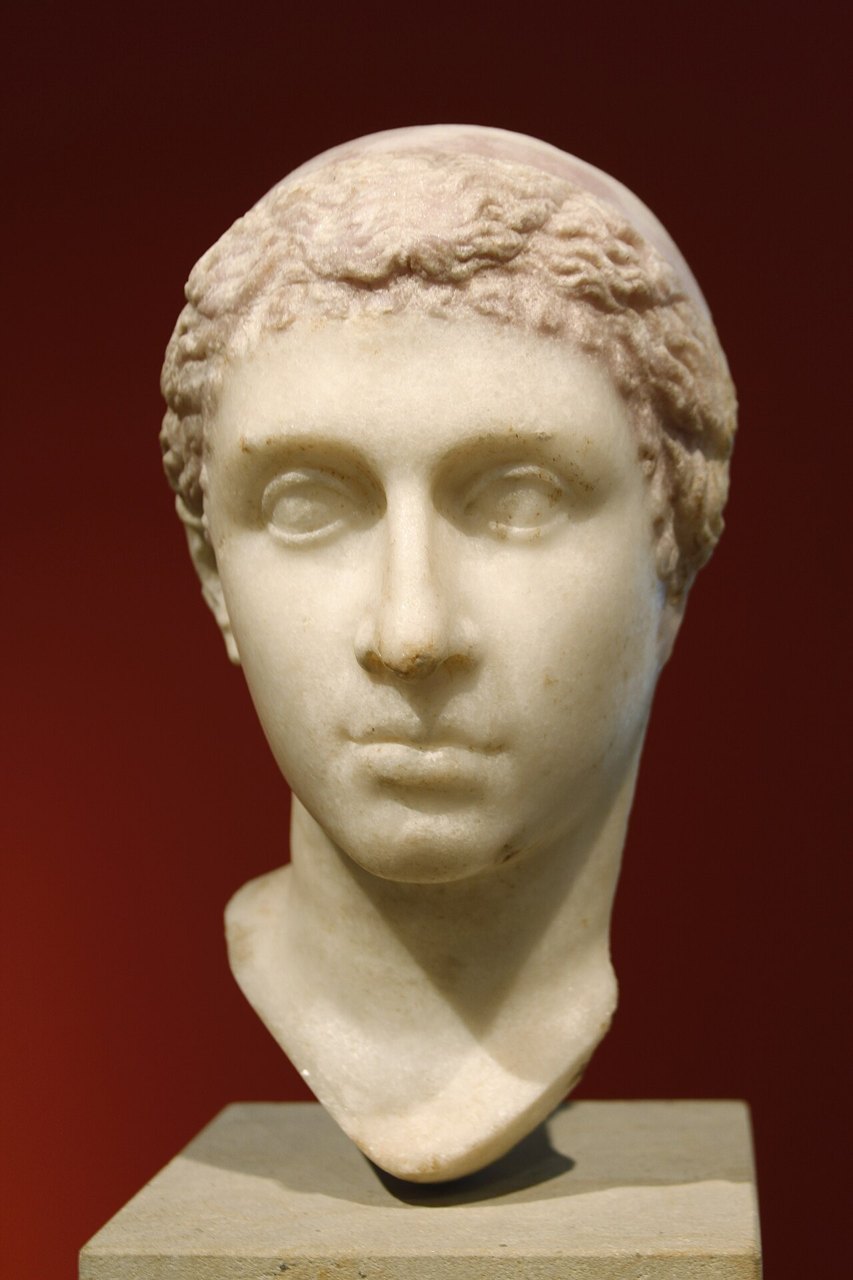
Cleopatra and Caesar
A 21-year-old queen, a 52-year-old general, and a war in the streets of Alexandria. The documented alliance — and the line where history becomes Hollywood.
The meeting
In October 48 BC Caesar arrived in Alexandria with a small force, pursuing Pompey. Egypt was in civil war between the siblings-spouses Cleopatra VII and Ptolemy XIII. Ancient sources (Plutarch, Life of Caesar 48–49) report Cleopatra had herself smuggled into Caesar’s quarters — the famous carpet (or laundry-sack) episode. Whether or not the wrapping is true, the meeting is well attested: Cleopatra needed Roman backing against her brother; Caesar needed Egyptian money for his war.
The Alexandrian War
Ptolemy’s ministers — who had murdered Pompey to curry favor — turned against Caesar. Outnumbered and cut off in the palace quarter, Caesar survived months of urban warfare, famously setting fire to ships in the harbor (the blaze’s effect on the Library’s collections is debated — see below). Reinforcements arrived in early 47 BC; Ptolemy XIII drowned in the Nile retreat; Cleopatra — now with her younger brother Ptolemy XIV as co-ruler — held Egypt as Rome’s client queen.
The relationship
Plutarch presents it as genuine passion; Dio stresses calculation. Both can be true. What is documented:
- Political: Egypt stayed out of the civil war’s endgame; its grain and wealth served Caesar.
- Personal: Their son Caesarion (Ptolemy XV) was born 23 June 47 BC. Cleopatra named Caesar as father; ancient sources repeat the claim; it cannot be proven.
- Public: In 46–44 BC Cleopatra lived in Rome as Caesar’s guest, in his villa across the Tiber — a scandal the sources savor. Caesar even placed a golden statue of her in the Temple of Venus Genetrix (Appian, Civil Wars 2.102).
The Nile cruise
After the war, Caesar and Cleopatra reportedly sailed up the Nile with a great flotilla — part victory tour, part honeymoon, part show of force. The sources attest the journey; its tone is modern embroidery.
What is romance, what is record
| Claim | Status |
|---|---|
| Cleopatra smuggled into Caesar’s quarters | Attested (Plutarch); the carpet detail is anecdotal |
| Caesarion was Caesar’s son | Asserted by Cleopatra, repeated by sources — unprovable |
| The Library of Alexandria burned by Caesar | Debated — the harbor fire is attested; the Library’s destruction was a longer process, and ancient sources differ on what burned |
| Cleopatra in Rome 46–44 BC | Attested (Cicero’s letters complain about her) |
| Golden statue in the Temple of Venus Genetrix | Attested (Appian) |
Aftermath
Caesarion survived his mother by days: after Alexandria fell in 30 BC, Octavian had him executed — “too many Caesars,” as the saying attributed to Arius went. The romance ended in a political murder, like everything else in this story.
Source notes
- Plutarch, Life of Caesar 48–49, Life of Antony 25–27; Dio Cassius 42; Suetonius, Divus Julius 35, 52; Appian, Civil Wars 2.89–90, 102; Caesar (?), Alexandrian War (2026-09-26).
- Cleopatra in Rome: Cicero, Letters to Atticus 15.15 (contemporary complaint — strong evidence).
- Caesarion’s birth date (23 June 47 BC): traditional, from the Egyptian record; paternity unprovable — see methodology.md.
- Library fire debate: see sources.md; ancient testimony is thin and contradictory.