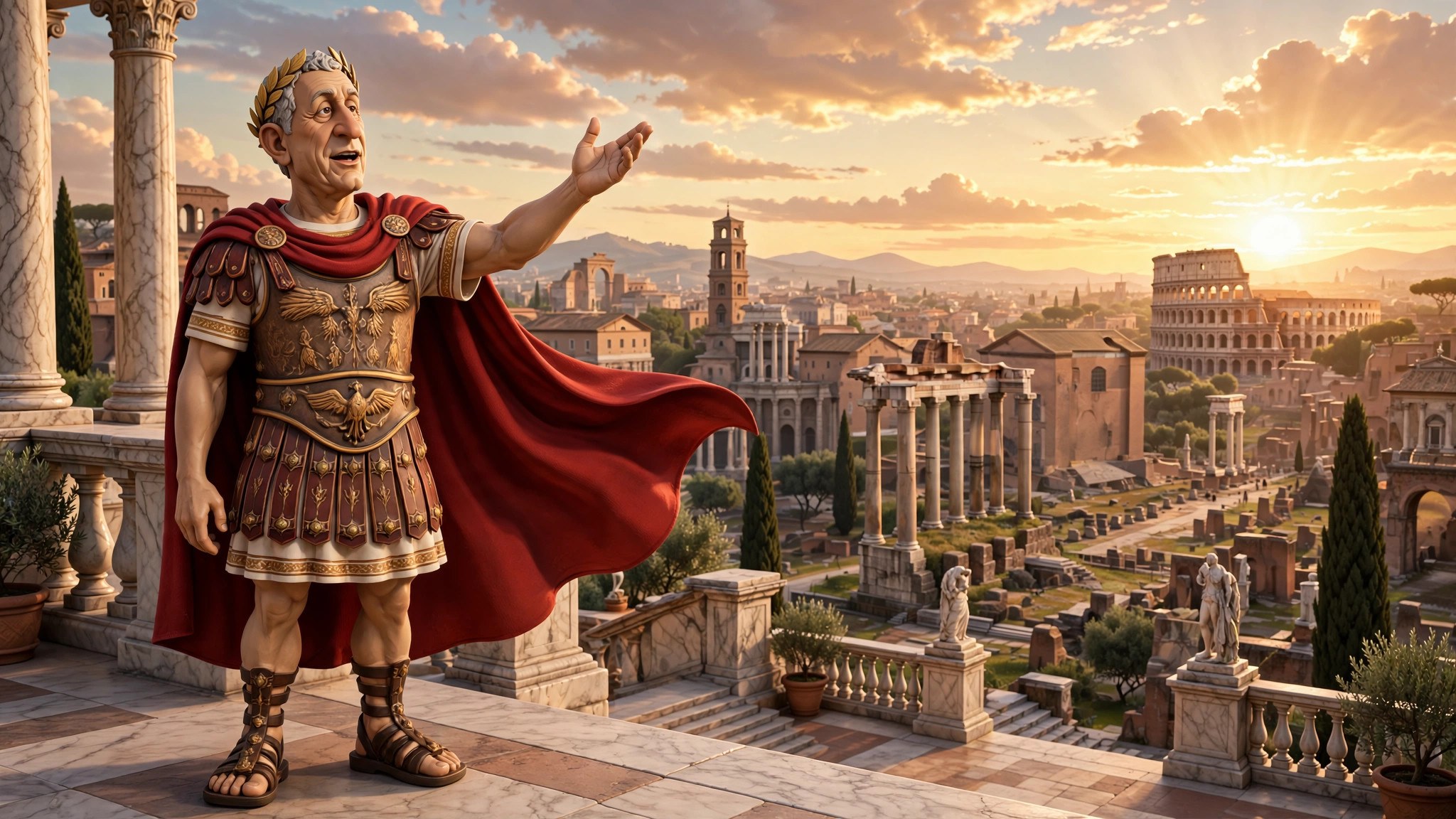
The Legend of Caesar in Later Ages
No Roman was reused more. Emperor's title, medieval warning, Renaissance hero, Shakespeare's ghost — the afterlife of Julius Caesar.
The name becomes a title
The most literal legacy: “Caesar” became the word for emperor. Augustus used it as a family name; his successors as a title; the German Kaiser and Russian Tsar (via tsesar) descend directly from it. For two millennia, to claim supreme power in Europe was to claim the name.
Antiquity: the model and the warning
- The emperors measured themselves against him — Augustus built his legitimacy on being Caesar’s heir; later emperors collected his dicta.
- The moralists used him both ways: Suetonius’s biography made him a case study in how genius curdles into tyranny; Plutarch paired him with Alexander as ambition incarnate.
- The Christians inherited a problem: the man who ordered the census-world into which Christ was born. Dante put Brutus and Cassius in the lowest circle of Hell — with Judas — for betraying the founder of Empire (Inferno 34).
The Middle Ages: the knight and the tyrant
Medieval writers knew Caesar mainly through Lucan, Suetonius, and the Commentarii (a school text). He appears as one of the Nine Worthies — the pagan exemplars of chivalry — and simultaneously as the tyrant whose assassination warned kings. Both Caeasars were useful; neither was historical.
Shakespeare (1599)
Julius Caesar fixed the popular image for the English-speaking world: the arrogant dictator, the noble Brutus, the “noblest Roman of them all,” Mark Antony’s funeral oration — and “Et tu, Brute?”, the most famous words Caesar never said. The play’s power is poetry, not history; its distortions (the Capitol instead of the Theatre of Pompey, the compressed timeline) are the price of drama. See Sayings.
The modern dictators’ mirror
Every modern strongman has auditioned for the role: Napoleon (who wrote on Caesar’s campaigns and named his heir “King of Rome”), Mussolini (who excavated and exhibited Caesar’s Rome), and countless others. The pattern is always the same — the admirer takes the genius and the clemency, and edits out the daggers.
The historians’ Caesar
Modern scholarship has swung between poles: Mommsen’s heroic state-builder, Syme’s cold anatomist of revolution (The Roman Revolution, 1939 — Caesar as the man who made the Empire possible by destroying the Republic’s oligarchy), and recent work (Morstein-Marx, Beard) stressing contingency — that the Republic’s fall was not one man’s plan but a system’s failure, in which Caesar was the accelerant, not the sole author.
Why he endures
Caesar wrote his own first draft of history, died at the dramatic peak, and left a name that became a job title. Ambition, genius, clemency, and murder — the ingredients don’t age.
Source notes
- Kaiser/Tsar etymology: standard historical linguistics (see glossary.md: imperator).
- Dante, Inferno 34.64–67 (Brutus and Cassius with Judas).
- Nine Worthies: medieval tradition (e.g. Voeux du Paon, c. 1312).
- Shakespeare’s distortions: Strauss, “Things Shakespeare Got Wrong About the Ides of March” (2015); the Capitol-vs-Theatre error noted in ides-of-march.md.
- Syme, The Roman Revolution (1939); Morstein-Marx, Julius Caesar and the Roman People (2021); Beard, SPQR (2015) (2026-09-26).