The Ides of March and the Ancient Sources
Sixty conspirators, twenty-three wounds, one afternoon that ended the Republic. Four ancient writers tell the story — and they don't quite agree.
What happened (the converging account)
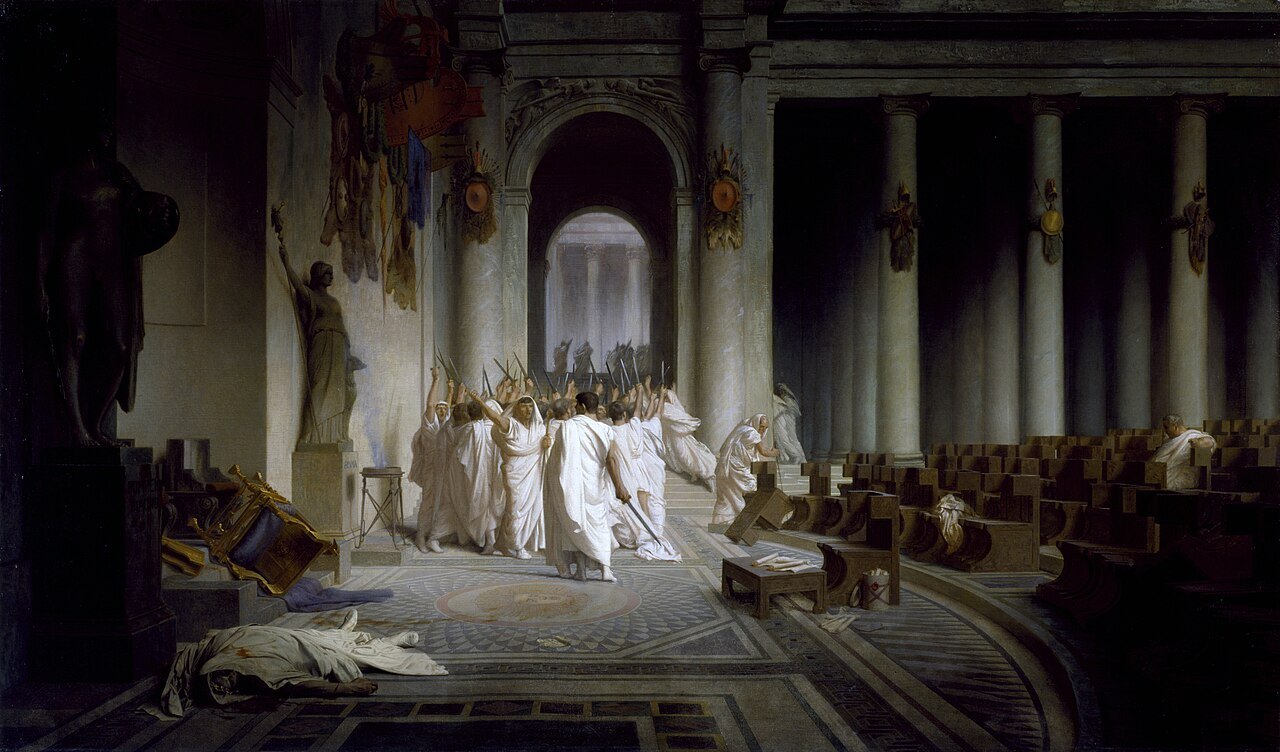
On the morning of 15 March 44 BC, Caesar — reportedly warned by his wife Calpurnia’s dream and the soothsayer Spurinna — was persuaded by Decimus Brutus to attend a Senate meeting at the Theatre of Pompey complex (the Senate’s usual house was being rebuilt). There, Tillius Cimber’s petition gave the signal; Cimber seized Caesar’s tunic; Casca struck the first blow; the conspirators closed in. Caesar fell at the foot of Pompey’s statue, stabbed 23 times (Suetonius). His body lay for hours before slaves carried it home. That evening Antony fled; the conspirators marched to the Capitol proclaiming liberty — to silence.
The four sources
Nicolaus of Damascus (contemporary)
Wrote a life of Augustus including the assassination; preserves the longest conspirator list. Fragmentary — survives only in excerpts.
Suetonius (Divus Julius 80–82, c. AD 120)
The fullest narrative: the warnings, the forged petition, Cimber’s grab, Caesar’s cry “ista quidem vis est!” (“why, this is violence!”), the 23 wounds, the physician’s finding that only one wound was fatal. On last words: Caesar said nothing but a groan — though some have written he said καὶ σύ, τέκνον to Brutus.
Plutarch (Life of Caesar 63–66; Life of Brutus; c. AD 100)
Dramatic and moralizing: the omens multiply, Artemidorus’s warning note goes undelivered, Caesar says in Latin to Casca “you villain, what are you doing?” (reported in Greek transliteration), then seeing Brutus, pulls his toga over his head and says nothing more.
Appian (Civil Wars 2.109–117, c. AD 150) and Dio Cassius (44.8–22, c. AD 220)
Later syntheses adding political context — the buildup of honors, the kingship rumors — and divergent details (Dio, like Suetonius, notes the kai su, teknon rumor as an alternative).
Where they disagree
- Last words: silence (Suetonius’s preference, Plutarch) vs. the Greek phrase (reported rumor in Suetonius and Dio). See Sayings.
- The warnings: each source distributes omens differently — Calpurnia’s dream, Spurinna, the sacrificed bull without a heart. The multiplication of portents is a literary convention; treat the fact of warnings as probable, the details as shaped.
- Numbers: ~60 conspirators (Eutropius), 23 wounds (Suetonius). Ancient round numbers; the order of magnitude is what matters.
- Caesar’s cry to Cimber/Casca: Suetonius gives “ista quidem vis est”; Plutarch gives the Casca rebuke. Both may preserve a genuine first reaction — or both may be reconstructions.
What the sources agree on (the solid core)
A large senatorial conspiracy led by Brutus and Cassius; the Theatre of Pompey venue; the petition ruse; death by multiple dagger wounds on 15 March 44 BC; the conspirators’ immediate political failure — Rome did not rise to thank them.
Source notes
- Suetonius, Divus Julius 80–83; Plutarch, Caesar 63–67, Brutus 8–14; Appian, Civil Wars 2.109–147; Dio Cassius 44.8–53; Nicolaus of Damascus, Life of Augustus (fragments); Eutropius, Breviarium 6.25 (2026-09-26).
- Modern reconstruction: Strauss, The Death of Caesar (2015) — narrative synthesis, flagged where it fills gaps.
- Venue: the Curia of Pompey within the Theatre of Pompey complex; the Curia Julia was still unfinished (see glossary.md).