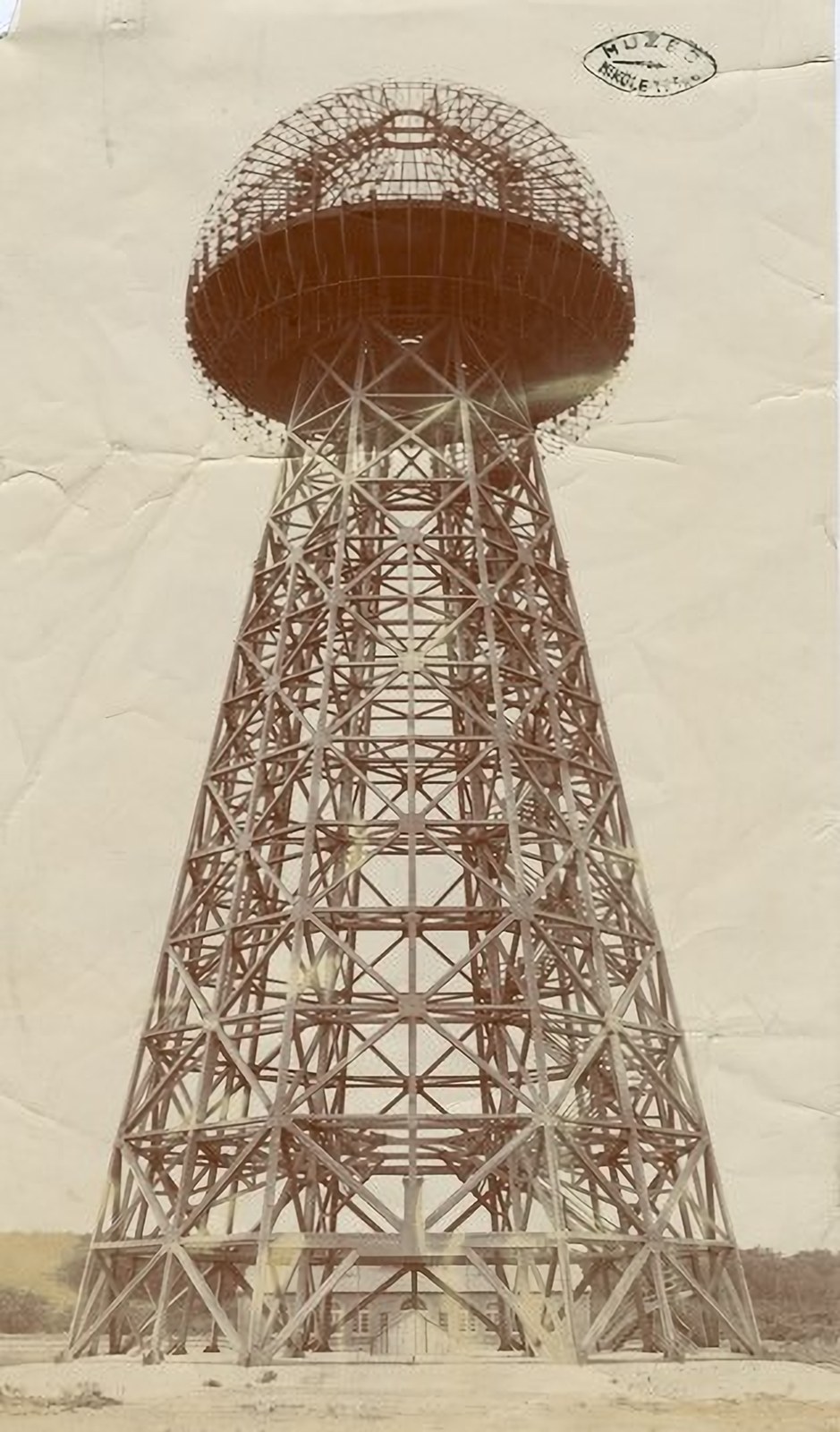
Wardenclyffe
A 187-foot tower on Long Island, $150,000 of J.P. Morgan's money, and the most famous unfinished project in the history of invention.
The idea
Wardenclyffe grew out of Tesla’s 1899–1900 experiments at Colorado Springs. There he had convinced himself that electrical energy could be transmitted through the Earth itself at resonance, and that a single great station could broadcast power — and messages — around the planet. He returned to New York in 1900 determined to build that station at full scale.
The money
In March 1901, J.P. Morgan agreed to put $150,000 (roughly $5 million in today’s money) into the project — by the standard account, in exchange for a 51% stake in Tesla’s wireless patents. The pitch Morgan bought was a transatlantic wireless communications system to compete with Marconi: messages, stock quotes, and photographs sent across the ocean without cables. Tesla’s larger ambition — transmitting electrical power worldwide — he kept largely to himself. That gap between what was sold and what was planned would prove fatal.
The tower
On 200 acres at Shoreham, Long Island — land from lawyer and banker James S. Warden, who dreamed of a “Radio City” called Wardenclyffe-on-Sound — Tesla built his station. The laboratory was designed by the celebrated architect Stanford White. The tower itself rose 187 feet, topped by a 55-ton copper dome about 68 feet across. Below it, crews sank shafts some 120 feet deep and drove iron pipes down toward the water table, to grip the Earth the way Tesla’s theory required.
The collapse
Two blows landed in quick succession. First, the project was underfunded from the start — a realistic budget would have been closer to a million dollars, and Tesla pressed ahead anyway, enlarging his plans as costs doubled. Then, on 12 December 1901, Guglielmo Marconi transmitted the Morse letter “S” across the Atlantic. Marconi’s system did not transmit power, but it worked, it was cheap, and it made headlines. Morgan, a disciplined investor, declined to put in more money. Tesla begged; the answer stayed no.
Construction ground to a halt around 1906. The press dubbed the skeleton “Tesla’s million-dollar folly.” It is worth saying plainly, as the myth-busting page does: the story that Morgan killed Wardenclyffe to protect energy profits collapses against this documented sequence — missed milestones, ballooning costs, and a competitor who shipped first.
The demolition
Tesla’s debts mounted; in 1915 the property was lost to foreclosure (his hotel creditors took the deed). On 4 July 1917 the unfinished tower was dynamited and sold for scrap — about $1,750 for the steel and copper. Only the laboratory building, designed by Stanford White, survived.
What remains
For decades the site sat derelict. In 2013 the nonprofit Tesla Science Center purchased it, after a crowdfunding campaign led by the cartoonist behind The Oatmeal raised about $1.37 million (matched by a New York State grant). The laboratory was added to the National Register of Historic Places in 2018, and the site is being developed as a museum — the only surviving Tesla laboratory.
The honest assessment
Modern engineering analysis sides against Tesla’s core premise: the Earth-transmission scheme, as he imagined it, could not have worked — the planet does not ring like a tuned bell with the efficiency he assumed. Tesla himself, quoted in the press as the dream collapsed, insisted: “It is not a dream,” he said, “it is a simple feat of scientific electrical engineering, only expensive — blind, faint-hearted, doubting world!” (as reported via Smithsonian Magazine). It was a genuine feat of engineering ambition. It was also, by every physical analysis since, a machine built on a mistaken theory of the Earth.
Source notes
- Morgan’s $150,000 (March 1901), 51% patent stake, and the communications-vs-power pitch gap: the standard biographical account (Carlson 2013; Seifer 1996); corroborated by contemporary summaries (Smithsonian Magazine; PBS).
- Tower dimensions (187 ft, 55-ton copper dome), 120-ft shafts, Stanford White’s laboratory design, Warden’s 200 acres: site and press records as reported in the biographical and preservation literature.
- Marconi’s 12 December 1901 transatlantic “S”: contemporary press.
- Construction halt ~1906, foreclosure 1915, demolition 4 July 1917, ~$1,750 scrap value: press and property records.
- Tesla Science Center purchase (2013), Oatmeal-led crowdfunding (~$1.37M), National Register listing (2018): contemporary press.
- Tesla’s quoted defense (“It is not a dream…”): press quotation as reproduced by Smithsonian Magazine — a reported quotation, not a verbatim-verified Tesla text.
- Physical assessment of the Earth-resonance scheme: modern engineering analysis as summarized in Carlson (2013); presented as analysis, not period fact.