Start Here
Five minutes on Nikola Tesla — the inventor, the real achievements, the honest gaps, and where to go next.
Who was he?
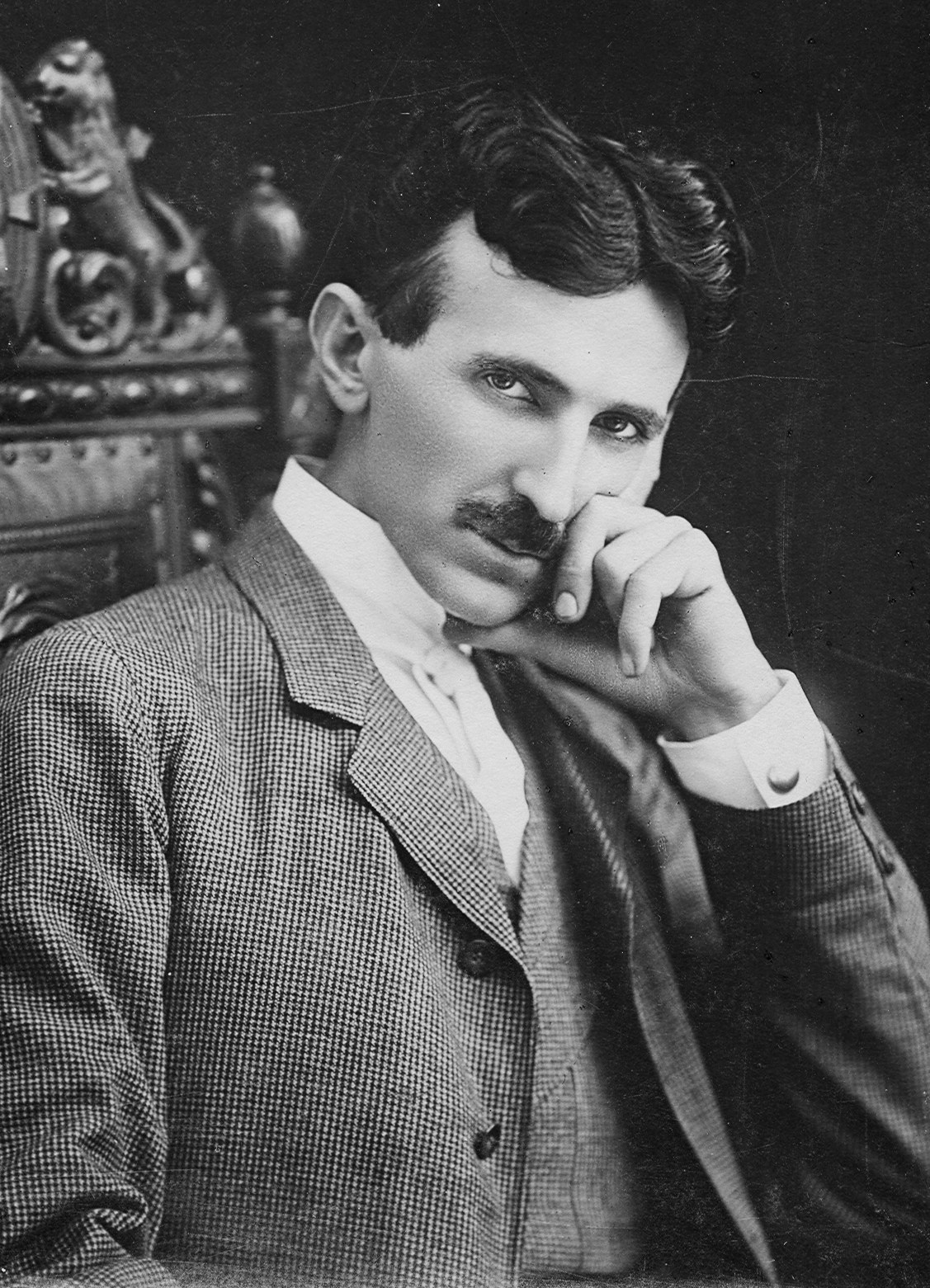
Nikola Tesla (1856–1943) was a Serbian-American electrical inventor. His alternating-current (AC) polyphase system — the induction motor, the transformer-based distribution scheme, the polyphase generator — is the foundation of the electrical grid that powers the modern world. He held roughly 300 patents worldwide, gave spectacular public lectures with high-frequency apparatus, and spent his later decades pursuing wireless power transmission that never worked at scale.
He was also a vivid, eccentric public figure: a dandy who dined at Delmonico’s, fed pigeons in Bryant Park, and in old age announced particle-beam weapons to the press. The internet has since made him a folk saint of “suppressed” inventions. This site keeps the inventor and the legend apart.
What did he actually do? (the short list)
- Conceived the rotating magnetic field (1882, by his own account) — the principle behind the AC induction motor.
- Patented the polyphase AC system (1888) and licensed it to Westinghouse, whose AC network won the “War of Currents.”
- Invented the Tesla coil (1891), still used in radio technology and physics demonstrations.
- Demonstrated the first radio-controlled boat (1898) at Madison Square Garden.
- Built the Colorado Springs laboratory (1899–1900) for high-voltage, high-frequency experiments.
- Attempted the Wardenclyffe wireless station (1901–1906), funded by J.P. Morgan — it was never completed.
For the full list with explanations, see Inventions.
Three things people get wrong
- He did not invent “free energy.” He never claimed perpetual motion or costless power; Wardenclyffe was meant to transmit power that would be metered and billed. See Myth vs. Record.
- He did not single-handedly invent radio. He held important early patents (priority upheld by the U.S. Supreme Court in 1943), but radio was the work of many hands — Marconi, Lodge, Popov, Fessenden among them.
- The famous quotes are mostly fake. “If you want to find the secrets of the universe, think in terms of energy, frequency and vibration” has no verified source. This site’s Sayings page includes only quotations traceable to Tesla’s published writings.
Where to go next
- The narrative: Biography
- The dates: Timeline
- His real words: Sayings
- The people around him: People
- The legends, checked: Myth vs. Record
- Terms explained: Glossary
Source notes
- Orientation summary compiled 2026-09-26 from the pages it links to; factual claims are sourced on those pages.
- “Roughly 300 patents worldwide” — the commonly cited figure across Tesla biographies (Carlson, Cheney, Seifer); exact counts vary by how continuations and foreign filings are counted.