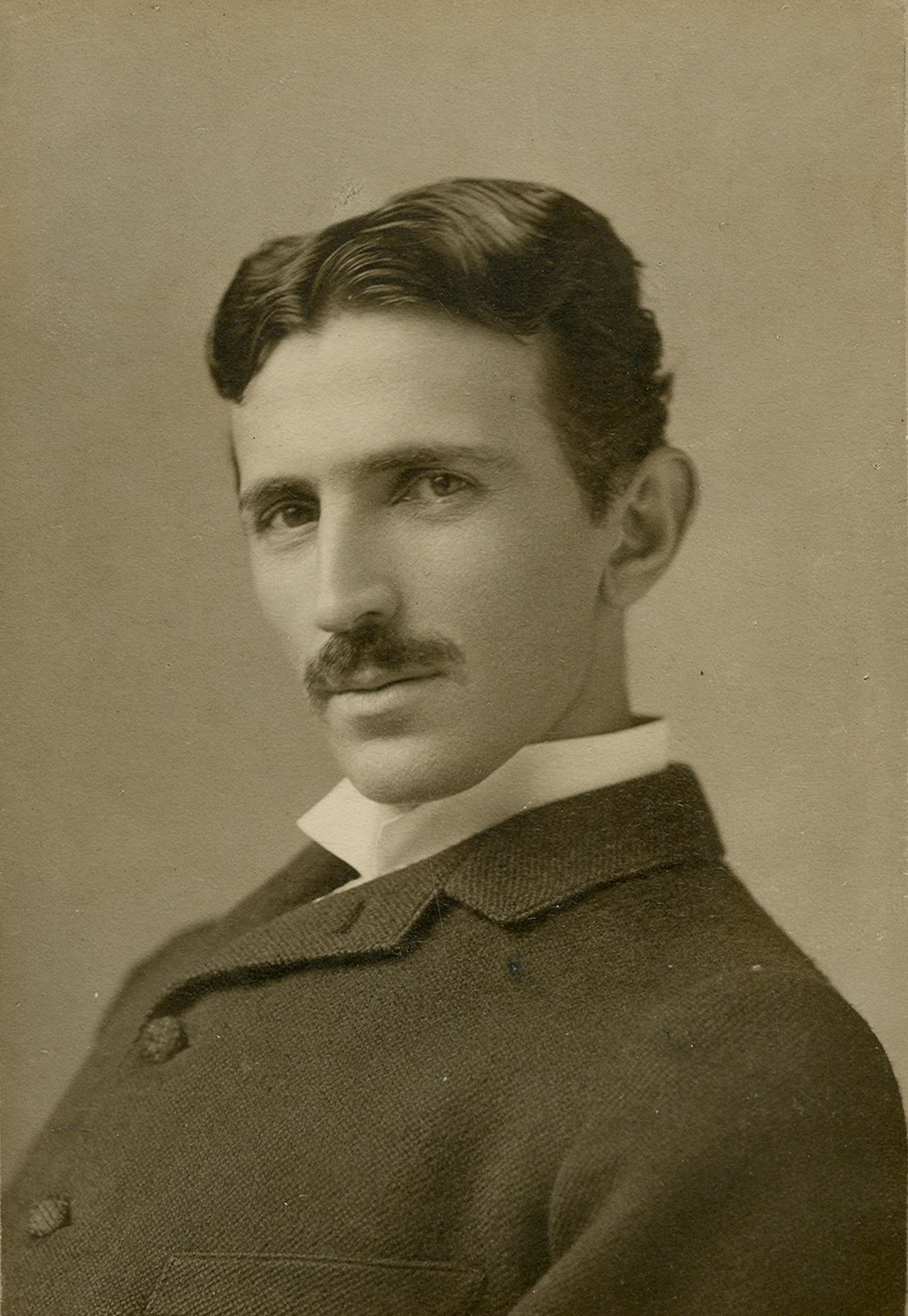
Biography
From a Serbian village in the Austrian Empire to the electrical age he helped create — Tesla's life in full, with the record's uncertainties marked.
Childhood in Smiljan (1856–1873)
Nikola Tesla was born on 10 July 1856 (28 June by the Julian calendar then in civil use) in Smiljan, a village in the Austrian Empire’s Military Frontier — in what is today Croatia. He was the fourth of five children of Milutin Tesla, a Serbian Orthodox priest, and Đuka (Mandić) Tesla, who never learned to read but, by her son’s account, invented household devices. His older brother Dane died in childhood — Tesla’s autobiography attributes it to a horse-riding accident, but the details come only from Tesla’s own late-life telling, and independent corroboration is thin.
Tesla claimed an eidetic visual memory and a childhood plagued by blinding flashes of images — again, his own account, written decades later. In 1873 he contracted cholera and was bedridden for months; his father, he wrote, promised to send him to engineering school if he recovered.
Education: Graz, Maribor, and the “lost years” (1875–1881)
Tesla enrolled at the Imperial-Royal Technical College in Graz in 1875 to study electrical engineering. He excelled at first — he later claimed he could integrate calculus in his head — then stopped attending lectures, took up gambling, and left in 1878 without a degree. He worked briefly as a draftsman in Maribor (1879); his father died that year.
Tesla later said he studied at Charles-Ferdinand University in Prague, but the university’s records for the period are incomplete and no enrollment has been firmly documented — this remains an open point in the biography.
In 1881 he found work as chief electrician at the new telephone exchange in Budapest. There, by his own famous account, the idea of the rotating magnetic field came to him in 1882 while walking in the City Park with his friend Anthony Szigeti, reciting Goethe’s Faust — he said he seized a stick and drew the induction motor’s diagrams in the sand. Whether the flash of insight happened exactly so is unverifiable; it is Tesla’s story, told consistently from the 1890s onward.
Paris and America (1882–1886)
Tesla worked for the Continental Edison Company in Paris (1882–84), repairing DC dynamos. In 1884 he emigrated to the United States — by his account arriving in New York on 6 June 1884 with four cents in his pocket — carrying a letter of introduction from Charles Batchelor to Thomas Edison.
He worked at the Edison Machine Works for about six months, then left. The reason is disputed. Tesla’s later account says Edison (or Batchelor) promised him $50,000 for redesigning DC generators and then dismissed the promise as “American humor.” Edison’s side left no record of such an offer, and the story survives only in Tesla’s telling — it should be read as his version, not established fact.
In 1886 Tesla formed the Tesla Electric Light & Manufacturing Company with investors, who soon pushed him out in favor of an arc-lighting scheme of their own. He spent roughly a year in menial labor — by his account, digging ditches — before finding backers willing to fund his AC work.
The AC system and Westinghouse (1887–1895)
In 1887, with Alfred Brown and Charles Peck, Tesla founded the Tesla Electric Company and filed the great series of polyphase AC patents — the induction motor, the rotating-field generator, the transformer-based distribution system. The core U.S. patents were granted in May 1888.
George Westinghouse licensed the patents in 1888 — for a lump sum plus per-horsepower royalties, under terms the biographies place at about $60,000 in cash and stock with royalties of $2.50 per horsepower. Westinghouse’s engineers turned the system into a commercial network, and in 1893 Westinghouse’s AC system famously lit the Chicago World’s Columbian Exposition, underbidding Edison’s General Electric. When Westinghouse faced a cash crisis in the late 1890s, Tesla — by the standard account — tore up the royalty contract to save the company, forgoing a fortune. (This, too, is told largely through Tesla’s circle; the underlying license and its abandonment are documented, the dramatic details less so.)
Tesla became a celebrity lecturer. His 1891–93 demonstrations of high-frequency currents — lighting wireless lamps, passing hundreds of thousands of volts through his own body — made him famous on two continents. In March 1895 his Fifth Avenue laboratory burned down, destroying years of apparatus and notes.
Niagara, Colorado Springs (1895–1900)
The Adams Power Plant at Niagara Falls, built to Westinghouse’s AC design on Tesla’s polyphase principles, began delivering power in 1896 — the first large-scale AC power system and the practical vindication of Tesla’s work. (The “War of Currents” was won as much by engineering economics as by any single inventor; see Myth vs. Record.)
In 1899–1900 Tesla built an experimental station at Colorado Springs, pursuing high-voltage, high-frequency transmission and, he hoped, wireless power. The experiments produced spectacular artificial lightning and a trove of notes (published much later as the Colorado Springs Notes), but no workable system.
Wardenclyffe and the long decline (1901–1919)
In 1901, with $150,000 from J.P. Morgan (in exchange for a majority stake in Tesla’s wireless patents, by the standard account), Tesla began building the Wardenclyffe wireless station on Long Island — a 187-foot wooden tower meant to transmit power and messages worldwide. Costs overran, Marconi’s 1901 transatlantic signal undercut the project’s rationale, and Morgan declined further funding. Construction stopped in 1906; the tower was demolished for debt in 1917.
Tesla’s fortunes never recovered. His 1919 autobiography, “My Inventions,” serialized in Electrical Experimenter, remains the most important first-person source on his life — and must be read as such: vivid, self-mythologizing, and written thirty years after the events.
The later years (1920–1943)
Tesla lived in a succession of New York hotels, latterly the New Yorker, sustained by a modest Westinghouse consulting arrangement and, from admirers, small kindnesses. He fed pigeons in Bryant Park, grew increasingly reclusive, and made grandiose announcements to birthday press conferences — including the 1930s “teleforce” particle-beam weapon proposal, which no government built.
He died alone of a coronary thrombosis on 7 January 1943 in Room 3327 of the New Yorker Hotel. His funeral on 12 January at the Cathedral of St. John the Divine drew some 2,000 mourners. The Office of Alien Property seized his papers; MIT professor John G. Trump reviewed them and reported nothing of military value. Tesla’s ashes were eventually interred in the Nikola Tesla Museum in Belgrade.
Source notes
- First-person backbone: Tesla, “My Inventions,” Electrical Experimenter (1919); flagged throughout where Tesla is the sole source (birth story, $50,000 Edison anecdote, Faust-in-the-park insight, ditch-digging year).
- Scholarly backbone: Carlson, Tesla: Inventor of the Electrical Age (2013); Cheney, Tesla: Man Out of Time (1981); Seifer, Wizard: The Life and Times of Nikola Tesla (1996).
- Birth date: 10 July 1856 (New Style) / 28 June (Julian) — Smiljan parish records and Tesla’s own statements agree on the date; the “midnight during a lightning storm” detail is Tesla’s own embroidery.
- Prague enrollment: unverified; noted as uncertain per Carlson’s discussion of the archival gap.
- Naturalization: U.S. citizen, 30 July 1891 (naturalization papers).
- Death: 7 January 1943, New Yorker Hotel; funeral 12 January 1943, Cathedral of St. John the Divine.
- Wardenclyffe financing: $150,000 from J.P. Morgan (March 1901), standard figure across biographies; tower demolished September 1917.
- Posthumous papers: seized by the Office of Alien Property, reviewed by John G. Trump — documented in FBI/administrative records summarized by Seifer.