Colorado Springs
Seven months in the Rockies with a magnifying transmitter — the most spectacular and the most contested experiments of Tesla's career.
Why Colorado
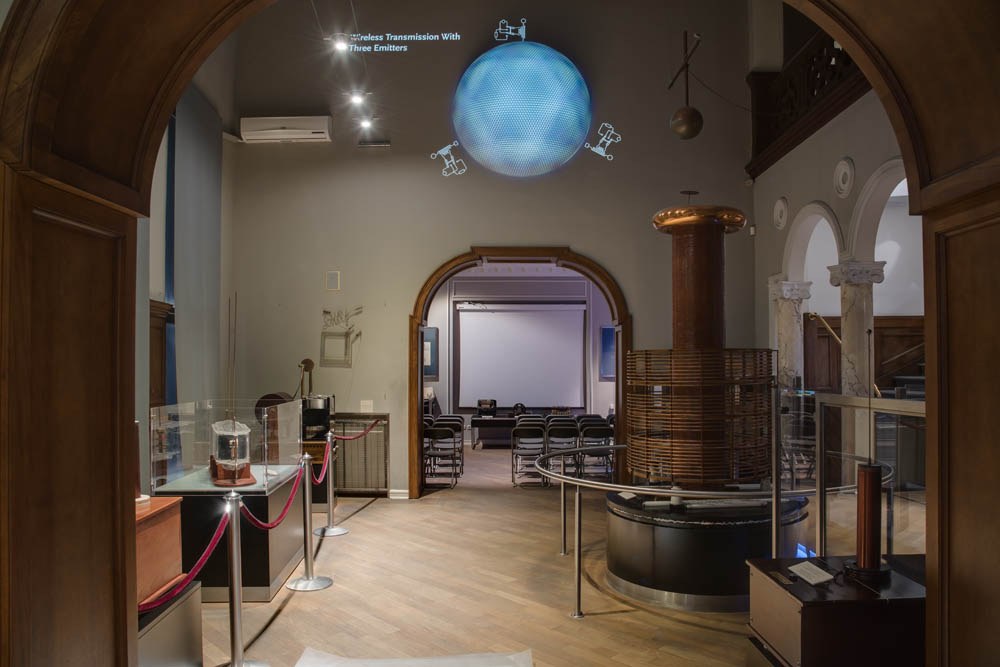
By 1899 Tesla wanted to test his wireless-power ideas at a scale New York could not safely contain. He built an experimental station at Colorado Springs and worked there from May 1899 to January 1900, supplied with power by the local El Paso power company. The centerpiece was his magnifying transmitter: a huge resonant transformer — a Tesla coil grown to building scale — meant to pump electrical oscillations into the Earth.
The artificial lightning
The results were spectacular. Tesla’s notes describe discharges reaching a hundred feet and more — bolts of man-made lightning crackling across the laboratory, photographed for the press. The most famous images from the campaign, including the well-known double-exposure portrait of Tesla seated calmly amid the discharges (see the home page), were publicity photographs: the lightning was real, but it was added to the portrait by double exposure. The discharges happened; the serene seated figure among them did not.
Local legend holds that the experiments once burned out the power company’s dynamo, blacking out the town — Tesla’s telling, widely repeated, uncorroborated by the company’s records. What is documented is that the station drew enormous power and that Tesla’s relations with his suppliers were strained.
The notes
Tesla kept voluminous daily records — the Colorado Springs Notes, published decades later (1978) by the Nikola Tesla Museum. They are a genuine treasure: careful measurements, circuit diagrams, and observations alongside soaring speculation. In them Tesla records what he believed was the detection of stationary waves in the Earth — the planet itself ringing with electrical resonance. He announced the finding in his 1900 Century Magazine article, “The Problem of Increasing Human Energy,” as the empirical foundation of his world-wireless scheme.
This is where the record splits. The notes are real and the observations are Tesla’s honest readings of his instruments. Whether the instruments were actually detecting terrestrial stationary waves — or local artifacts of his own colossal transmitter — is doubted by modern physicists. The claim was never independently replicated, and the physics as Tesla stated it does not check out.
What came of it
No workable wireless-power system emerged from Colorado Springs. What did emerge was the conviction that carried Tesla into Wardenclyffe: the belief, unshaken by the ambiguous data, that the Earth could be made to carry power around the globe. The station was dismantled when he left in January 1900; the notes survived.
The honest ledger
| What is documented | Status |
|---|---|
| Seven months of high-voltage experiments, May 1899 – Jan 1900 | Documented |
| Artificial lightning, photographed | Documented (portraits are double exposures — disclosed as such) |
| Discharge lengths “a hundred feet and more” | Tesla’s notes; no independent measurement |
| Burned-out town dynamo | Tesla’s telling; uncorroborated |
| Detection of terrestrial stationary waves | Tesla’s claim; doubted, never replicated |
| A working wireless-power system | None resulted |
Source notes
- Dates (May 1899 – January 1900), the magnifying transmitter, and the El Paso power supply: Tesla’s Colorado Springs Notes (1899–1900; published 1978) and the biographical literature.
- Discharge descriptions (“a hundred feet and more”): Tesla’s own notes; flagged as his measurement, not independently verified.
- Double-exposure publicity photographs: the images themselves and the photographic literature; the site labels them as such.
- The burned-out-dynamo story: Tesla’s telling; no corroborating company record published.
- Stationary-wave claims: Tesla’s Century Magazine article (June 1900); modern skepticism summarized from the physics literature via Carlson (2013).
- The Colorado Springs Notes were published by the Nikola Tesla Museum, Belgrade (1978); the manuscript record is genuine.