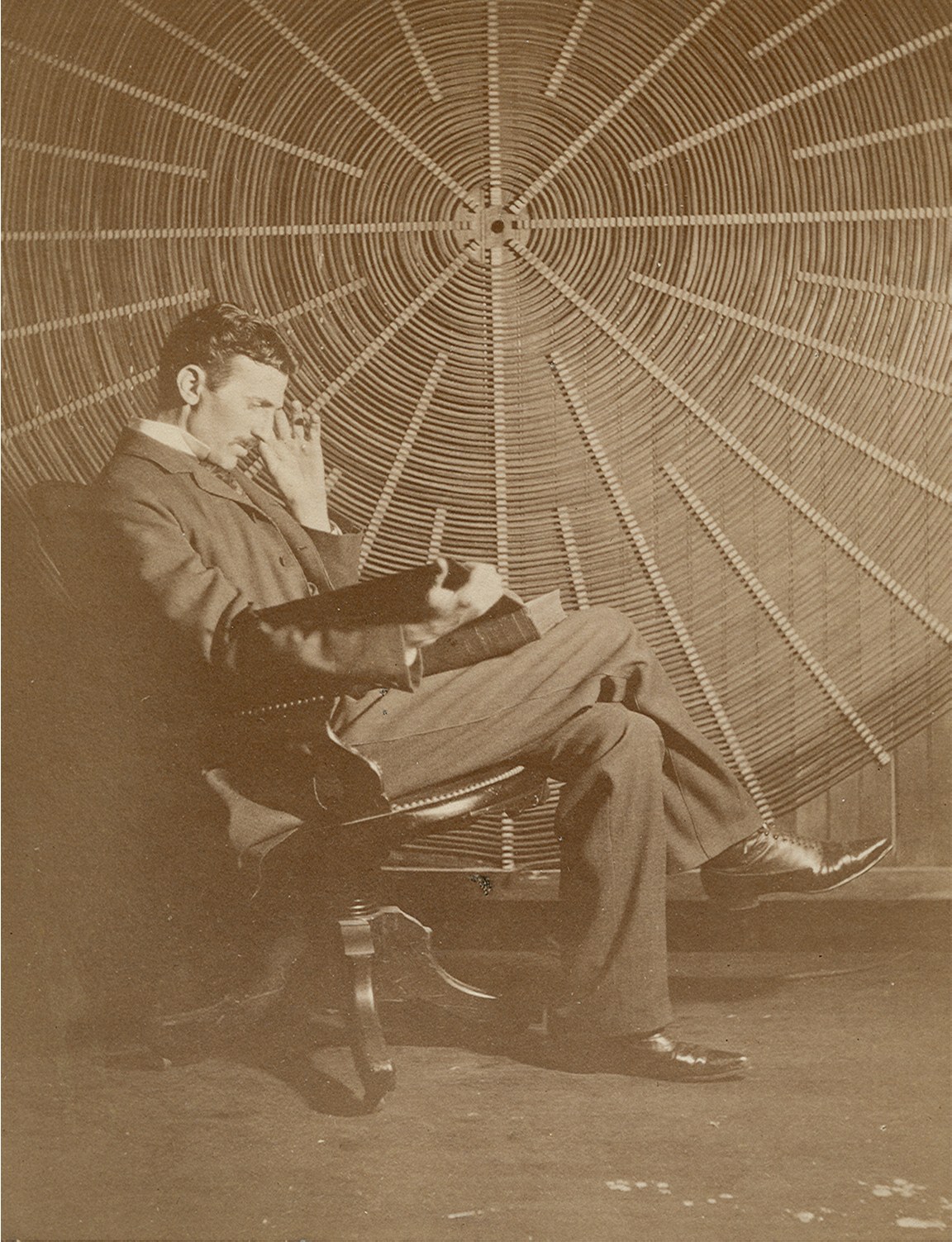
Tesla's Later Years
Three decades of hotel rooms, unpaid bills, birthday press conferences, and pigeons — the long twilight of a man who had already changed the world.
After the fall
Wardenclyffe’s collapse (see Wardenclyffe) broke Tesla financially and, by most accounts, emotionally. The years 1906–1915 were a slow unwinding: the tower stood unfinished, the money was gone, and the press moved on. Tesla declared bankruptcy in the mid-1910s and spent the following decades moving between New York hotels, leaving unpaid bills behind him.
Real honors amid the decline
The “unrecognized genius” narrative omits the recognition he did receive. In 1917 the American Institute of Electrical Engineers awarded him its Edison Medal — the profession’s highest honor, named for his old rival. On his 75th birthday in 1931 he appeared on the cover of Time magazine and received a congratulatory letter from Albert Einstein. The establishment had not forgotten him; it had simply filed him under “pioneer” while he was still alive and still dreaming.
The New Yorker
In 1934 Tesla settled into the Hotel New Yorker, where he would live for the rest of his life — rooms 3327 and 3328, by the standard account. The biographical literature reports that Westinghouse covered his hotel rent in these years, a quiet pension from the company his patents had built. He lived simply: milk, bread, honey, vegetable juice, long daily walks.
The pigeons
Every day he walked to nearby Bryant Park to feed the pigeons. His biographer John J. O’Neill, in Prodigal Genius (1944), retells Tesla’s devotion to one white pigeon in particular — “I loved her as a man loves a woman, and she loved me. As long as I had her, there was a purpose to my life.” The words come to us through O’Neill, not from Tesla’s own pen, and the story’s details are secondhand; what is firsthand is the daily ritual, witnessed by half of midtown Manhattan for years.
The same years brought the compulsions: counting steps, rooms numbered in multiples of three, eighteen napkins at the table, the violent aversion to pearls and earrings he describes himself in “My Inventions.” The eccentricities are documented. Diagnoses are not — retrospective medical claims belong in the footnotes, not the biography.
The birthday press conferences
Each July, reporters gathered for Tesla’s birthday, and Tesla fed them marvels: a motor that ran on cosmic rays, a new physics to replace Einstein’s, a method of photographing thoughts, and — repeatedly — the “teleforce” beam (see Death Ray & 3-6-9). The papers printed it all. Whether he believed it all is unknowable; that he needed the audience is plain.
The end
On the morning of 7 January 1943, a hotel maid found Tesla dead in his room — a “do not disturb” sign had kept visitors away for two days. He was 86; the cause was coronary thrombosis. Some 2,000 mourners attended his funeral on 12 January at the Cathedral of St. John the Divine. Within days, the Office of Alien Property seized his papers — the beginning of the story told in FBI Files. Months later, the U.S. Supreme Court restored his priority over Marconi on key radio patents: vindication that arrived, as it so often had in his life, just too late for him to enjoy.
Source notes
- Hotel years, unpaid bills, and the bankruptcy: the standard biographical account (Carlson 2013; Cheney 1981; Seifer 1996).
- Edison Medal (1917): American Institute of Electrical Engineers records.
- Time cover and Einstein letter (1931): contemporary press.
- Hotel New Yorker (from 1934), rooms 3327/3328, Westinghouse paying the rent: the standard biographical account.
- White-pigeon story: O’Neill, Prodigal Genius (1944) — secondhand, attributed as such; the daily pigeon-feeding is widely witnessed.
- Compulsions (pearls, earrings, napkins, multiples of three): Tesla’s own “My Inventions” (1919) and the biographical literature; no retrospective diagnosis is offered here.
- Death (7 January 1943, coronary thrombosis), funeral (12 January 1943, ~2,000 mourners, Cathedral of St. John the Divine): contemporary press.
- Papers seizure and Supreme Court decision: see FBI Files and Patents.