The War of Currents
The famous fight over how electricity would be delivered — Edison's direct current against alternating current — was a corporate contest with real casualties, not a personal duel.
What was at stake
Direct current (DC), Edison’s system, flows one way and cannot easily change voltage. That made long-distance transmission ruinously expensive: power had to be generated near where it was used, with a generating station every mile or so in a dense city. Alternating current (AC) can be stepped up to high voltage for transmission and stepped down for use — one plant can serve a region. The physics favored AC; the incumbent’s money favored DC.
Tesla’s entry
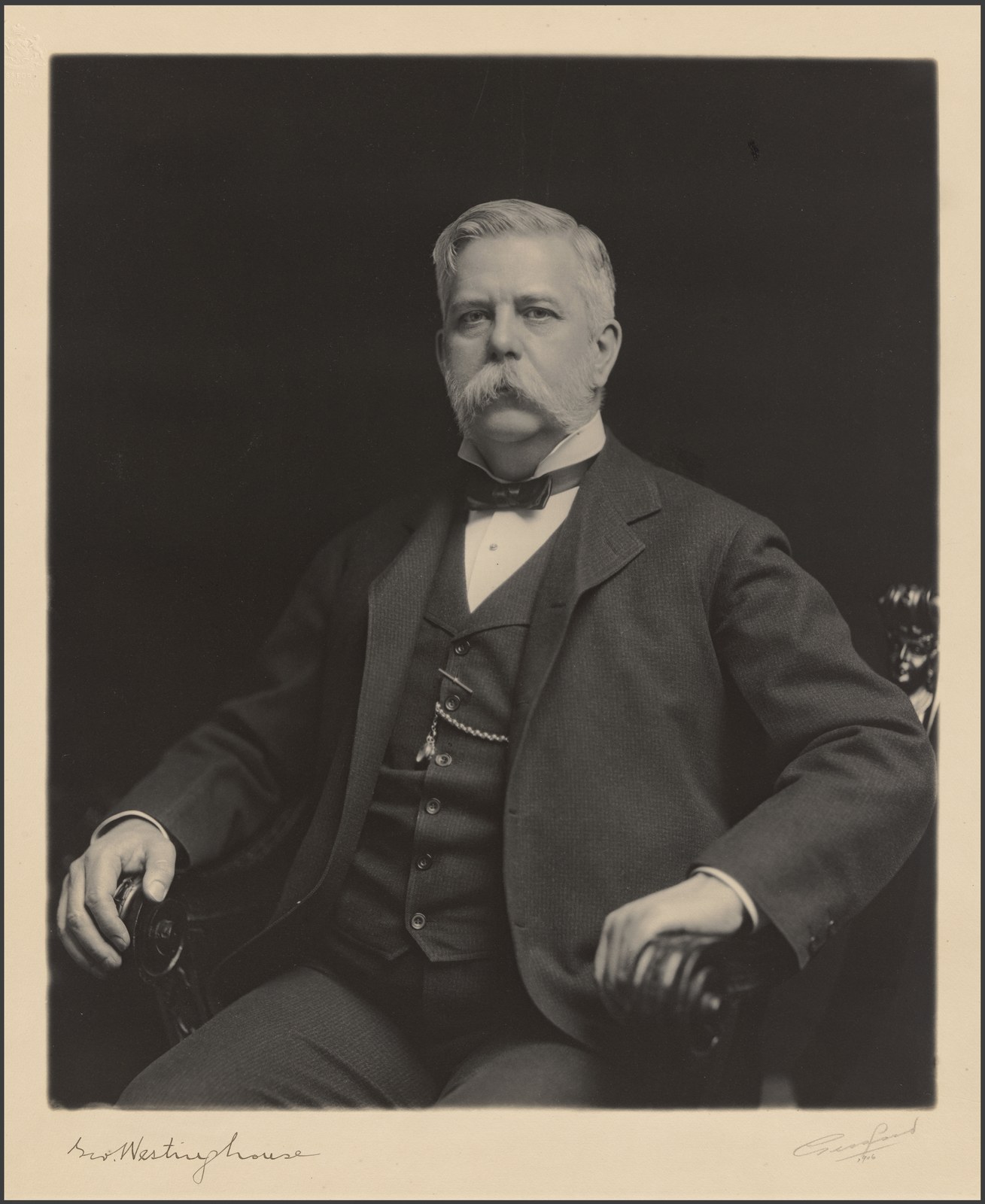
In 1888 Tesla’s polyphase AC patents were granted and licensed to George Westinghouse the same year — a lump sum (biographies report about $60,000 in cash and stock) plus per-horsepower royalties (see Patents). Westinghouse’s engineers — notably Oliver Shallenberger and Benjamin Lamme — turned Tesla’s principles into working, manufacturable systems. Tesla’s own celebrated 1891 lectures before the American Institute of Electrical Engineers sold the engineering world on the system.
The propaganda campaign
Edison’s camp fought back with fear. Harold Brown, an Edison associate, staged public electrocutions of dogs, calves, and a horse (1888–1890) to brand AC as the “executioner’s current,” and campaigned successfully for an AC-powered electric chair. The first judicial electrocution — William Kemmler at Auburn Prison, 6 August 1890, using a Westinghouse generator — was botched and gruesome, which is exactly what the campaign had banked on: the verb “to Westinghouse” briefly entered the language as a synonym for electrocution.
The record matters here: this was a corporate campaign run by Edison’s associates, not Edison personally electrocuting animals, and Tesla was never its sole target. The popular “Edison vs. Tesla cage match” framing is a later simplification (see Myth vs. Record).
The fair that settled it
The decisive commercial battle was the contract to light the 1893 World’s Columbian Exposition in Chicago. Westinghouse bid about $399,000; Edison’s General Electric bid about $554,000. The committee chose Westinghouse. More than ninety thousand incandescent lamps — the fair’s entire illumination — burned on alternating current. Tesla was there in person, demonstrating his Egg of Columbus and wirelessly lit lamps before enormous crowds. It was the first time most Americans had seen the AC system at scale, and it worked flawlessly.
Niagara
The engineering crown was the Adams Power Plant at Niagara Falls, built to the Westinghouse AC design on Tesla’s polyphase principles. It began delivering power in 1896 — the first large-scale AC transmission system, sending power twenty-six miles to Buffalo. The War of Currents was effectively over: generation could now sit at the waterfall and the customers could live in another city.
The royalty release
One of the war’s famous episodes concerns money, not machinery. Around 1891, Westinghouse was in financial trouble, and the per-horsepower royalties owed to Tesla were a liability on the company’s books. By the standard biographical account (Carlson 2013; Cheney 1981), Tesla agreed to release Westinghouse from the royalties — money that, had it been paid over the life of the patents, would have made him one of the richest men in America. Tesla’s own telling has him magnanimously tearing up the contract; the biographers treat the release as real and the tear-up scene as his embroidery. Either way, the choice was voluntary, and it was costly: see Myth vs. Record on the “cheated genius” narrative.
What the historians actually argue about
Serious scholarship does not dispute that AC won — it disputes how much of the win belongs to Tesla. Carlson (2013) stresses that Westinghouse’s engineers did the grinding work of making Tesla’s elegant principles into a system that could be built, sold, and maintained. Tesla supplied the foundational patents and the vision; Shallenberger, Lamme, and their colleagues supplied the power system. The War of Currents was won by an alliance, not a lone inventor.
Source notes
- Patent dates and license terms: U.S. Patent Office records (polyphase grants, May 1888); Carlson (2013) and Cheney (1981) on the Westinghouse license and the ~1891 royalty release.
- Brown’s electrocution campaign, the Kemmler execution (6 August 1890), and the “Westinghouse” verb: contemporary press and the standard biographical literature.
- The 1893 fair bids (~$399,000 Westinghouse vs. ~$554,000 GE) and the fair’s AC lighting: exposition records as reported in the biographical literature.
- Niagara Adams plant operation from 1896: corporate and press records.
- The “Edison personally electrocuted animals” correction: the campaign was run by Edison’s associates (notably Harold Brown); framing as corporate rather than personal follows the historical record.