Timeline
Eighteen events, 1952 to 2024. Dates marked "documented" rest on official records; those marked "reported" rest on credible accounts that lack an official paper trail.
7 October 1952 — Born in Leningrad (documented)
Vladimir Vladimirovich Putin is born in Leningrad, the son of Vladimir Spiridonovich Putin and Maria Ivanovna Shelomova.
1975 — Graduates in law; joins the KGB (documented)
Putin graduates from the law faculty of Leningrad State University and is recruited into the KGB’s First Chief Directorate (foreign intelligence).
1985–1990 — KGB posting in Dresden (documented)
Putin serves as an intelligence officer in Dresden, East Germany, returning around 1990 at the rank of lieutenant colonel. Details of the work are thin in the public record.
20 August 1991 — Resigns from the KGB (reported)
Per Putin’s own account in First Person, he resigns from the KGB during the August coup attempt against Mikhail Gorbachev and goes to work for reformist Leningrad leader Anatoly Sobchak.
1991–1996 — St. Petersburg city administration (documented)
Putin serves as adviser to Sobchak, then chairman of the Committee for Foreign Relations, rising to first deputy mayor by 1994. A 1992 city-council commission alleges irregularities in barter licenses; no charges follow.
1996 — Moves to Moscow (documented)
After Sobchak’s electoral defeat, Putin moves to Moscow and joins the Presidential Property Management Directorate, then the Presidential Administration in 1997.
25 July 1998 — Appointed FSB director (documented)
Boris Yeltsin appoints Putin director of the FSB; in March 1999 he also becomes secretary of the Security Council.
16 August 1999 — Confirmed as prime minister (documented)
The State Duma confirms Putin as prime minister after Yeltsin’s nomination on 9 August. Weeks later, the Second Chechen War begins following the Dagestan incursion and the September apartment bombings.
31 December 1999 — Becomes acting president (documented)
Yeltsin resigns in a televised address; Putin becomes acting president and issues a decree granting Yeltsin immunity.
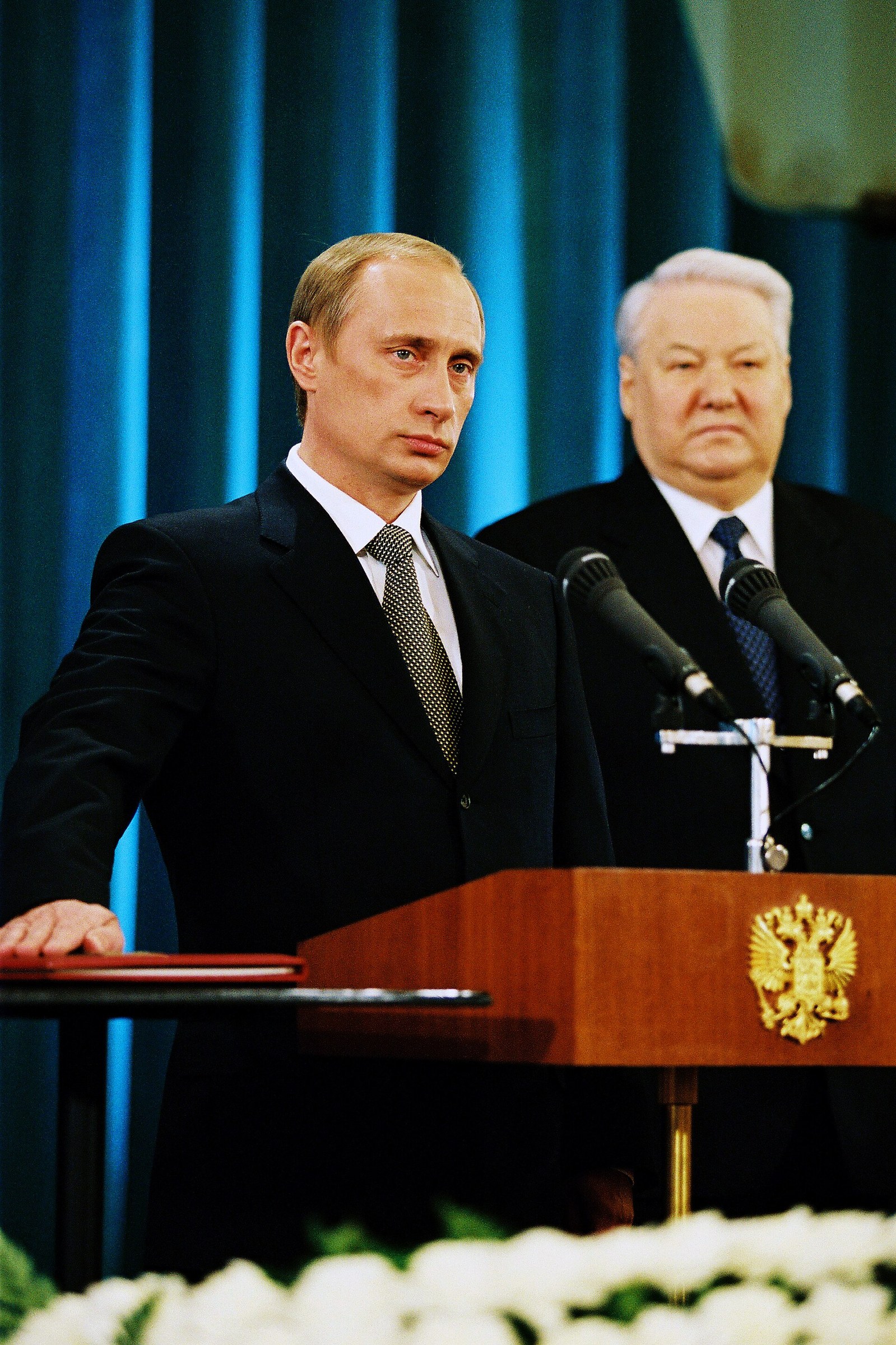
26 March 2000 — Elected president (documented)
Putin wins the presidency in the first round with 53.4% of the official vote; he is inaugurated on 7 May 2000.
14 March 2004 — Re-elected (documented)
Putin wins a second term with 71.3% of the official vote. The constitution bars a third consecutive term.
10 February 2007 — The Munich speech (documented)
At the Munich Security Conference, Putin denounces the “unipolar model” of American power and calls NATO expansion a “serious provocation” (see Sayings).
2 March 2008 — Medvedev elected; Putin becomes prime minister (documented)
Dmitry Medvedev wins the presidency (70.28% official); Putin becomes prime minister on 8 May 2008. In August, Russia fights a brief war with Georgia (see Medvedev Interlude).
4 March 2012 — Elected president again (documented)
Putin returns to the presidency with 63.6% of the official vote amid fraud allegations and street protests; he is inaugurated on 7 May for a six-year term.
16–18 March 2014 — Crimea referendum and annexation (documented)
A referendum in Crimea is followed on 18 March by Russia’s treaty of accession; Ukraine and Western governments do not recognize it (see Ukraine Conflict).
1 July 2020 — Constitutional referendum (documented)
Amendments resetting Putin’s term count are approved, per the Central Election Commission, with 77.92% voting yes — potentially permitting him to remain president through 2036 (see Constitutional Changes).
24 February 2022 — Full-scale invasion of Ukraine begins (documented)
Putin announces a “special military operation”; Russia begins its large-scale military attack on Ukraine. The UN General Assembly characterizes it as aggression (ES-11/1); on 17 March 2023 the ICC issues an arrest warrant for Putin (see Ukraine Conflict).
15–17 March 2024 — Re-elected to a fifth term (documented)
Putin is declared the winner with 87.28% of the official vote; Western governments state the election was neither free nor fair, a characterization the Kremlin rejects (see Constitutional Changes).
Source notes
- Dates of appointments, elections, and official acts: presidential decrees, the Kremlin’s official chronology, and Central Election Commission results (see public-record and sources).
- The 20 August 1991 resignation date rests on Putin’s own account (First Person, 2000); no independent documentary confirmation is publicly available — hence “reported.”