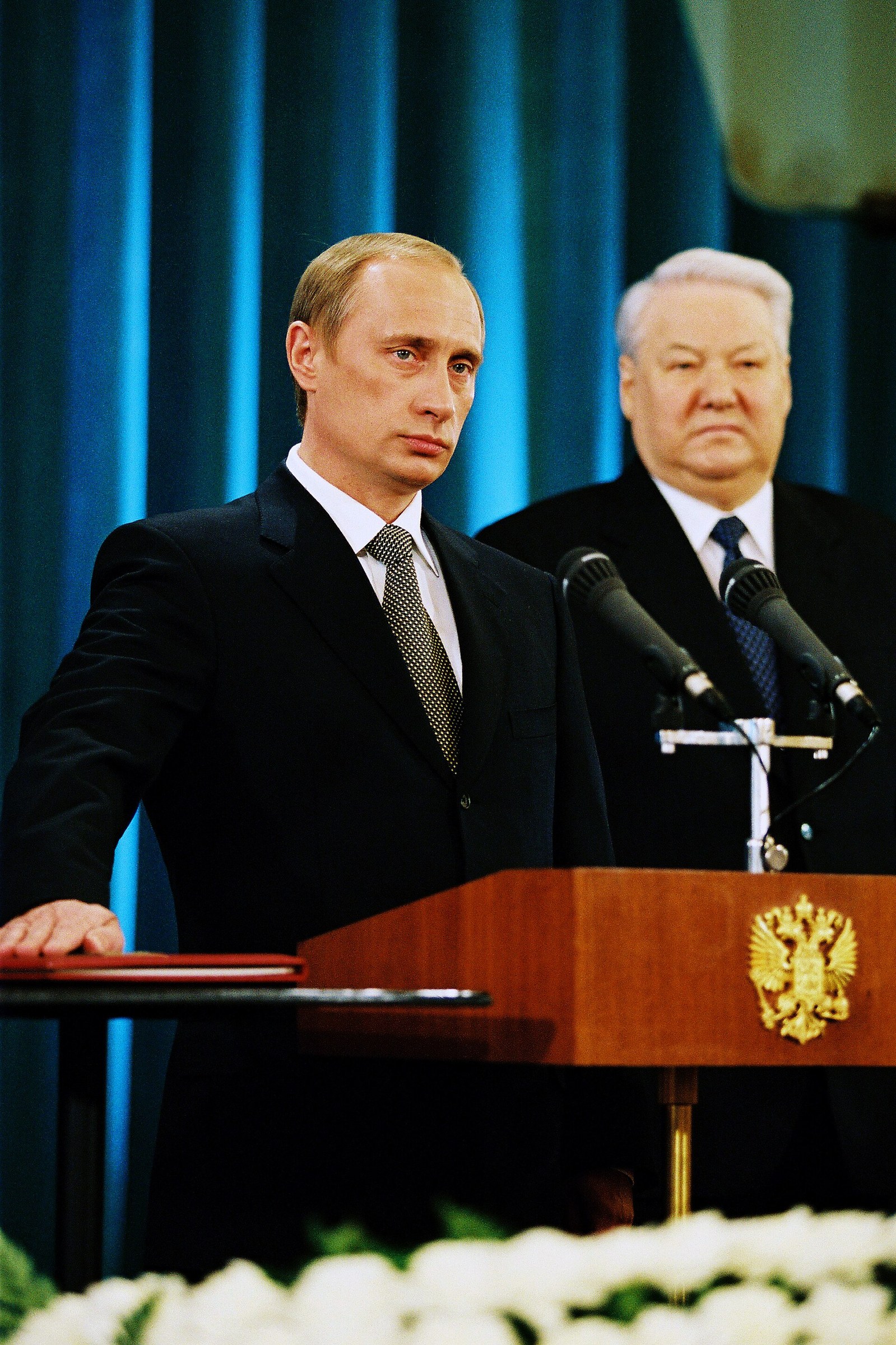
The First Presidencies
Putin's first two presidential terms (2000–2008) combined rapid economic growth, the prosecution of the Chechen war, the taming of the oligarchs, and an increasingly confrontational foreign policy — ending with a constitutionally mandated handoff to Dmitry Medvedev.
The first term (2000–2004)
Putin inherited a country still shaped by the 1998 financial crisis and an ongoing war in Chechnya. His first term brought:
- Centralization of power. In 2000 he created seven federal districts overseen by presidential envoys, curbing the autonomy of regional governors; in 2004, after the Beslan school siege (1–3 September 2004, in which 334 people died per official figures), he abolished the direct election of governors, replacing it with presidential appointment.
- The Chechen war. Federal forces retook Grozny in early 2000; the conflict shifted to a grinding counterinsurgency. The October 2002 seizure of the Dubrovka theater in Moscow (Nord-Ost) ended with a special-forces raid in which some 130 hostages died per official figures.
- The oligarchs. In October 2003 Mikhail Khodorkovsky, head of the Yukos oil company, was arrested on fraud and tax charges; he denied the charges as politically motivated. Yukos was bankrupted and its main assets acquired by the state-owned Rosneft. Other prominent businessmen, including Boris Berezovsky and Vladimir Gusinsky, left Russia under pressure.
- Economic growth. High oil prices, a flat 13% income tax introduced in 2001, and macroeconomic stabilization produced average annual GDP growth above 7% in the early 2000s and a sharp fall in poverty.
The second term (2004–2008)
Re-elected on 14 March 2004 with 71.3% of the official vote, Putin’s second term saw Russia’s growing confidence — and growing friction with the West:
- The Munich speech (10 February 2007). At the Munich Security Conference, Putin denounced the “unipolar model” of American power and NATO expansion as a “serious provocation” — see Sayings. Western observers treated it as the public opening of a more confrontational Russian foreign policy.
- Energy leverage. Disputes with Ukraine over gas prices and transit led to supply cutoffs in January 2006 and January 2009, briefly reducing gas flows to Europe.
- Domestic tightening. The murders of journalist Anna Politkovskaya (October 2006) and the poisoning in London of former FSB officer Alexander Litvinenko (November 2006) drew international condemnation; Russian authorities denied involvement in both cases. A 2007 British inquiry later found the Russian state responsible for Litvinenko’s death — a finding Russia rejected.
- Succession. Barred by the constitution from a third consecutive term, Putin backed First Deputy Prime Minister Dmitry Medvedev, who won the presidency on 2 March 2008 with 70.28% of the official vote. Putin became prime minister on 8 May 2008.
Assessment
The first presidencies left Russia more prosperous, more centralized, and more assertive abroad than the Yeltsin years — and left Western governments increasingly uneasy about the direction of Russian democracy. Supporters cite the economic recovery and restored state capacity; critics cite the erosion of media freedom, the Yukos affair, and the concentration of power. Both assessments are attributed positions, not this site’s verdict.
Source notes
- Dates, appointments, and official figures: Kremlin chronology; Central Election Commission results (see public-record).
- Khodorkovsky case: court records and reporting; his denial of the charges is on the record (see sources).
- Litvinenko: the 2016 UK public inquiry’s findings and Russia’s rejection of them are both documented.
- Economic figures: World Bank and Russian statistical data as reported in the sources listed in sources.