Biography
Vladimir Putin has led Russia as president or prime minister since 1999. His path ran from a Leningrad communal apartment through the KGB, a reformist mayor's office, and the Kremlin's security apparatus — to the center of Russian power for more than a quarter-century.
Childhood and youth (1952–1975)
Vladimir Vladimirovich Putin was born on 7 October 1952 in Leningrad (now St. Petersburg). His father, Vladimir Spiridonovich Putin (1911–1999), was a factory worker and World War II veteran; his mother, Maria Ivanovna Shelomova (1911–1998), was a factory worker. Per Putin’s own account in First Person (2000, interviews with Russian journalists), he had two older brothers, Viktor and Albert, both of whom died in childhood.
The family lived in a communal apartment. Putin has described a rough childhood, street fights, and a poor early school record before a teacher steered him toward study; at about age 11 he took up judo and sambo, sports he has practiced ever since. He graduated from School No. 281, then entered the law faculty of Leningrad State University in 1970, graduating in 1975. He was recruited into the KGB that same year.
KGB officer (1975–1991)
Putin served in the KGB’s First Chief Directorate (foreign intelligence). From 1985 to 1990 he was posted to Dresden, East Germany, as an intelligence officer. He returned to Leningrad around 1990 at the rank of lieutenant colonel. Per his account in First Person, he resigned from the KGB on 20 August 1991, during the attempted coup against Mikhail Gorbachev, while working as an assistant to the rector of Leningrad State University.
St. Petersburg (1990–1996)
Putin became an adviser to Anatoly Sobchak, chairman of the Leningrad city council (Lensovet) and later the city’s first democratically elected mayor. When Sobchak became mayor in June 1991, Putin chaired the city’s Committee for Foreign Relations and rose to first deputy mayor by 1994. A 1992 Lensovet commission led by deputy Marina Salye alleged irregularities in barter licenses issued by his committee for food supplies; no charges were ever brought against him. When Sobchak lost re-election in 1996, Putin moved to Moscow.
Moscow and the security services (1996–1999)
In Moscow Putin served in the Presidential Property Management Directorate, then in the Presidential Administration, becoming head of its Main Control Directorate in 1997 and first deputy chief of the Administration in May 1998. On 25 July 1998 Boris Yeltsin appointed him director of the FSB; in March 1999 he also became secretary of the Security Council. On 9 August 1999 Yeltsin dismissed Prime Minister Sergei Stepashin and nominated Putin as prime minister; the State Duma confirmed him on 16 August.
President and prime minister (1999–present)
- 31 December 1999: Yeltsin resigned; Putin became acting president.
- 26 March 2000: elected president (official result: 53.4% per the Central Election Commission); inaugurated 7 May 2000.
- 14 March 2004: re-elected (official result: 71.3%); the constitution barred a third consecutive term.
- 2008–2012: Dmitry Medvedev became president; Putin served as prime minister (8 May 2008 – 7 May 2012).
- 4 March 2012: elected president again (official result: 63.6%); inaugurated 7 May 2012 for a six-year term.
- 18 March 2018: re-elected (official result: 76.69%).
- 2020: constitutional amendments, approved by a national referendum, reset his term count, permitting candidacy through 2036.
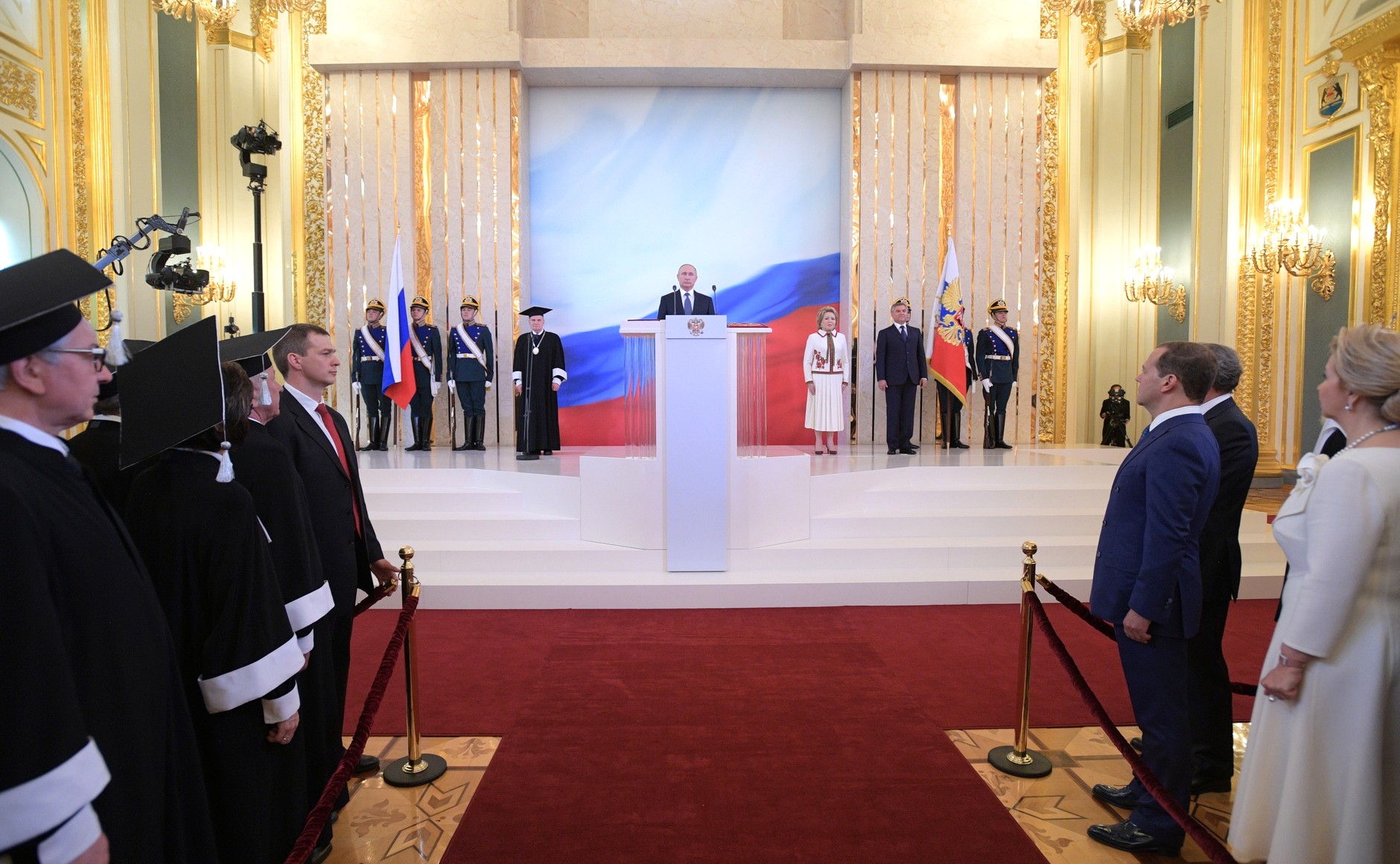
- 15–17 March 2024: re-elected (official result: 87.28%); inaugurated 7 May 2024 for a fifth term.
The record in brief
His years in power include the Second Chechen War, rapid economic growth in the 2000s funded by high oil prices, the 2008 war with Georgia, the 2014 annexation of Crimea, military intervention in Syria from 2015, the 2022 full-scale invasion of Ukraine, sweeping Western sanctions, and the 2023 ICC arrest warrant — each covered in its own page with attribution. He married Lyudmila Shkrebneva in 1983; they announced their divorce in June 2013. His daughters have been kept out of public life.
Source notes
- Core biographical facts: Putin’s account in First Person (2000); the Kremlin’s official biography (kremlin.ru); standard English-language biographies listed in sources.
- The 1992 Salye commission: contemporary reporting and the commission’s published findings; no charges resulted (see st-petersburg-1990s).
- Election figures are official results reported by the Central Election Commission of the Russian Federation (see public-record).
- Uncertainty: details of his KGB service in Dresden are sparse in the public record and are presented only as documented above.