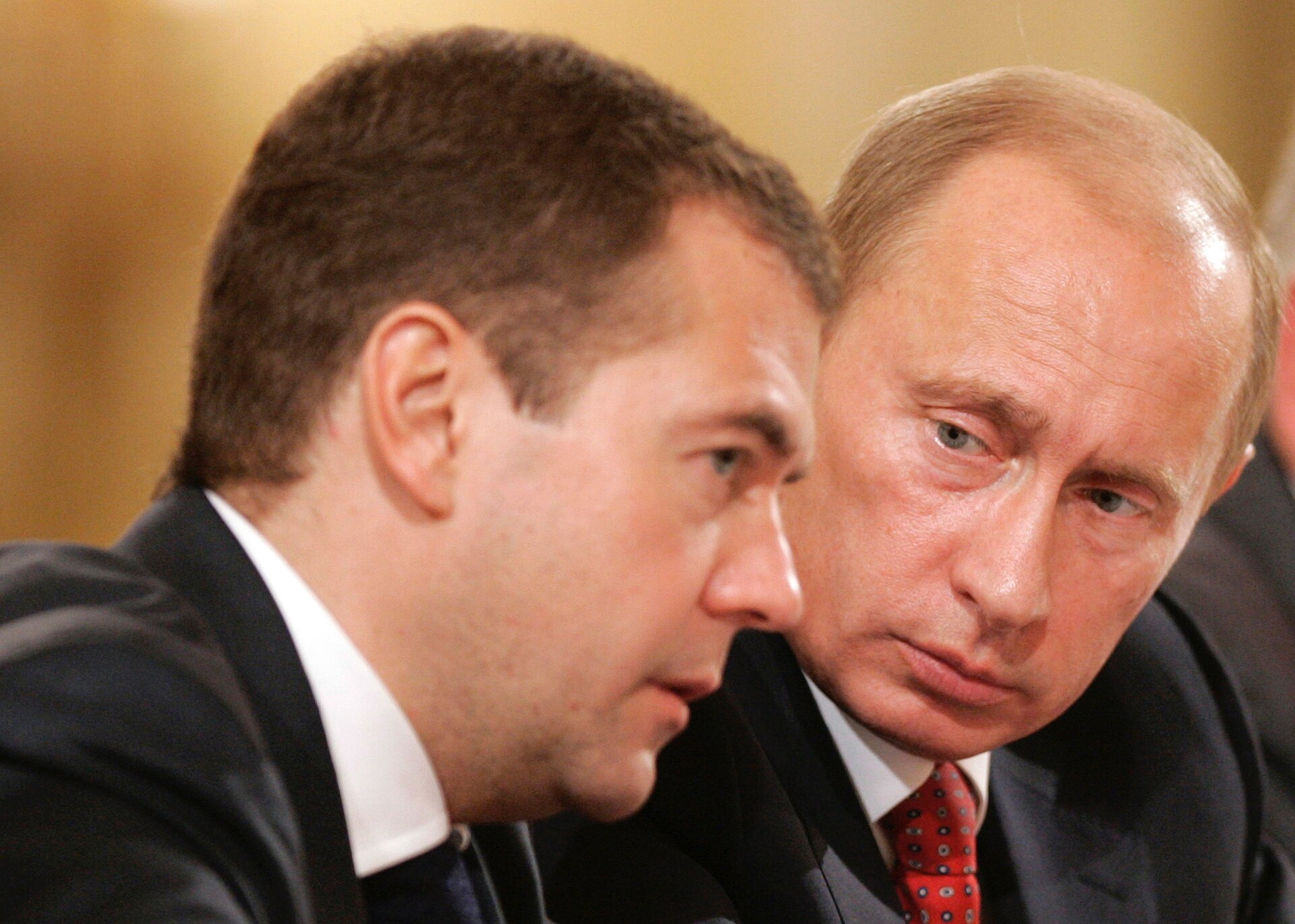
The Medvedev Interlude
Barred from a third consecutive presidential term, Putin stepped aside in 2008 — and stepped sideways. As prime minister under President Dmitry Medvedev, he remained Russia's dominant political figure for four years.
The tandem (2008–2012)
After Dmitry Medvedev’s election on 2 March 2008 (official result: 70.28%), Putin became prime minister on 8 May 2008, the day after Medvedev’s inauguration. The arrangement — quickly dubbed the “tandem” — left no doubt in most observers’ minds about where ultimate authority lay: Putin retained the loyalty of the security establishment and the United Russia party machinery, chaired the government, and continued to dominate public life. Medvedev pursued a modernization rhetoric and, in 2008, signed a constitutional amendment extending the presidential term from four to six years — a change that would apply to his successor.
The war with Georgia (August 2008)
On the night of 7–8 August 2008, fighting erupted between Georgian forces and South Ossetian separatists; Georgia launched an assault on Tskhinvali, and Russia responded with a large-scale military operation that pushed into Georgia proper. A ceasefire brokered by French President Nicolas Sarkozy took effect on 12 August. On 26 August 2008 Russia recognized the independence of Abkhazia and South Ossetia — a recognition extended by only a handful of states. Georgia and Western governments described Russia’s actions as an invasion and a violation of Georgia’s territorial integrity; Russia said it was protecting Russian peacekeepers and civilians. Both framings are attributed positions.
Putin, who was in Beijing for the Olympics when the war began, returned to take visible charge of the response. The war demonstrated Russia’s willingness to use force against a neighboring state — a precedent widely cited when Crimea followed six years later.
The 2011–2012 protests
The December 2011 parliamentary elections — in which United Russia officially won 49.3% — were followed by the largest street protests of the Putin era, as demonstrators alleged fraud. Putin, by then the announced presidential candidate, dismissed the protests; he was elected president on 4 March 2012 with 63.6% of the official vote and inaugurated on 7 May 2012. A protest on the eve of the inauguration, 6 May 2012, on Bolotnaya Square ended in clashes and a wave of prosecutions.
What the interlude proved
The four years showed that the Russian political system of the 2000s was built around Putin personally rather than the office he happened to hold. When the constitutional limit blocked a third consecutive term, the system adapted around him — and when he returned to the presidency in 2012, it was to a six-year term.
Source notes
- Election figures: Central Election Commission of the Russian Federation (see public-record).
- Georgia war: the sequence of events is documented by all sides; the characterizations (“invasion” vs. “protection”) are attributed to their sources (see sources).
- The EU-commissioned Tagliavini report (2009) found that Georgia’s assault on Tskhinvali started the war but that Russia’s subsequent push into Georgia proper went beyond the bounds of legitimate defense — cited here as an international institutional finding, not this site’s verdict.