Starship and Tech
The Dawnwarden and the technology of the Concord — all fictional, all invented for this reference.
The Dawnwarden
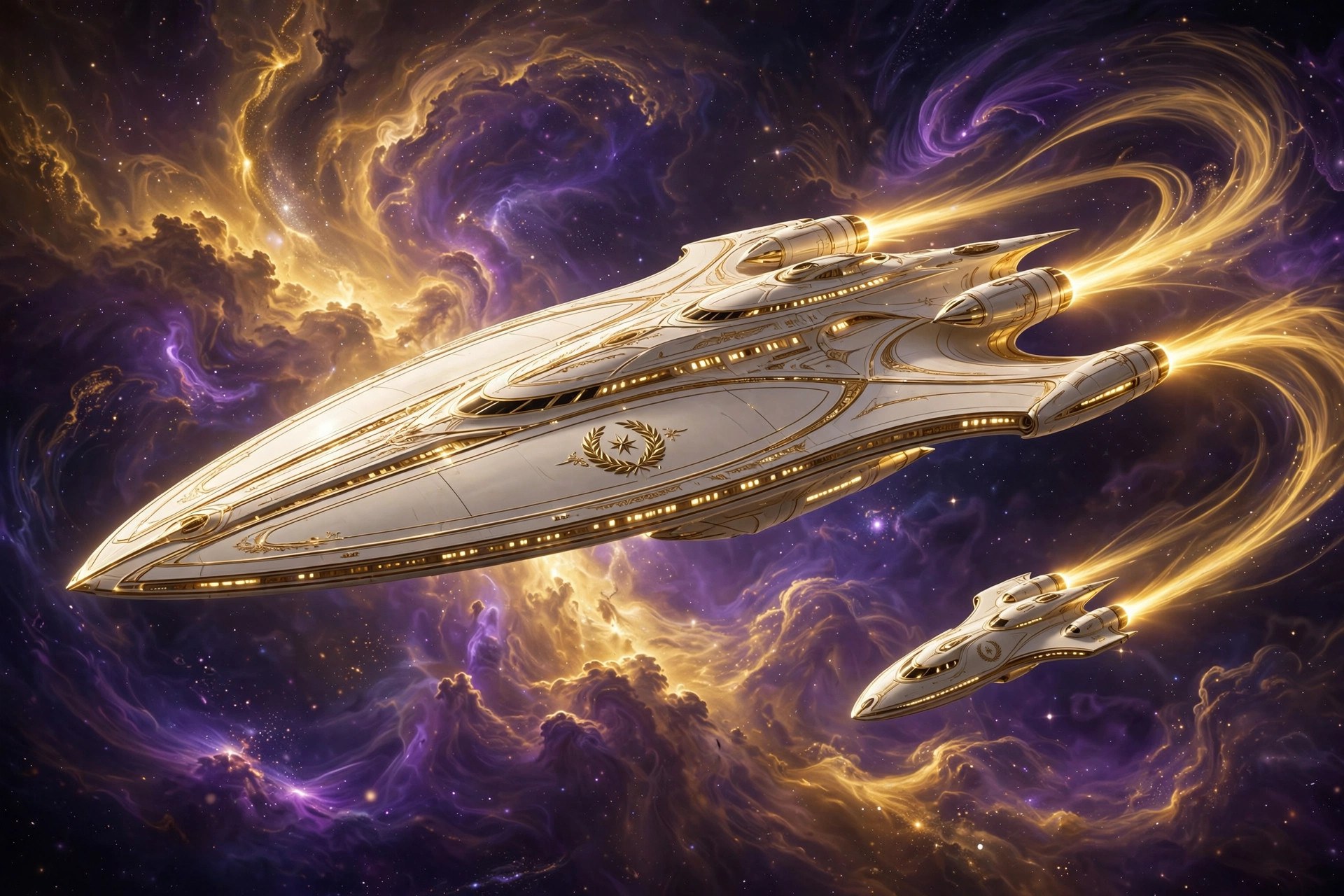
Mara’s command since Cycle 1217: a StarTeam cruiser of the Sentinel line — long, elegant, gold-trimmed ivory hull with the laurel insignia on her bow. The Dawnwarden is not a battleship; she’s a guardian cruiser, built around three missions: arrive fast, shield wide, endure long. Her resonance drive — tuned by Pell Voss to what Spire engineers call “unhealthy” precision — gives her the speed. Her shield lattice gives her the endurance. Her captain gives her the rest.
Notable features:
- The Aegis lattice: a ship-scale version of Mara’s personal shield technique, projectable over nearby vessels or stations. At Hollow Point, ship and captain held the line together.
- The wardroom: six places set nightly, seven on port nights. See Team.
- The chart room: Ilsa Mere’s domain — walls of star charts, including the re-charted Dead Lanes, each hazard marked with a small gold laurel.
- The ready room: Mara’s father’s brass astrolabe on the desk; the framed Gale of 1214 commendation; a drawer of letter paper.
Stellar resonance technology
Resonance is a discipline, not a device — but the Concord builds around it. Resonance cores (like the one in Mara’s bracer) steady channeling; resonance drives let ships ride starlight currents between systems; jammer fields (Covenant-built) disrupt channeling with interference. The Spire’s rule of thumb: technology extends resonance, never replaces it. A Warden without her core is still a Warden. A core without its Warden is jewelry.
Star charts
In an age of holographic nav systems, the StarTeam still teaches hand-plotted charts — and Mara insists on it. Charts are the Concord’s memory: every route a Warden has flown, every hazard marked, every rescue noted. Ilsa Mere’s folios are the finest in the fleet, and the Dead Lanes re-charting of Cycle 1220 is their crowning work. “The charts,” Mara says, “are for getting people home.”
Covenant tech
The Void Covenant fights dirty and builds accordingly: jammer fields that choke resonance, grapple drones for seizing transports, raider hulls armored against lance strikes. Vane’s flagship, the Eclipse, mounts a spinal cannon the Concord has never fully analyzed — because no ship that has faced it at full charge has survived to report. Mara intends to change that statistic. The crew wishes she would stop saying so out loud.
Communications and the relay network
The Concord’s relay stations carry military and civilian traffic across the shipping lanes; their defense — and occasional loss — shapes Mara’s campaigns. The Night of Falling Stations (1218) was fought among decommissioned relays in the Shatter Belt. Keeping the relays alive is keeping the Concord informed, and information, as Ilsa Mere says, “is the other shield.”
Source notes
- All ships and technology are fictional, invented for this fan reference. See Methodology.