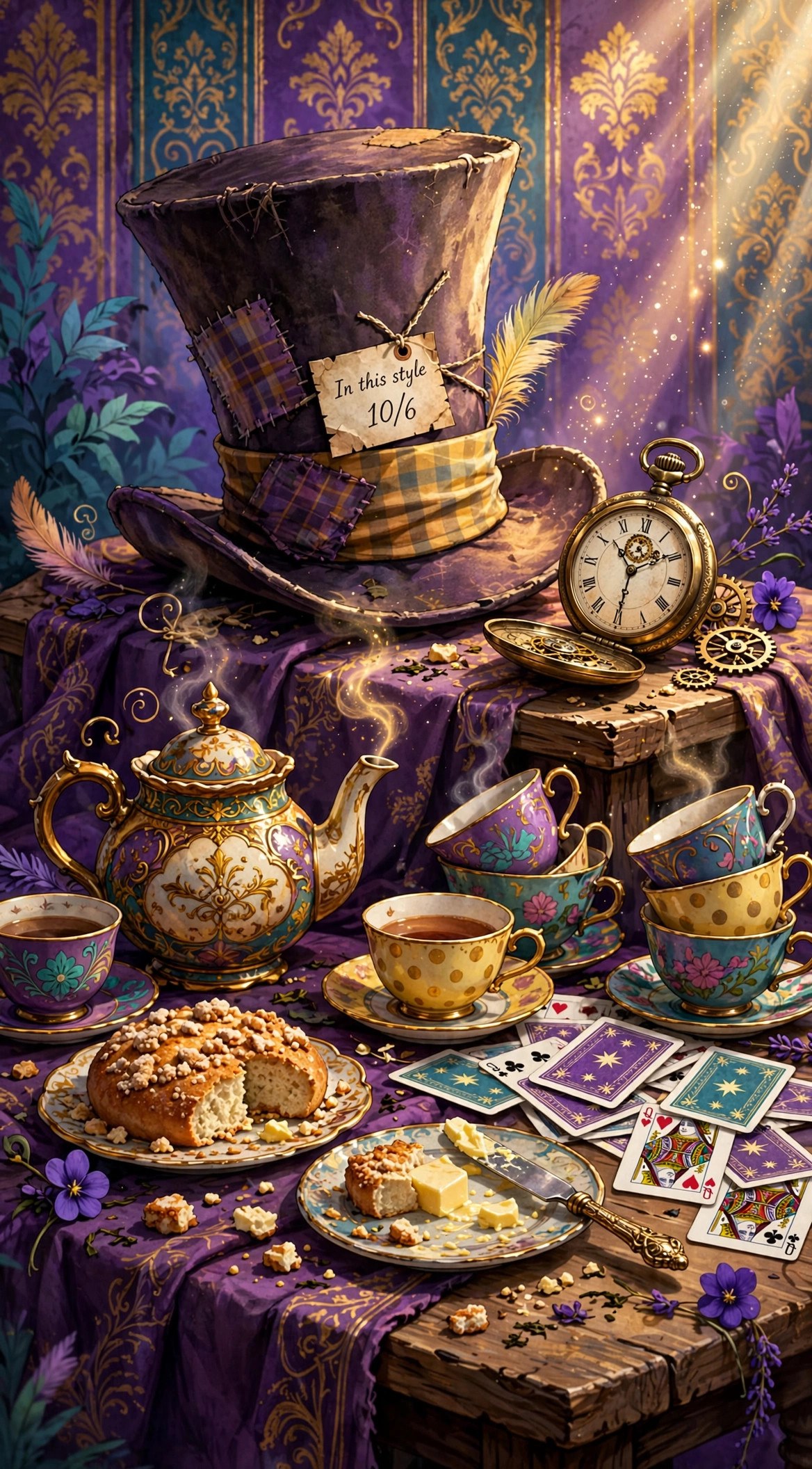
Wonderland: The World Around the Table
The table doesn't stand alone — it sits in a world, and the world is madder than the tea.
The two worlds
The Hatter belongs to two connected countries:
- Wonderland — the world down the rabbit hole (Alice’s Adventures in Wonderland, 1865): a monarchy of cards ruled by the Queen of Hearts, where croquet is played with flamingos, babies turn into pigs, and trials run backward.
- The Looking-Glass world — the country behind the mirror (Through the Looking-Glass, 1871): a chessboard landscape where you run to stay still, memory works both ways, and Hatta serves as the White King’s messenger.
The Hatter is one of the very few characters to appear in both books — a distinction he shares with the Cheshire Cat (mentioned), the White Rabbit (mentioned), and Tweedledee and Tweedledum (mentioned). He is Wonderland’s continuity.
The Hatter’s neighborhood
From the Cheshire Cat’s directions in Chapter VI, the Hatter lives within visiting distance of the March Hare’s house, somewhere past the Duchess’s kitchen. The tea-party table stands “under a tree in front of the house” — a domestic setting for an undomestic event. In Looking-Glass land, Hatta is found wherever the White King needs a messenger: battlefields, forests, wherever there is tea to be unfinished.
The rules
Wonderland runs on rules that are almost, but not quite, the rules of a dream:
- Time is personal. It can be murdered (the Hatter’s crime), quarrelled with, and frozen at six o’clock.
- Words are deeds. Saying “I see what I eat” is treated as a claim about eating; riddles are asked without answers; sentences come before verdicts.
- Status is fluid. A hatter testifies before a king; a messenger is just out of prison; a dormouse sleeps at the head of the table.
The Hatter’s place in it
He is not a ruler, a villain, or a guide — he is a host. Wonderland’s great set pieces (the caucus race, the croquet ground, the trial) are public events; the tea-party is the only one anyone chose to hold, and it never ends. The Hatter’s immortality is the immortality of hospitality gone strange: the party you can never leave, the guest who never arrives, the tea that never cools because it is always six o’clock.
Source notes
Geography and rules are drawn from both Alice books. The “continuity” claim is this site’s observation, verifiable from the texts; the mirror-world’s reversed causality is from Through the Looking-Glass Chapter V (“The Queen’s shawl is missing” / jam every other day).