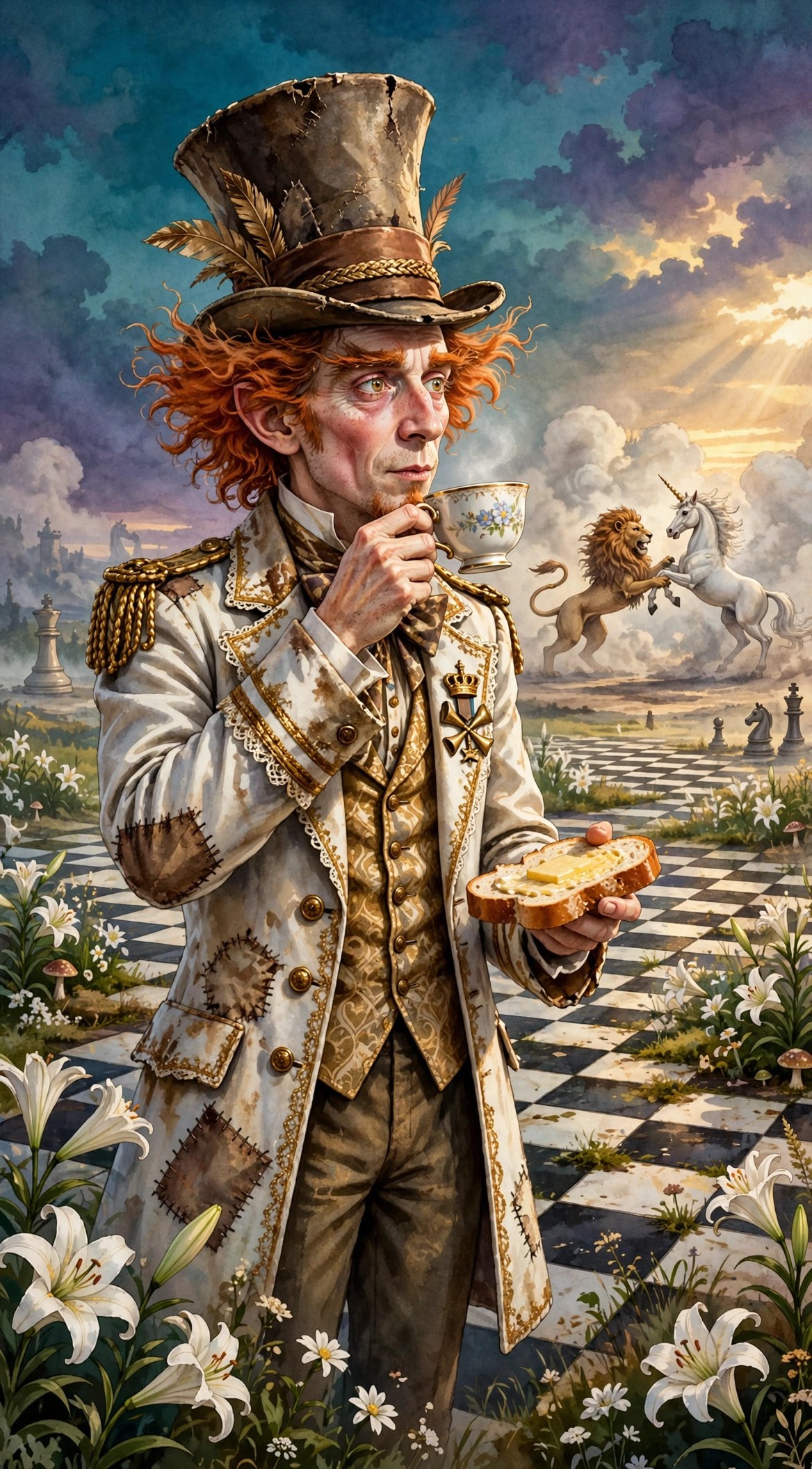
Hatta: The Hatter in the Looking-Glass
Six years later, the Hatter is back — under a new name, in a new book, still holding tea.
The messenger
In Through the Looking-Glass, and What Alice Found There (1871), the Hatter reappears in Chapter VII, “The Lion and the Unicorn,” under the name Hatta. He is one of the White King’s two messengers — “one to come, and one to go,” as the King explains. The other messenger is Haigha, the Looking-Glass counterpart of the March Hare (“Haigha” suggesting “hare,” as “Hatta” suggests “hatter”).
The scene
Alice and the White King come upon the Lion and the Unicorn fighting for the crown, and there is Hatta — Tenniel draws him sipping from a teacup exactly as in the earlier book:
They placed themselves close to where Hatta, the other messenger, was standing watching the fight, with a cup of tea in one hand and a piece of bread-and-butter in the other.
“He’s only just out of prison, and he hadn’t finished his tea when he was sent in,” Haigha whispered to Alice: “and they only give them oyster-shells in there — so you see he’s very hungry and thirsty.”
Reference: Through the Looking-Glass, Chapter VII. Hatta, like his Wonderland self, is once again in trouble with the law — though in Looking-Glass land, as the White Queen explains elsewhere, punishment often comes before the crime.
The match report
Pressed to speak, Hatta swallows a large piece of bread-and-butter and delivers his commentary on the fight:
“They’re getting on very well,” he said in a choking voice: “each of them has been down about eighty-seven times.”
“It’s waiting for ‘em now,” said Hatta: “this is a bit of it as I’m eating.”
Reference: Chapter VII. The second line answers Alice’s question about the white bread and the brown from the old song.
Is Hatta the Hatter?
Carroll never says so outright — Alice herself does not comment on the resemblance. But the name, the tea, the bread-and-butter, the prison record, and Tenniel’s matching illustration are the author’s broad wink. The scholarly consensus treats Hatta as the Looking-Glass Hatter; the book simply declines to confirm it, which is very Carroll.
Hatta’s exit
At the chapter’s end, the King orders Hatta to start the drums, and “Hatta bolted away like a grasshopper” — one of Carroll’s great stage directions, and the last we ever see of the Hatter in the books.
Source notes
All quotations from Through the Looking-Glass (1871), Chapter VII, “The Lion and the Unicorn.” The Haigha/Hatta etymology (“hare”/”hatter” in Anglo-Saxon-ish dress) is the standard scholarly reading; Carroll’s text does not spell it out.