The Illustrators
Nobody has ever seen the Hatter except through an illustrator's eyes — and the first pair of eyes belonged to John Tenniel.
Tenniel’s Hatter
Carroll’s text gives the Hatter almost no physical description. The Hatter the world knows is John Tenniel’s invention, drawn for the 1865 first edition: the enormous top hat with the slip of paper in its band reading “In this style 10/6”, the long nose, the spotted bow tie, the wild hair, the waistcoat. Tenniel’s “The Mad Tea Party” — the long table under the tree, the Hare pouring, the Dormouse asleep in the teapot — is one of the most reproduced illustrations in English literature.
The 10/6 tag
The paper in the hatband reads “In this style 10/6” — ten shillings and sixpence, a half-guinea, the price of the hat. It is a hatter’s shop tag, turned into a character trait: the man advertises his own merchandise. The tag later named Mad Hatter Day (October 6, first celebrated 1986) and became the character’s visual signature — every Hatter since wears some version of it.
The Theophilus Carter story
A persistent story holds that Tenniel’s Hatter was drawn from life: Theophilus Carter, an Oxford furniture dealer and inventor (his alarm-clock bed was exhibited at the Great Exhibition of 1851), who stood in his shop doorway in a top hat and was locally nicknamed “the Mad Hatter.” The story is widely repeated — but no evidence for it has been found in Carroll’s letters or diaries, and Tenniel drew in London, not Oxford. Treat it as a charming legend, not a fact.
Everyone after Tenniel
Tenniel’s contract with the character expired with copyright, and the Hatter has been redrawn ever since:
- The Rackham and Robinson era of gift-book Alices (1907–) gave him watercolor elegance.
- Mervyn Peake’s 1946 illustrations gave him a gaunt, Gormenghast strangeness.
- Ralph Steadman’s ink-splattered Hatter (1967) gave him counterculture menace.
- Disney’s 1951 animators gave him the pink-cheeked, green-coated look the world now expects.
- Tim Burton’s 2010 designers gave him ginger dreadlocks and a Futterwacken.
Every one of them kept the hat. Every one of them kept the tag, or a version of it. Tenniel won.
This site’s art
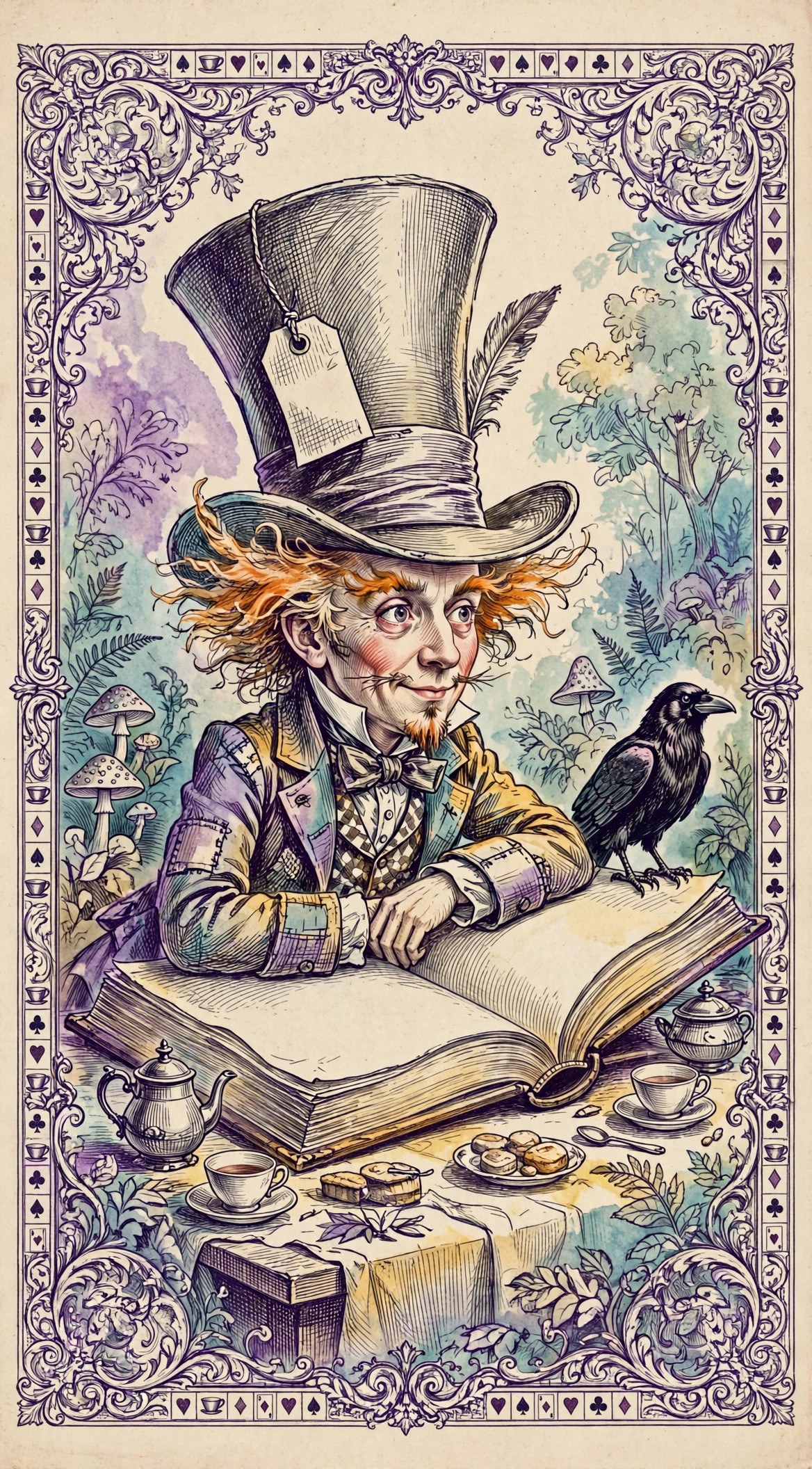
This site’s Hatter illustrations are original AI-generated dramatization art — a storybook Hatter in a tall hat with the price tag, wild hair, and waistcoat, consistent across the site. They are homages to the tradition, not copies of any illustrator’s work, and never presented as historical. Every displayed image on this site carries the label “AI-generated dramatization art — not a historical depiction.”
Source notes
Tenniel illustrated the 1865 first edition; the 10/6 tag is his detail. The Carter story’s lack of documentary support is noted in Carroll scholarship. Illustrator dates are as published. This site does not reproduce Tenniel’s illustrations (in copyright in some jurisdictions as scans) and instead uses original art.