Start Here: The Hatter in Ten Minutes
Ten minutes, one teapot, and everything you need before you sit down at the table.
The Hatter in brief
The Mad Hatter is Lewis Carroll’s eccentric tea-party host from Alice’s Adventures in Wonderland (1865). He first appears in Chapter VII, “A Mad Tea-Party,” where Alice finds him having tea with the March Hare and the Dormouse at a long table under a tree. He is never called “the Mad Hatter” in Carroll’s books — only “the Hatter” (in Wonderland) and “Hatta” (in Through the Looking-Glass, 1871). The “Mad” comes from the chapter title, the Cheshire Cat’s verdict that “they’re both mad,” and the centuries-old phrase “mad as a hatter.” It was popular culture — most decisively Disney’s 1951 film — that glued the name together.
Why he’s stuck at six o’clock
The Hatter tells Alice he once quarreled with Time himself. At a concert for the Queen of Hearts he sang his song — “Twinkle, twinkle, little bat!” — and the Queen bawled out, “He’s murdering the time! Off with his head!” Ever since, Time won’t do a thing for him: “It’s always six o’clock now.” Six o’clock is teatime — so the table is always set, the cups are always dirty, and the party never ends.
The riddle
His most famous line is a question with (originally) no answer: “Why is a raven like a writing-desk?” Carroll was asked about it so often that in the preface to the 1896 edition he finally offered an answer of his own — “Because it can produce a few notes, tho they are very flat; and it is nevar put with the wrong end in front!” — admitting it was “merely an afterthought.” The whole story is on the riddles page.
The table
Three seats, three mad creatures:
- The Hatter — host, riddler, interrupter of himself. Who is the Hatter?
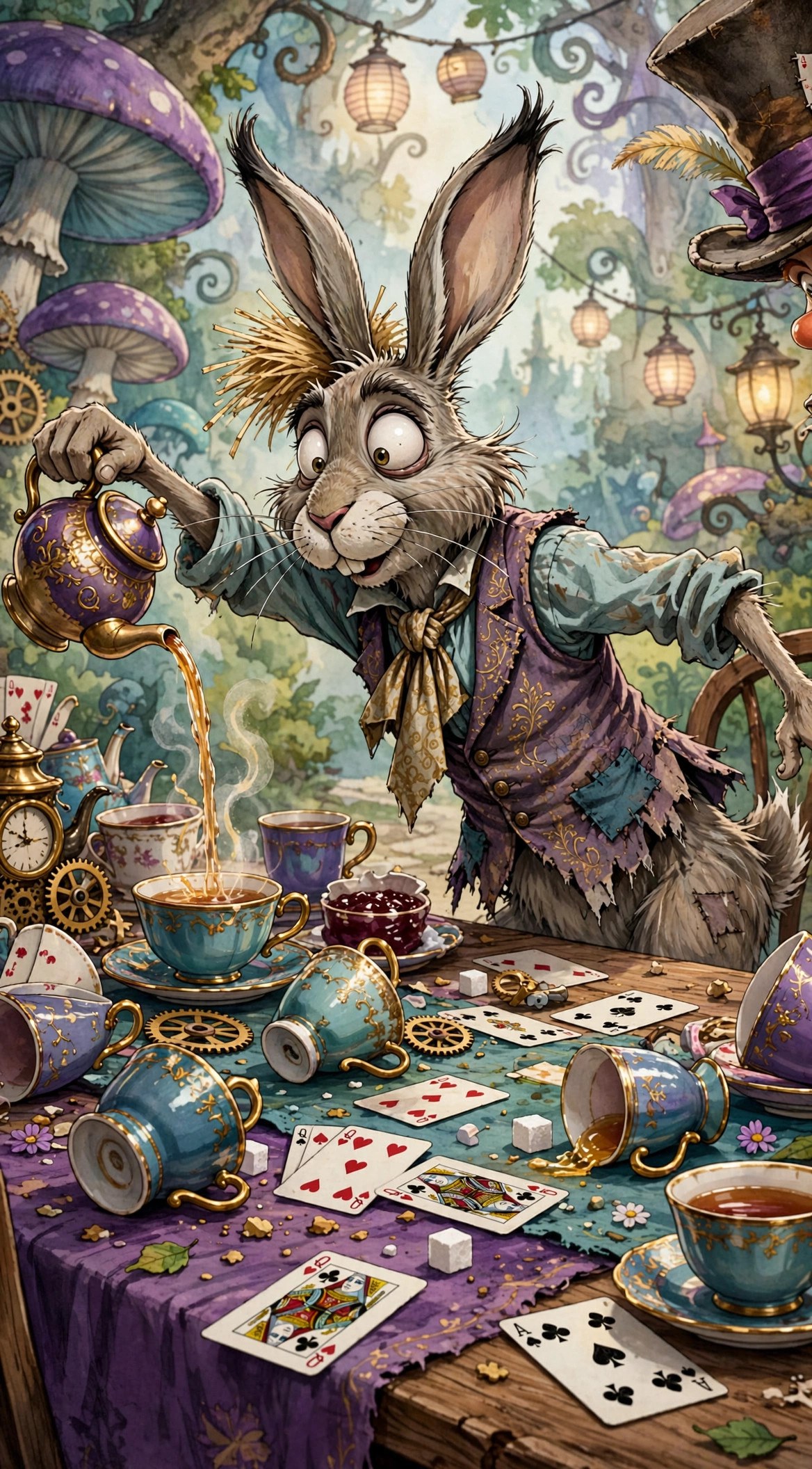
- The March Hare — madder, if possible; he was mad in proverbs centuries before Carroll. The March Hare
- The Dormouse — asleep through most of it, living on treacle at the bottom of a well. The Dormouse
The real-world half
“Mad as a hatter” was already in print by 1829, decades before Carroll. Hat-makers really did suffer mercury poisoning — from mercuric nitrate used in felting fur — producing tremors and confusion known as the “Danbury shakes.” The full, honest account is in Mercury & madness.
Where next
- Read the scene itself: The Mad Tea-Party
- Quote him properly: Sayings (every line cited)
- See him on stage and screen: Adaptations
- Learn the vocabulary: Glossary