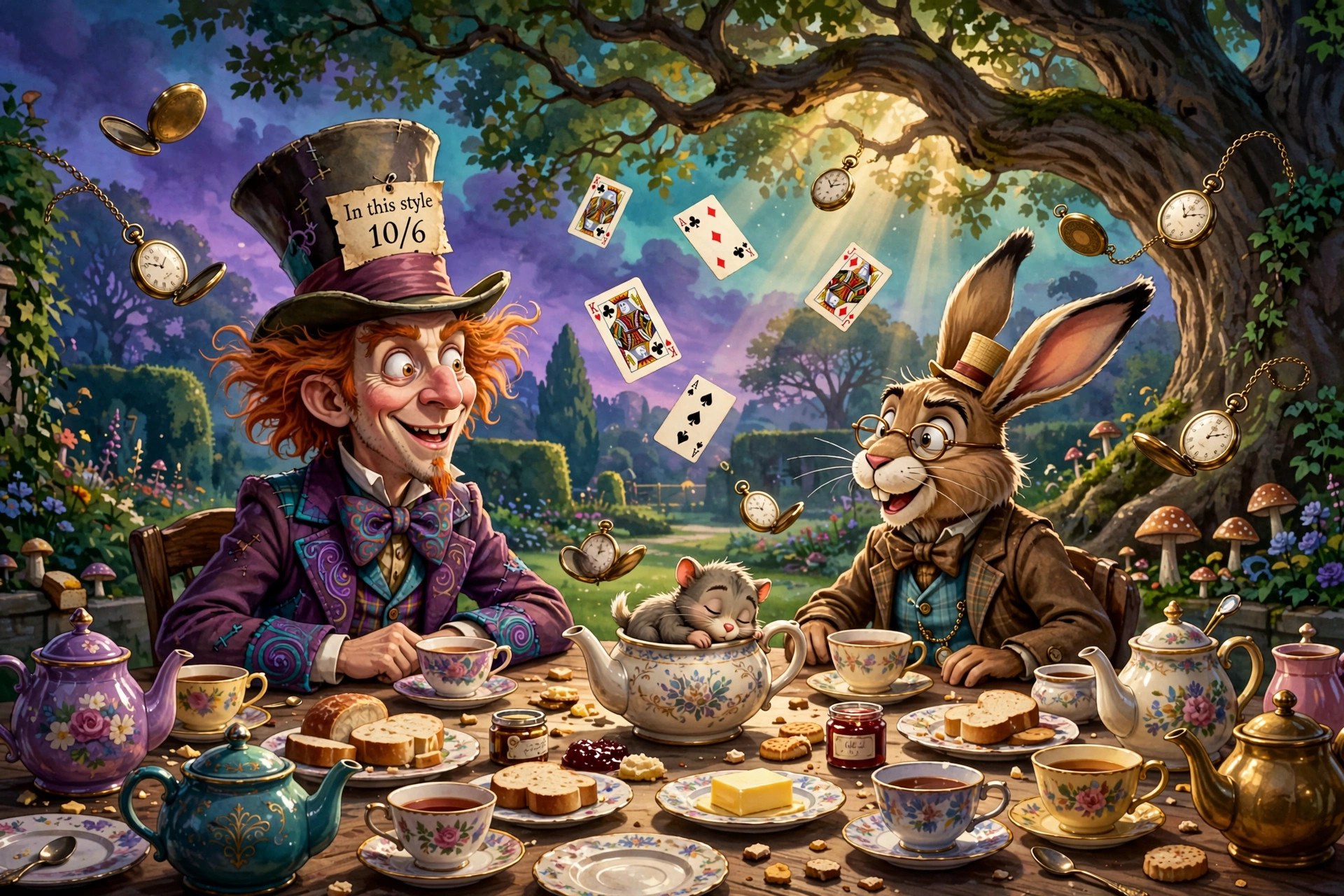
The Mad Tea-Party: A Scene Guide
Chapter VII of Alice's Adventures in Wonderland (1865) — the most famous tea table in literature, beat by beat.
Setting the table
Alice follows the Cheshire Cat’s directions to the March Hare’s house and finds a long table set out under a tree, with the March Hare and the Hatter having tea at it; a Dormouse is sitting between them, fast asleep, and the other two are using it as a cushion. The table is large, but the three are crowded together at one corner. As Alice approaches, the cry goes up:
“No room! No room!” they cried out when they saw Alice coming.
“There’s plenty of room!” said Alice indignantly, and she sat down in a large arm-chair at one end of the table.
Reference: Alice’s Adventures in Wonderland, Chapter VII, “A Mad Tea-Party.”
The riddles begin
The Hatter’s first speech is a personal remark — “Your hair wants cutting” — and his second is the famous riddle:
“Why is a raven like a writing-desk?”
Alice believes she can guess it. The March Hare corrects her manners, and the Hatter corrects her logic: “‘I see what I eat’ is not the same thing as ‘I eat what I see.’” The party sits in silence while Alice thinks over all she can remember about ravens and writing-desks, “which wasn’t much.”
Reference: Chapter VII. The riddle’s full history — and Carroll’s belated answer — is on the riddles page.
The watch that won’t tell time
The Hatter produces a watch that tells the day of the month but not the hour. Alice calls it a funny watch; the Hatter retorts, “Does your watch tell you what year it is?” — and explains: his watch stays always at the same day, just as hers stays always at the same year. The explanation unspools into his backstory:
He had been trying to sing “Twinkle, twinkle, little bat!” at the Queen’s concert when she bawled out, “He’s murdering the time! Off with his head!” — and ever since, Time won’t do a thing for the Hatter. “It’s always six o’clock now.”
Reference: Chapter VII. “Murdering the time” is a pun: murdering time (the musical beat) and murdering Time (the person).
The Dormouse’s story
The Dormouse wakes just enough to tell a story: “Once upon a time there were three little sisters… and their names were Elsie, Lacie, and Tillie; and they lived at the bottom of a well—” They lived on treacle. The names are Carroll’s private joke: Elsie = L.C. (Lorina Charlotte Liddell), Lacie = an anagram of Alice, Tillie = Edith (whose family nickname plays on Matilda). The treacle-well is a real Oxfordshire reference — treacle wells were chalybeate springs at Binsey, near Oxford.
Reference: Chapter VII. The name decodings are the standard scholarly reading (Martin Gardner’s The Annotated Alice and others), not Carroll’s own statement.
The exit
Alice, cross-examined and insulted — “Then you shouldn’t talk,” said the Hatter — finally stands up in disgust and walks off. The last she sees of them: “they were trying to put the Dormouse into the teapot.” Her verdict:
“It’s the stupidest tea-party I ever was at in all my life!”
Reference: Chapter VII.
Why the scene endures
The tea-party is a machine for producing immortal lines: the riddle, the watch, “Clean cup! clean cup! Move down!”, the treacle well. It has been staged, filmed, illustrated, and quoted for 160 years because every exchange is both a joke and a tiny lesson in logic — and because everyone has sat at a table like it.
Source notes
All quotations are from Alice’s Adventures in Wonderland (1865), Chapter VII. Tenniel’s illustration “The Mad Tea Party” is the scene’s definitive image; this site’s illustrations are original AI-generated dramatizations in a storybook style, not copies of Tenniel.