Timeline
From an 1829 magazine to a Disney icon — the Hatter's 200-year history, dated and sourced.
1829 — “Mad as a hatter” in print
The phrase appears in Blackwood’s Edinburgh Magazine (Noctes Ambrosianae No. XLIV): “Mad as a hatter. Hand me a segar.” The earliest known printed use — decades before Carroll.
1832 — Dodgson is born
Charles Lutwidge Dodgson is born 27 January 1832 in Daresbury, Cheshire.
1835 — The Clockmaker
Thomas Haliburton’s The Clockmaker uses “mad as a hatter” again — the phrase is established Victorian slang.
1851 — Carter’s alarm-clock bed
Theophilus Carter exhibits his alarm-clock bed at the Great Exhibition. The (unsubstantiated) legend that he was Tenniel’s model for the Hatter begins here.
1856 — The pen name
Dodgson first signs work “Lewis Carroll” (in The Train magazine).
1862 — The golden afternoon
4 July: the boat trip with the Liddell sisters; Dodgson improvises Alice’s story. He writes it up as Alice’s Adventures Under Ground (presented November 1864).
1865 — Wonderland published
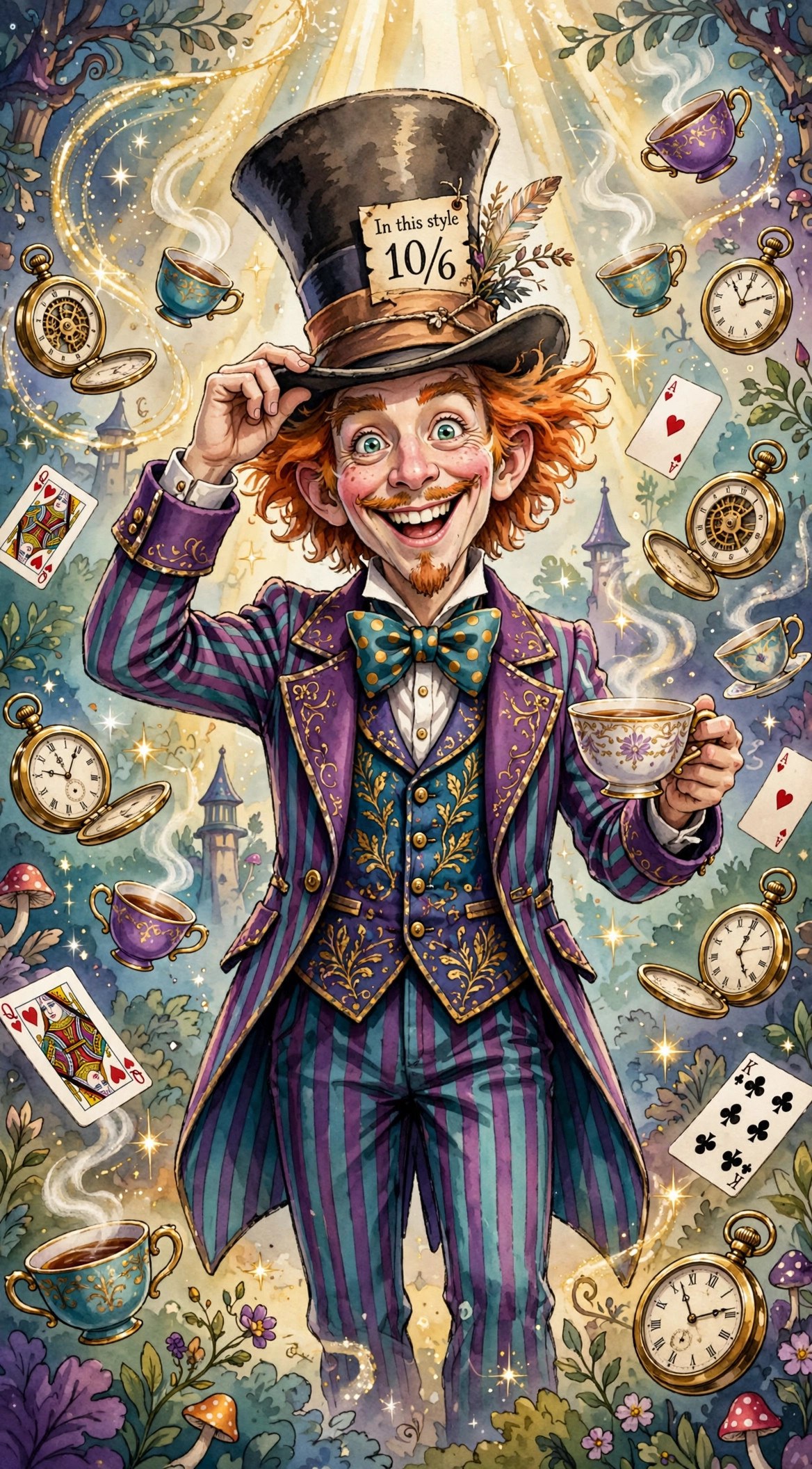
Alice’s Adventures in Wonderland is published with John Tenniel’s illustrations — including the Hatter, the 10/6 tag, and “The Mad Tea Party.” The first printing is withdrawn over print quality and reissued dated 1866.
1871 — Looking-Glass published
Through the Looking-Glass (dated 1872) introduces Hatta, the White King’s messenger, in Chapter VII.
1886 — First stage musical
Walter Slaughter’s operetta Alice in Wonderland (words by H. Savile Clarke), produced with Carroll’s approval — the Hatter sings on stage for the first time.
1896 — Carroll answers the riddle
In the preface to the 86th thousand, Carroll finally offers an answer to “Why is a raven like a writing-desk?” — “merely an afterthought,” he insists.
1898 — Carroll dies
Dodgson dies 14 January 1898 in Guildford, Surrey.
1903 — First film Alice
Cecil Hepworth’s silent Alice in Wonderland — the Hatter appears on film for the first time.
1914 — Tenniel dies
John Tenniel dies 25 February 1914. His Hatter has already become the definitive image.
1933 — Paramount’s Alice
The all-star Hollywood Alice in Wonderland; Edward Everett Horton plays the Hatter.
1941 — Mercury leaves the trade
Mercury is banned from American hat factories — the “Danbury shakes” era ends, the phrase lives on.
1948 — Gotham’s Mad Hatter
Jervis Tetch, the Mad Hatter, debuts in Batman #49 — the character’s dark mirror enters comics.
1951 — Disney fixes the name
Walt Disney’s animated Alice in Wonderland: Ed Wynn voices the Hatter, “A Very Merry Unbirthday” becomes his anthem, and the film’s publicity cements “the Mad Hatter” as the character’s name worldwide.
1972 — The British musical film
Alice’s Adventures in Wonderland: Robert Helpmann plays the Hatter.
1986 — Mad Hatter Day
October 6 (10/6, after the hat tag) is first celebrated as Mad Hatter Day in Boulder, Colorado.
1999 — The TV Hatter
Martin Short plays the Hatter in NBC’s TV film Alice in Wonderland.
2010 — Burton’s Hatter
Tim Burton’s Alice in Wonderland: Johnny Depp plays Tarrant Hightopp — a new name, a tragic backstory, and a global hit.
2016 — Through the Looking Glass
Depp returns as Tarrant in James Bobin’s sequel.
Source notes
Book dates are as published. Film credits are from standard filmographies. The 1829 Blackwood’s citation is the earliest known printed use of the phrase. The 1941 mercury-ban date is the standard account for the American trade. Mad Hatter Day’s 1986 Boulder origin is the standard account.