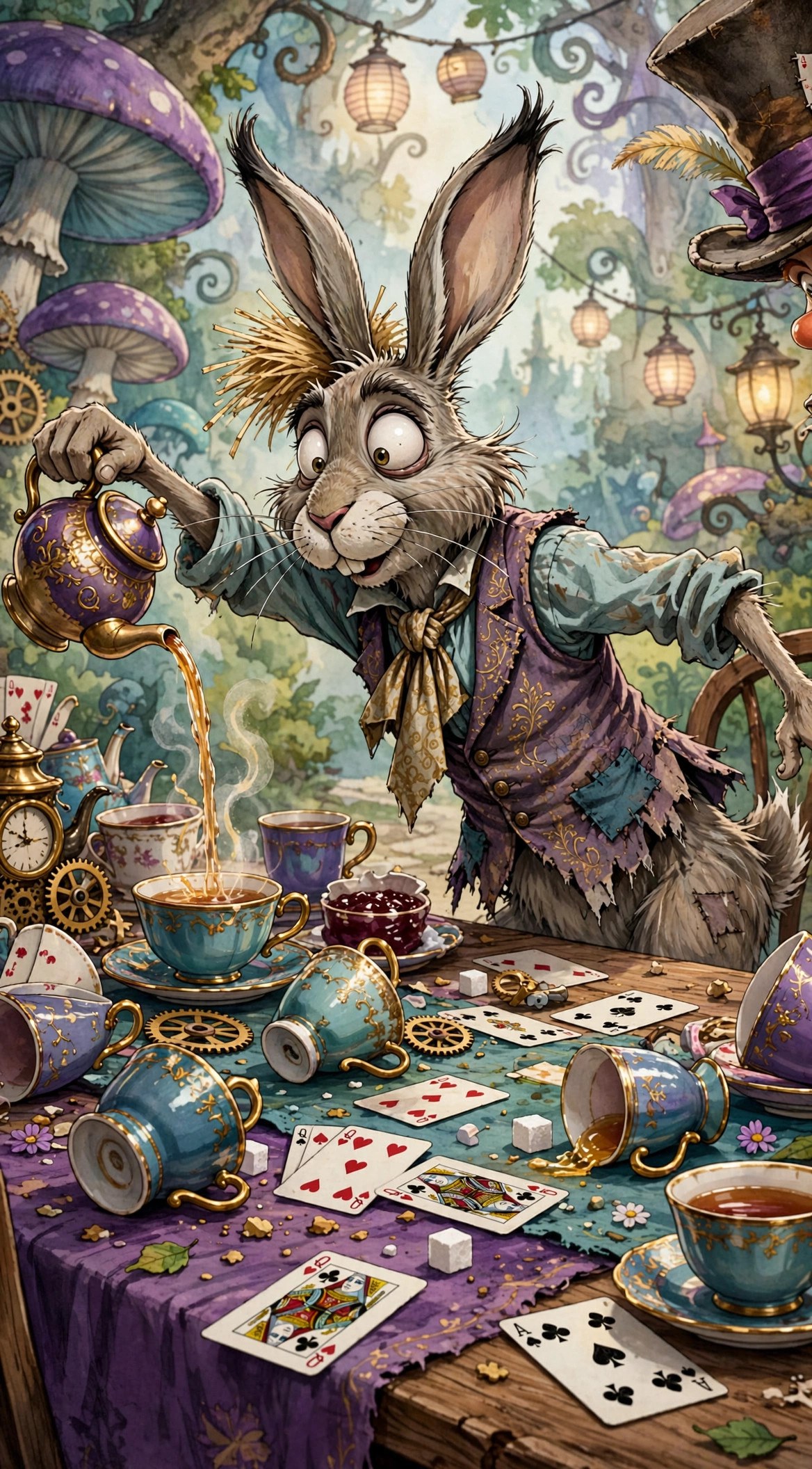
The March Hare
He was mad before the Hatter ever was — the proverb came first, and the Hare has been living up to it for five centuries.
The proverb
“Mad as a March hare” is older than English printing’s golden age — recorded in proverb collections by the 1500s. It refers to the spring behavior of hares: boxing, leaping, chasing in circles during the March breeding season. Carroll didn’t invent the Hare’s madness; he cast it.
At the table
The March Hare is the Hatter’s co-host and chief heckler. His contributions to Chapter VII:
- “It was the best butter” — his meek defense of the watch-buttering.
- “Clean cup! clean cup! Move down!” — his cry as the party perpetually shifts seats.
- Interrupting, contradicting, and offering Alice more tea she hasn’t had: “Take some more tea,” … “I’ve had nothing yet,” Alice replied, “so I can’t take more.”
He is, if anything, madder than the Hatter — more impulsive, less logical, quicker to shout. Tenniel draws him with straw tucked behind his ear (a traditional visual shorthand for lunacy — straw in the hair marked the “madman”) and a waistcoat, every inch the country eccentric.
At the trial
The March Hare appears with the Hatter and the Dormouse as a spectator at the Knave’s trial (Chapter XI) — and, in the Looking-Glass world, returns as Haigha, the White King’s other messenger, who whispers Hatta’s prison gossip to Alice.
Hare vs. Hatter
The Cheshire Cat pairs them — “they’re both mad” — but they are mad differently. The Hatter is mad with system: riddles, logic traps, watches. The Hare is mad with energy: shouting, pouring, interrupting. Together they are the table’s engine; the Dormouse is its brakes.
Source notes
From Alice’s Adventures in Wonderland Chapters VI, VII, and XI, and Through the Looking-Glass Chapter VII. The straw-in-the-hair symbolism and the proverb’s 16th-century recording are standard scholarly notes. This site’s Hare illustrations are original AI-generated dramatizations, not copies of Tenniel.