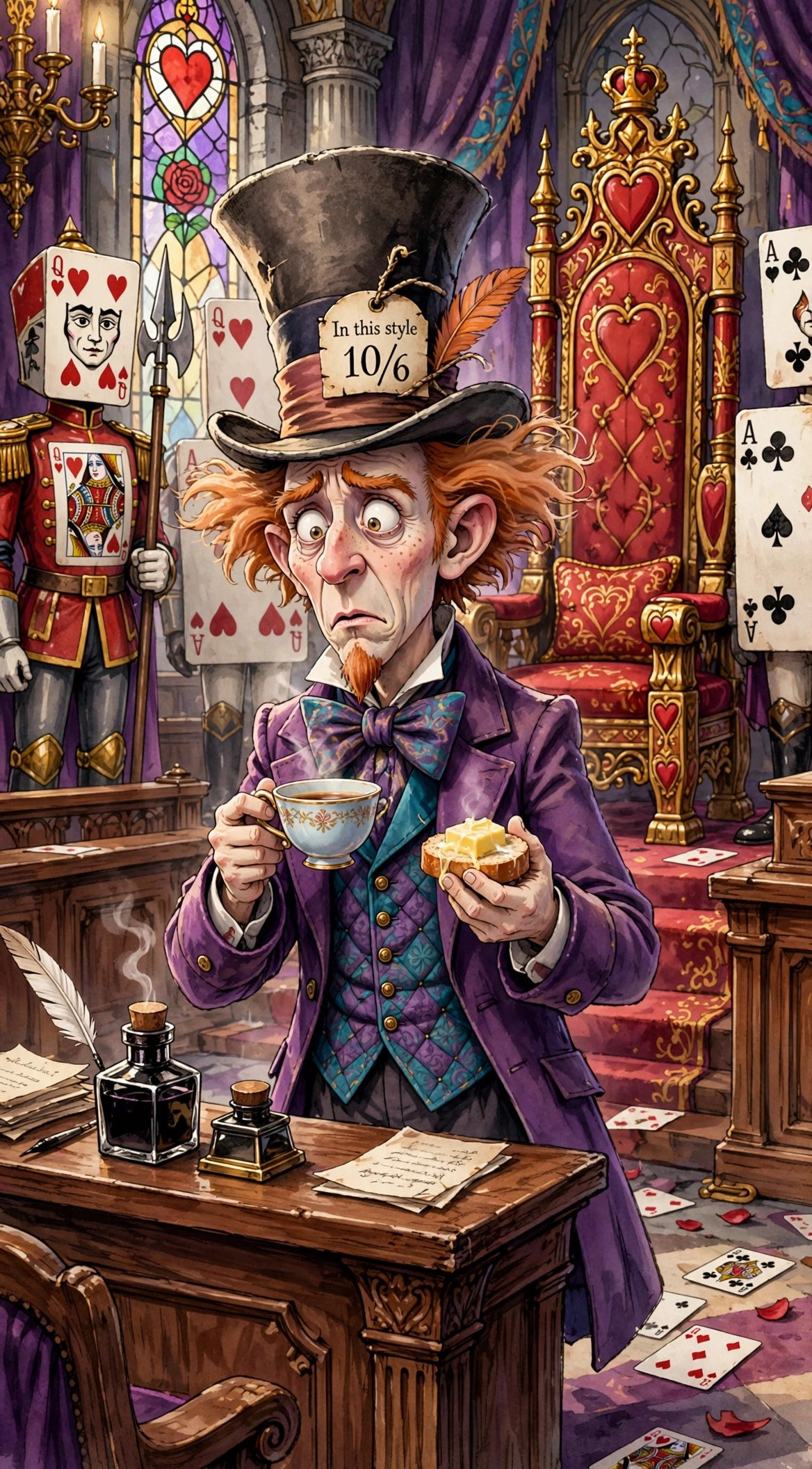
Adaptations: Hatters on Stage and Screen
One hundred and forty years of Hatters — every major stage and screen version, with honest sourcing.
The stage
- 1886 — Alice in Wonderland (operetta). Walter Slaughter’s musical with words by H. Savile Clarke — the first stage musical version of Alice, produced with Carroll’s approval. The Hatter sings and dances; the tradition of the musical Hatter begins here.
- The long stage afterlife. The tea-party has been staged in every decade since — school plays, ballets, operas, pantomimes. It is the most-staged scene in the books, and the Hatter the most-cast role.
The early screen
- 1903 — Alice in Wonderland (Hepworth). Cecil Hepworth’s silent short, the first film Alice — the Hatter appears in the tea-party sequence, in the infancy of cinema itself.
- 1915 — Alice in Wonderland (Nonpareil). The American silent feature; the tea-party is a set piece.
- 1933 — Alice in Wonderland (Paramount). The all-star Hollywood version — Edward Everett Horton plays the Hatter behind elaborate makeup, in a film remembered for its starry cast and its box-office failure.
1951 — Disney fixes the name
Walt Disney’s animated Alice in Wonderland gave the world the Hatter most people picture: voiced by Ed Wynn, pink-cheeked, giggling, pouring tea with both hands. The film’s song “A Very Merry Unbirthday” — written for the movie, not by Carroll — became the character’s anthem. Most decisively, Disney’s publicity and credits called him “the Mad Hatter” — the first time the compound name was officially attached to the character on screen. From 1951 on, he is the Mad Hatter to the world.
The later screen
- 1972 — Alice’s Adventures in Wonderland (British musical film). Robert Helpmann plays the Hatter in the star-studded British version (Peter Sellers as the March Hare, Dudley Moore as the Dormouse).
- 1985 — Alice in Wonderland (NBC TV film). The two-part American television spectacular; the tea-party is played for full variety-show energy.
- 1999 — Alice in Wonderland (NBC TV film). Martin Short plays the Hatter — manic, vaudevillian, and widely remembered as a highlight.
- 2009 — Alice (Syfy miniseries). Andrew Lee Potts plays a reimagined Hatter in a modern-Wonderland thriller.
- 2010 — Alice in Wonderland (Tim Burton). Johnny Depp plays Tarrant Hightopp — a new name for a new Hatter: ginger-haired, Scots-lilted, with a tragic backstory and a dance (the Futterwacken). The film was a global hit and made the Hatter a fashion icon.
- 2016 — Alice Through the Looking Glass. Depp returns; the film gives Tarrant a family and a history.
Beyond Wonderland
- 1948 — Batman #49. Jervis Tetch, the Mad Hatter, debuts as a Batman villain — a criminal hypnotist obsessed with Alice. The comics Hatter is the character’s dark mirror, and he has never left Gotham since.
- 2011– — Once Upon a Time. Sebastian Stan plays Jefferson, the Storybrooke version of the Hatter — a portal-jumper with a hat that travels worlds.
- 2000 — American McGee’s Alice. The video game’s Hatter is a half-mad inventor-boss — Wonderland as horror.
Source notes
Stage and film credits are from standard filmographies. The 1951 Disney naming claim — that it cemented “the Mad Hatter” as the character’s name — is the standard account in Carroll scholarship; the book text itself uses only “the Hatter” and “Hatta.” The Tarrant Hightopp name is from the 2010 film’s credits. Dates are as released.