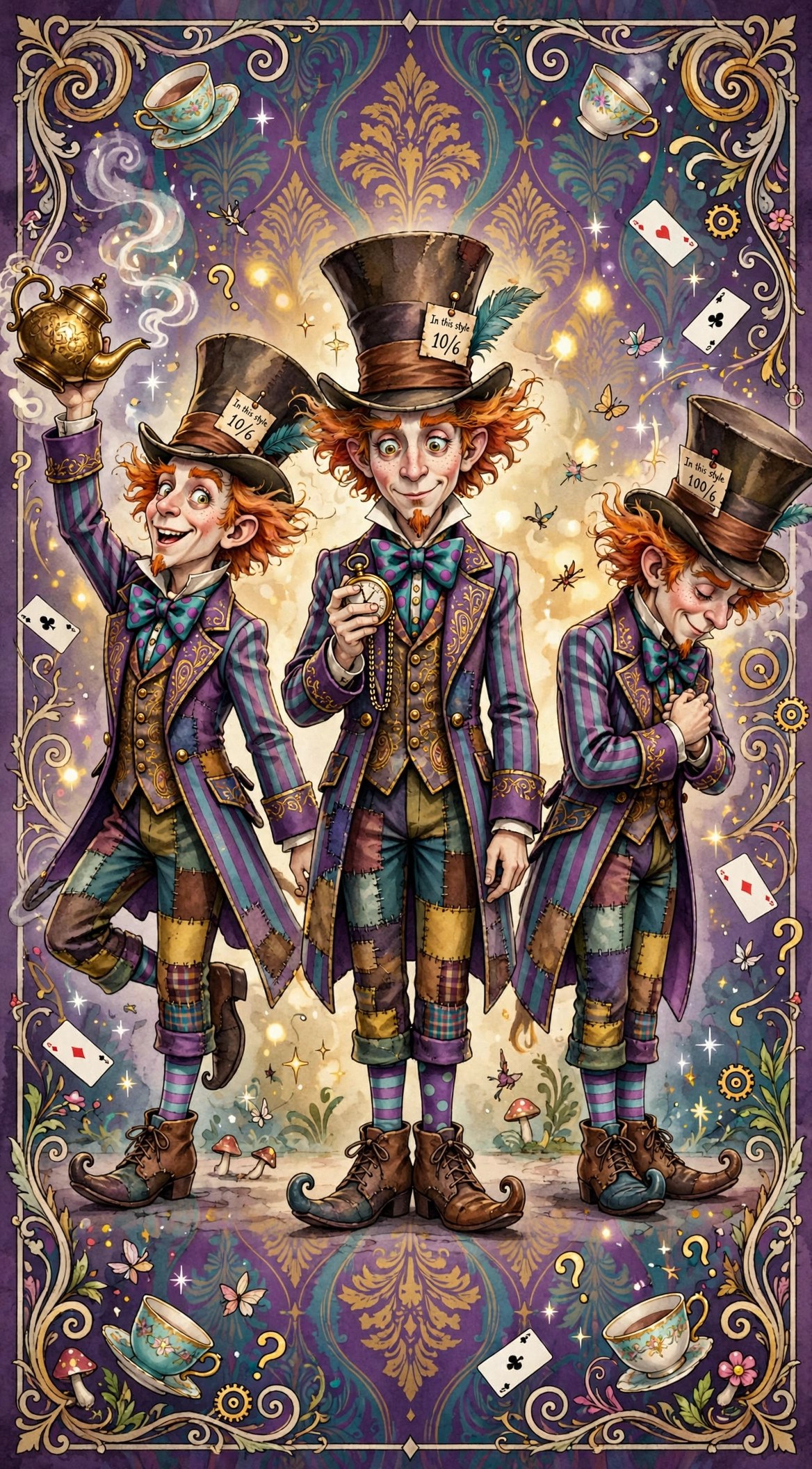
Who Is the Hatter?
Eccentric, courteous, ruthless with logic, and permanently at teatime — a portrait of literature's strangest host.
The host of the endless tea
The Hatter is a tradesman of Wonderland — a hatter by profession, as the price tag on his hat declares — who has been exiled from ordinary time into a permanent six o’clock. His defining traits:
- Courteous and discourteous by turns. He opens with a personal remark (“Your hair wants cutting”) and is offended when Alice returns the favor — then asks triumphantly, “Who’s making personal remarks now?”
- A ruthless logician. His nonsense is structured nonsense. “You might just as well say that ‘I see what I eat’ is the same thing as ‘I eat what I see’!” is impeccable logic about non-equivalent statements.
- A performer wronged. He was a singer before he was a host; the Queen’s sentence for “murdering the time” froze him at teatime.
- Restless. He is always moving the party round the table — “Clean cup! clean cup! Move down!” — because the cups never get washed and time never passes.
What he looks like
Carroll’s text gives almost no physical description. The visual Hatter is John Tenniel’s invention: the enormous top hat with the slip of paper reading “In this style 10/6,” the long nose, the wild hair. Every illustrator and filmmaker since has worked from Tenniel’s template, remixed. (See the illustrators.)
What the books actually tell us
Carroll is sparing with backstory, and what he gives is comic testimony, not biography:
- He was singing for the Queen of Hearts when she sentenced him (Chapter VII).
- He quarreled with Time, who now refuses to move for him — hence the watch that tells the day of the month but not the hour.
- He is called as the first witness at the Knave of Hearts’ trial, where he arrives with a teacup in one hand and bread-and-butter in the other (Chapter XI). The Queen appears to recognize him as the singer she condemned.
- In Through the Looking-Glass he reappears as Hatta, one of the White King’s messengers, just out of prison and still clutching his tea.
The name he never had
Carroll never wrote the words “Mad Hatter.” The chapter is “A Mad Tea-Party,” the Cat says the Hatter is mad, and the phrase “mad as a hatter” was already Victorian slang — but the compound name is the readers’ invention, cemented by Disney in 1951. Purists may call him “the Hatter”; the world calls him the Mad Hatter, and he doesn’t seem to mind.
Source notes
Character details are drawn from Alice’s Adventures in Wonderland Chapters VI, VII, and XI, and Through the Looking-Glass Chapter VII. Carroll’s text gives no birthplace, age, or family for the Hatter — this site does not invent any.