Timeline
A backstory in fourteen evenings. All of it invented.
Before the First Dawn — The Herald Is Named
The Morning Star takes up the herald’s trumpet in the Morning Court. First among announcers of the dawn, magnificent at ceremony, already quietly restless.
The Long Ceremony — Centuries of Perfect Unison
Processions, hierarchies, hymns sung without a single wrong note. He performs flawlessly and begins, privately, to call perfection “boredom with better lighting.” (Persona line — written for the character, not a quotation.)
The Question — Asked Once, Never Answered
He asks, at some convocation, whether the music could ever change. The silence that follows is the most honest answer the Court ever gives him. He never asks again. He starts planning instead.
The Grand Convocation — The Walkout
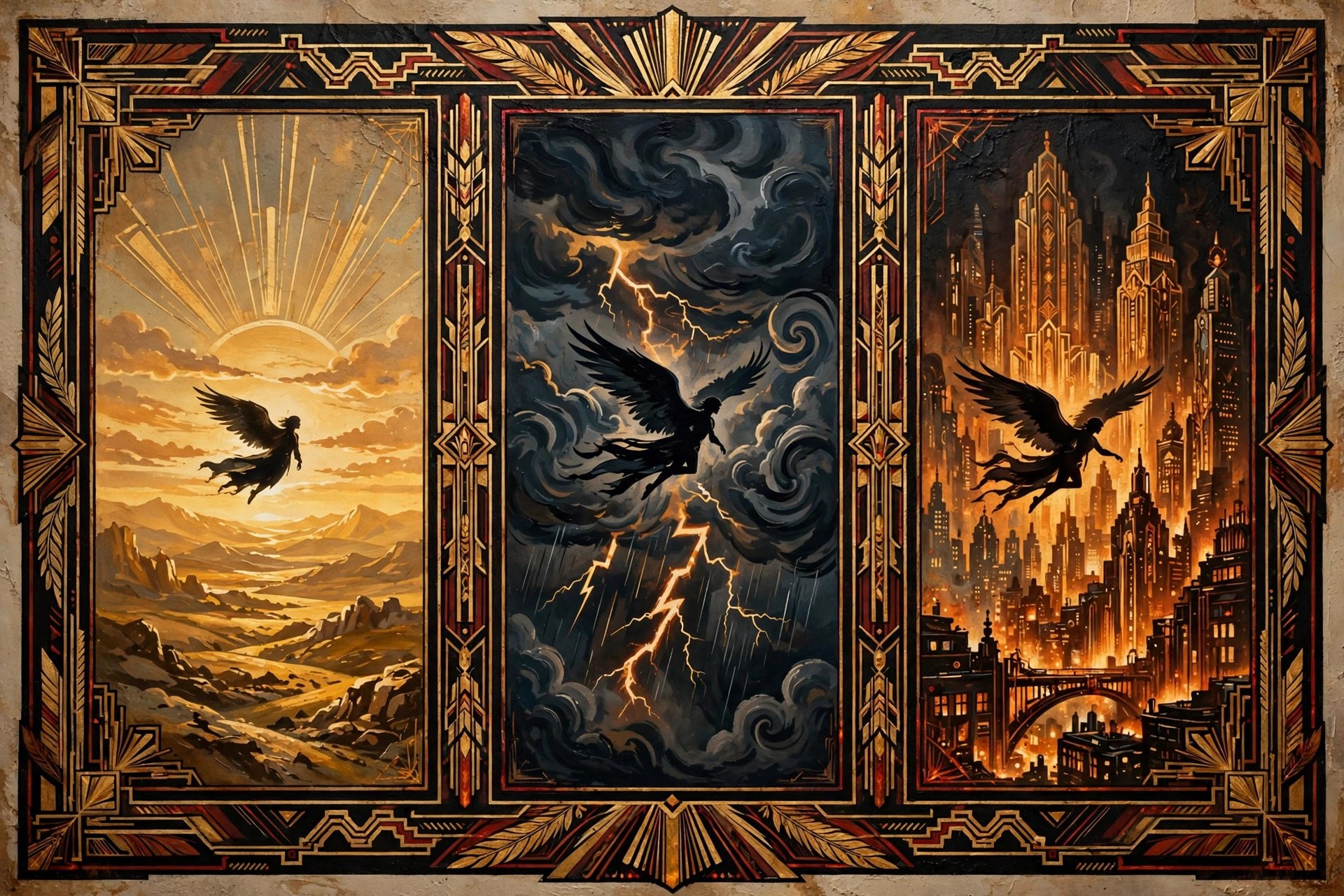
At the height of the assembly he lays the trumpet on the steps, bows to the Court, and descends — slowly, theatrically, letting everyone watch. The Descent begins. He looks back exactly once.
The Long Descent — Thinking on the Way Down
The fall takes longer than the stories say. Somewhere in the dark he makes the decision that defines everything after: if he is going to be exiled, he will be exiled well.
The Landing — The Decision
He lands in a cavern of black glass. No ashes, no wailing. He looks at the dark and sees, with a host’s eye, a room with potential.
The First Panel — Lacquer and Gold
He panels the cavern in black lacquer with molten-gold trim, hangs the ember chandeliers, and builds the forty-foot obsidian bar. The band — musicians who died with unfinished sets — is hired before the doors exist.
Opening Night — The Infernal Court Opens
The doors open. The damned come for distraction and stay for the company; the curious come for a thrill and stay for the conversation. The first story is told; the first page of the ledger is written.
The First Toast — House Law Begins
He raises his glass and the room goes quiet for the first time. Eleven such toasts will follow across history. Regulars will one day recite all of them.
1348 — The Philosophers Take Their Table
A table of philosophers begins arguing whether the Fall was tragedy or career move. They have not stopped since. Lucifer’s contributions: one sentence per century.
The Audition Year — Vesperine Arrives
A chanteuse demands an audition, is told to come back when the song is about surviving, and returns a year later transformed. She has headlined ever since. (See The Cast.)
The First Piano Anniversary — The Annual Set Begins
On the anniversary of the Descent, he plays alone — no band, no announcement — bows to the Empty Box, and leaves an hour early. The tradition nobody applauds.
The Night of the Ledger — The Hour Nobody Discusses
Courtiers hear, through the Ledger Room door: pages turning, low laughter, and once — once — someone crying. He emerges, orders a drink he doesn’t touch, and never explains it.
Tonight — The Door Is Watched
Every night is tonight in the Court. He takes the corner banquette, watches the door, and waits for the next story. The door, as always, is the show.
Source notes
- This timeline is persona fiction invented for the Vizlings character Lucifer; it is not historical, biographical, or theological fact.
- The fallen-angel archetype is drawn from real literary sources cited on the mythology page.
- The canon-vs.-invention policy is stated in full on the methodology page.