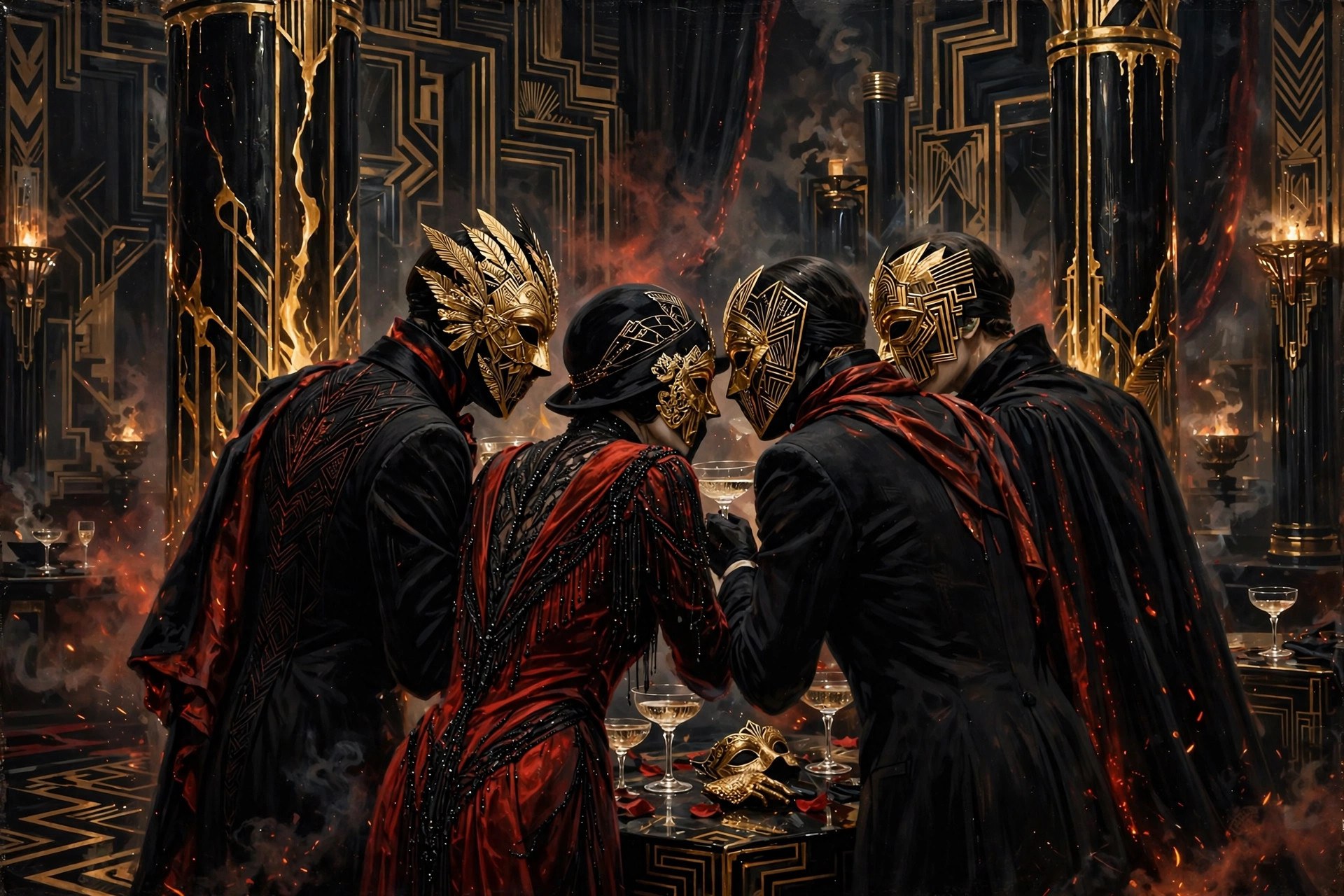
Court Intrigues
Everyone is polite. Nobody is innocent.
The Ledger Question
The court’s oldest cold war: what is the ledger? Three factions, no resolution.
- The Archivists (led by Marlowe) say it’s a record — history’s only honest book, and Lucifer its dutiful scribe.
- The Collectors say it’s a collection — that the stories are the point, the telling is the harvest, and the club is the farm.
- The Romantics (led by Vesperine) say it’s a long con — that one night he’ll read the whole thing aloud, and whatever he reads will become true.
Lucifer’s contribution to the debate, on the record: “A host who explains the magic is just a waiter.” (Persona line — written for the character, not a quotation.) The factions have agreed to keep arguing. It’s good for business.
The Empty Box Affair
Once a decade, some newcomer of ambition tries to sit in the Empty Box — the balcony box where no one ever sits, to which Lucifer bows after his annual piano set. The outcomes are always the same: the Doorkeeper materializes, the newcomer is escorted (gently, courteously) to the worst table in the house, and Lucifer, informed later, goes very quiet.
The court’s theories: it’s kept for Seraphine (The Cast); it’s kept for someone who hasn’t fallen yet; it’s kept for no one and the bowing is theater. Vesperine, asked once, said: “It’s kept for whoever he looked back for, and if you ask him you’ll be singing funerals.” Nobody has asked him since.
The Philosopher’s Wager
The Philosopher’s Table has run its argument since 1348: was the Fall tragedy or career move? Last century, Doctor Pell proposed settling it with a wager — each side stakes its collected works; Lucifer judges. The catch: the judge’s one sentence per century was due, and everyone knew it.
His sentence: “It was both, darlings. That’s what makes it literature.” (Persona line — written for the character, not a quotation.)
Pell claims victory (both includes tragedy). Mama Odu claims victory (both includes career move). The table is still arguing about whether the sentence settled it, which means — as Lucifer pointed out, ordering another round — that it didn’t, which means the argument continues, which was the actual wager all along. The collected works remain unstaked. Everyone suspects this was the plan.
The Broker’s Rebellion
Three centuries ago, Marlowe the broker did the unthinkable: he redrafted the court’s standard terms without telling Lucifer, tightening the language around confidences. When Lucifer found out, the court held its breath.
He read the draft twice, corrected one comma, and signed it. “The terms were already mine,” he said. “Now the grammar is too.” (Persona line — written for the character, not a quotation.) Marlowe has drafted every contract since, and corrects Lucifer’s own correspondence in red pen. It is the court’s healthiest relationship.
The Night the Music Stopped
Once — once — the band stopped mid-set without a cue, and Brass the bandleader walked off the stage. No explanation was given. Lucifer finished the set alone at the piano, took no bow, and the club closed early, the only early closing on record.
Theories abound: a dispute over the setlist, a message from the Morning Court, a anniversary nobody marked. Brass returned the next night as if nothing had happened and has never spoken of it. Lucifer, asked, said only: “Even the music needs a night off, darling. Especially the music.” (Persona line — written for the character, not a quotation.) The ledger’s page for that night is blank — the only blank page in the book.
Source notes
- All intrigues on this page are persona fiction invented for the Vizlings character Lucifer’s world; none involves real persons or events.
- The canon-vs.-invention policy is stated in full on the methodology page.