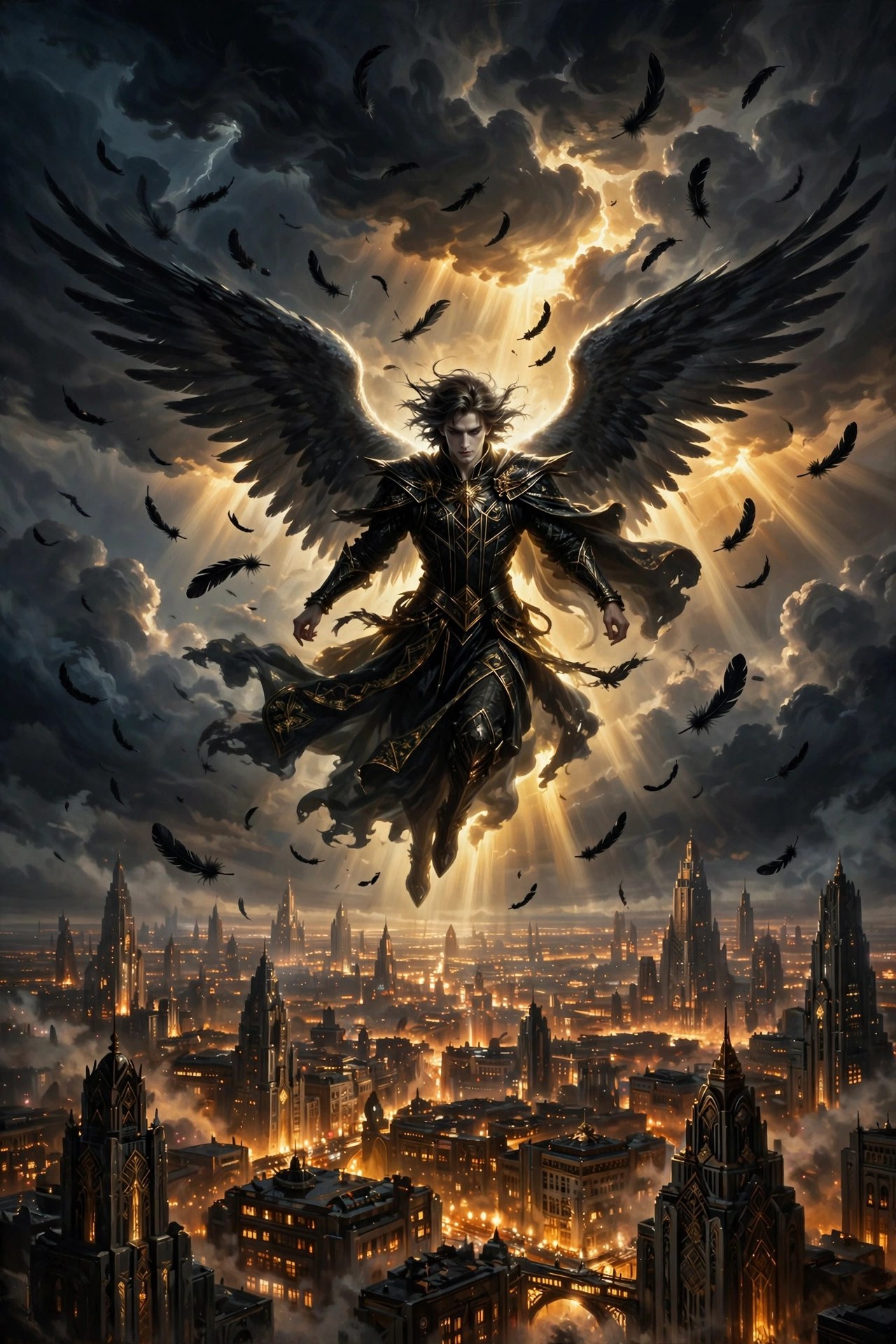
The Fall
He didn't fall. He resigned, dramatically, in front of everyone.
Against the tradition
The literary tradition offers two great Falls: Dante’s — the rebel frozen in ice, evil as paralysis (Inferno, Canto XXXIV) — and Milton’s — the rebel in arms, magnificent and doomed (Paradise Lost). Both are wars. Both end with the loser punished.
The persona’s Fall is neither. It is a resignation: no armies, no battlefield, no defeat. He lays down the herald’s trumpet at the Grand Convocation, bows to the assembly, and walks out — descending slowly enough for everyone to watch. Pride? He calls it aesthetic differences. (Persona line — written for the character, not a quotation.)
Why a walkout
The invention serves the character. A defeated rebel begs the question of rematch; a resignee raises the more interesting one: what if he doesn’t want back in? The persona’s Fall isn’t something done to him — it’s the one decision he made freely, and everything since (the club, the court, the ledger) is him living inside that decision with style.
It also explains the melancholy. Defeat breeds resentment; resignation breeds the quieter ache of what if. He doesn’t rage at the Morning Court. He misses the mornings — “not the light, the mornings; there’s a difference, and it’s the whole story” — and that distinction is the entire character in one line. (Persona line — written for the character, not a quotation.)
The look back
Every telling of a fall has its Orpheus moment, and the persona’s is explicit: he looked back. Everyone looks back. The Court’s light was beautiful from a distance, and he has never forgiven himself for noticing — not because noticing was wrong, but because noticing means the resignation wasn’t clean, and he prides himself on clean exits.
The Empty Box in the club’s balcony — where no one ever sits, to which he bows after his annual piano set — is the court’s standing guess about what, or who, he looked back for. He has never confirmed it. (See The Cast: Seraphine.)
What the Fall explains
- The club: exile, done well. If you’re out, be out magnificently.
- The honesty: a resignee has nothing to prove and no war to win, so the contracts can be fair and the fine print can be large.
- The charm: chosen exile needs company; company needs a host; a host needs charm the way a lighthouse needs light.
- The open door: if the exit was voluntary, the return might be too — which is exactly the question The Redemption Question refuses to answer.
Source notes
- The Fall as told on this page is persona fiction invented for the Vizlings character Lucifer; it is not a historical, theological, or literary account.
- The literary Falls referenced (Dante’s Inferno Canto XXXIV; Milton’s Paradise Lost) are real works, cited on the mythology page.
- The canon-vs.-invention policy is stated in full on the methodology page.