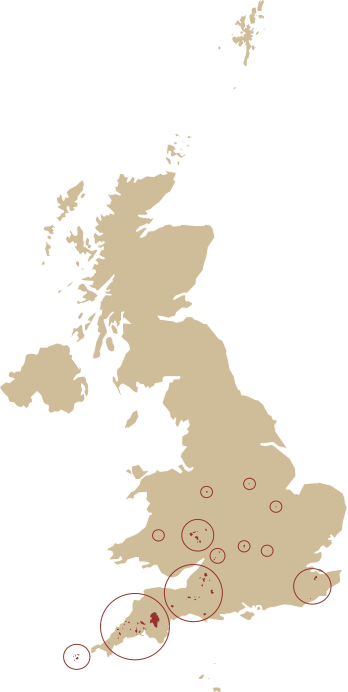
The Duchy of Cornwall
Seven centuries old, a billion pounds in land — the private estate that made the heir financially independent.
What it is
The Duchy of Cornwall was created in 1337 by Edward III for his son, the Black Prince. It is a private estate — not state property — held by the heir apparent (when there is one) to provide an independent income. Its portfolio spans roughly 130,000 acres across 23 counties, concentrated in the South West: farmland, forests, coastline, commercial property, and the Oval cricket ground in London.
By 2022 the Duchy’s assets were valued at around £1 billion, generating an annual surplus for the Duke of roughly £21–23 million in the final years of Charles’s tenure.
Charles’s seventy years as Duke
Charles became Duke of Cornwall automatically on his mother’s accession in 1952, aged three, and ran the Duchy actively from his twenties:
- Farming: He converted Duchy Home Farm at Highgrove to organic production in 1985 and pushed sustainable management across the estate’s tenanted farms.
- Building: On Duchy land he developed Poundbury (Dorset, begun 1993) and Nansledan (Cornwall) — new settlements on traditional urbanist lines that doubled as demonstrations of his architectural philosophy.
- Stewardship vs. profit: The Duchy is run as a commercial estate; Charles presented it as a model of responsible landownership. Critics noted the tension: a feudal landholding preaching sustainability while collecting rents.
The money question
The Duke pays income tax voluntarily on the Duchy surplus (an arrangement dating to 1993, when Charles agreed to it) — but the Duchy itself pays no corporation tax, a long-standing controversy. Republican campaigners call it a tax dodge; the Duchy notes it is not a company and that the arrangement was agreed with the Treasury. Both facts are true; the judgment is political.
The handover
On 8 September 2022 the Duchy passed automatically to William, the new heir. William’s first full year as Duke (2023–24) drew a surplus of about £30 million — reported with the usual debate about what an heir needs.
What the Duchy is not
- It is not the Crown Estate (state property whose revenue funds the Sovereign Grant).
- It is not the King’s personal property to sell — it passes with the title.
- Its income funds the heir’s official and charitable work, not just private spending — though the line between the two is exactly what critics probe.
Source notes
- Duchy history and portfolio: the Duchy of Cornwall’s published annual reports and accounts (presented to Parliament).
- Asset value (~£1bn) and surplus figures: Duchy annual reports; figures move year to year and are dated in the reports.
- Voluntary tax arrangement (1993): announced by Buckingham Palace; the Duchy’s corporation-tax position is stated in its own accounts.
- Poundbury and Nansledan: Duchy publications and planning records.
- William’s first-year surplus (~£30m, 2023–24): Duchy of Cornwall annual report, widely reported.