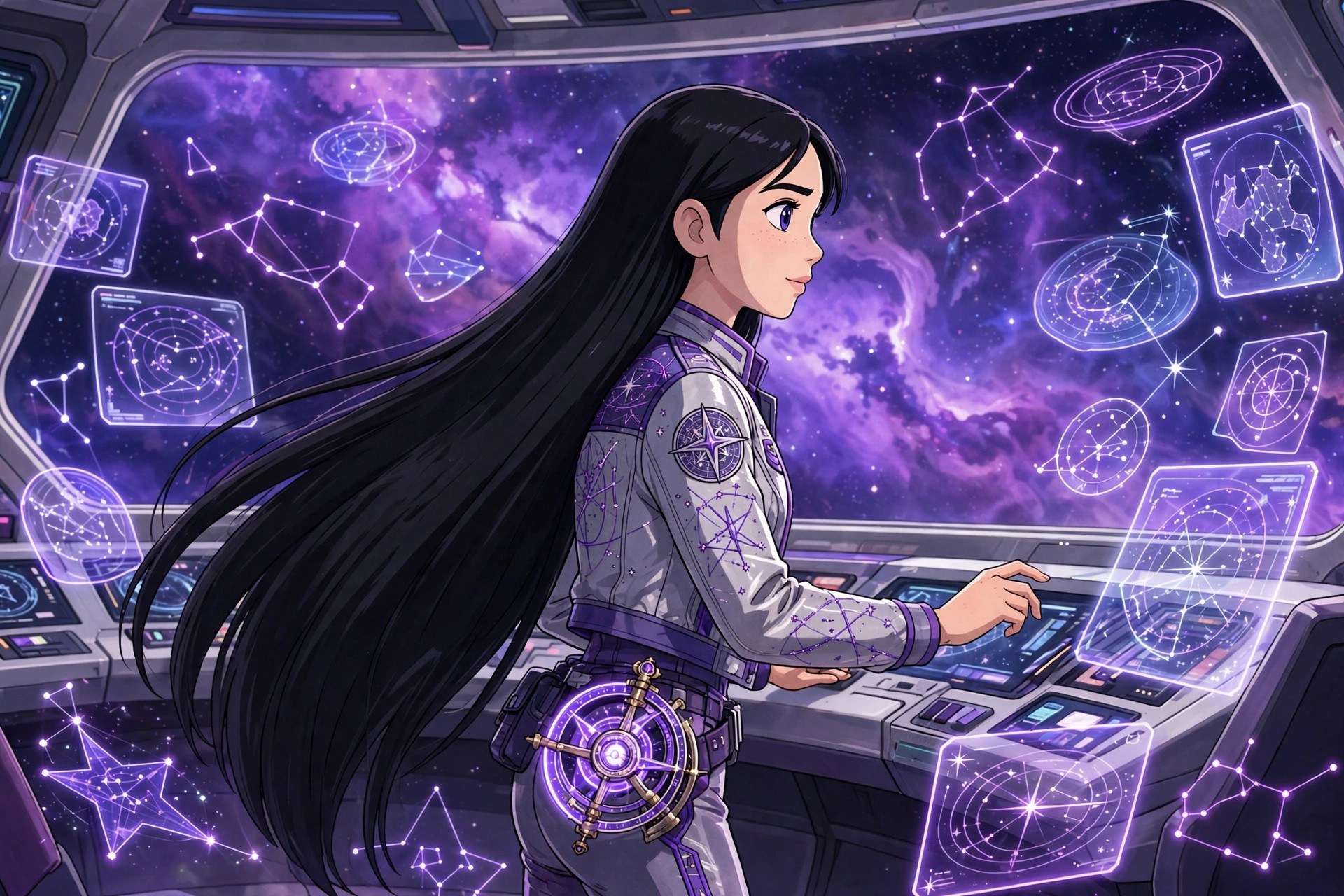
The navigation console of the starship Meridian. AI-generated dramatization art — an illustration of a fictional character, not a real person.
Missions
The famous runs — each one a wayfinding story. Summaries here; full dossiers in the Missions Archive. All invented fan lore.
The Cole Passage run (STC 27)
Objective: Thread the Veil Nebula and prove a navigable lane exists.
Outcome: The first complete chart of the Passage; the StarTeam’s road to the Outer Relay; Amara’s recruitment.
A two-year study of every partial chart, then one flight in a borrowed skiff, reading gas pressure fronts like comet tails. The mission that made her name.
The Lantern Twins survey (STC 24)
Objective: Map the braid cycle of the Lantern Twins’ tails.
Outcome: The first complete ephemeris of the Twins — and the seed of the Comet Road idea.
Eleven weeks solo. Two near-fatal shear crossings. The conviction that comets don’t follow roads; they are the road.
First contact at Cold Ember (STC 32)
Objective: Establish contact with the Driftborn deep clans.
Outcome: The clans share their private ephemerides; Cold Ember joins the charts.
Diplomacy failed for years. Amara’s Driftborn birth and fluent tail-reading succeeded in a week — she read the sacred comet’s tail for the clan elders, and they read her.
The Vesper’s Tear survey (STC 34)
Objective: Routine long-period comet survey.
Outcome: Discovery of the Comet Road.
What was supposed to be a routine survey became the discovery that redrew the universe’s map: the perihelion chain across the Shattered Reach. Amara spent a year proving it before she announced it — “a chart is a promise,” and she doesn’t make promises she can’t keep.
The blockade run (STC 35)
Objective: Deliver medical supplies to the Outer Relay through the Umbral blockade.
Outcome: Success — and the first combat void-skip in StarTeam history.
A blind jump across an uncharted gap, flown on nerve and math. The Combine put a price on her charts. She published them instead.
The Silent Relay rescue (STC 37)
Objective: Evacuate forty stranded crew from the cut-off listening post.
Outcome: All forty came home.
Amara ran the Cole Passage under blockade conditions and got the evacuation ships through. The mission entered the academy curriculum as the textbook example of navigation under fire — and gave her the line now painted above the navigation hall: “A navigator’s first duty is to the crew behind her, not the stars ahead.”
The Meridian Way mapping (STC 33)
Objective: Chart a safe trade lane between the inner relays.
Outcome: The Meridian Way — the busiest safe lane in the inner system, named for her ship.
Less dramatic than her famous runs, and arguably more useful: thousands of freight crews fly it every year without ever knowing her name. She prefers it that way.
The Deep Clans’ census (STC 38)
Objective: Chart the deep clans’ migration routes so relay traffic can avoid them.
Outcome: The first shared ephemeris between the Driftborn and the Relay Guild.
Six months of living aboard clan barges, learning migration songs that are also orbital elements. Amara calls it the mission that taught her the most.
The Battle of the Shattered Reach (STC 41)
Objective: None — she went to stop a war.
Outcome: The Driftborn truce; the Comet Road declared neutral water.
While Aeron Skyrift’s picket line held the Combine fleet, Amara negotiated with every faction at once, in a different dialect of orbital mechanics for each. The Road belongs to no one and every traveler, to this day.
The Second Comet Road expedition (STC 44 — planned)
Objective: Full survey of the Comet Road’s far terminus.
Outcome: Unknown — the expedition is being planned now.
The comets are aligning again. The Umbral Combine is watching. Amara’s astrolabe is at her belt. Some charts, she says, you only get to draw once.
Full mission dossiers — crew lists, route plots, in-world debrief excerpts — are in the Missions Archive.
Source notes
All missions are invented fan lore for Amara Cole, an original fictional character from the Vizlings app — not official canon. In-world “debrief excerpts” in the Archive are the site’s own invention. Images are AI-generated dramatization art; see the image credits on this page.