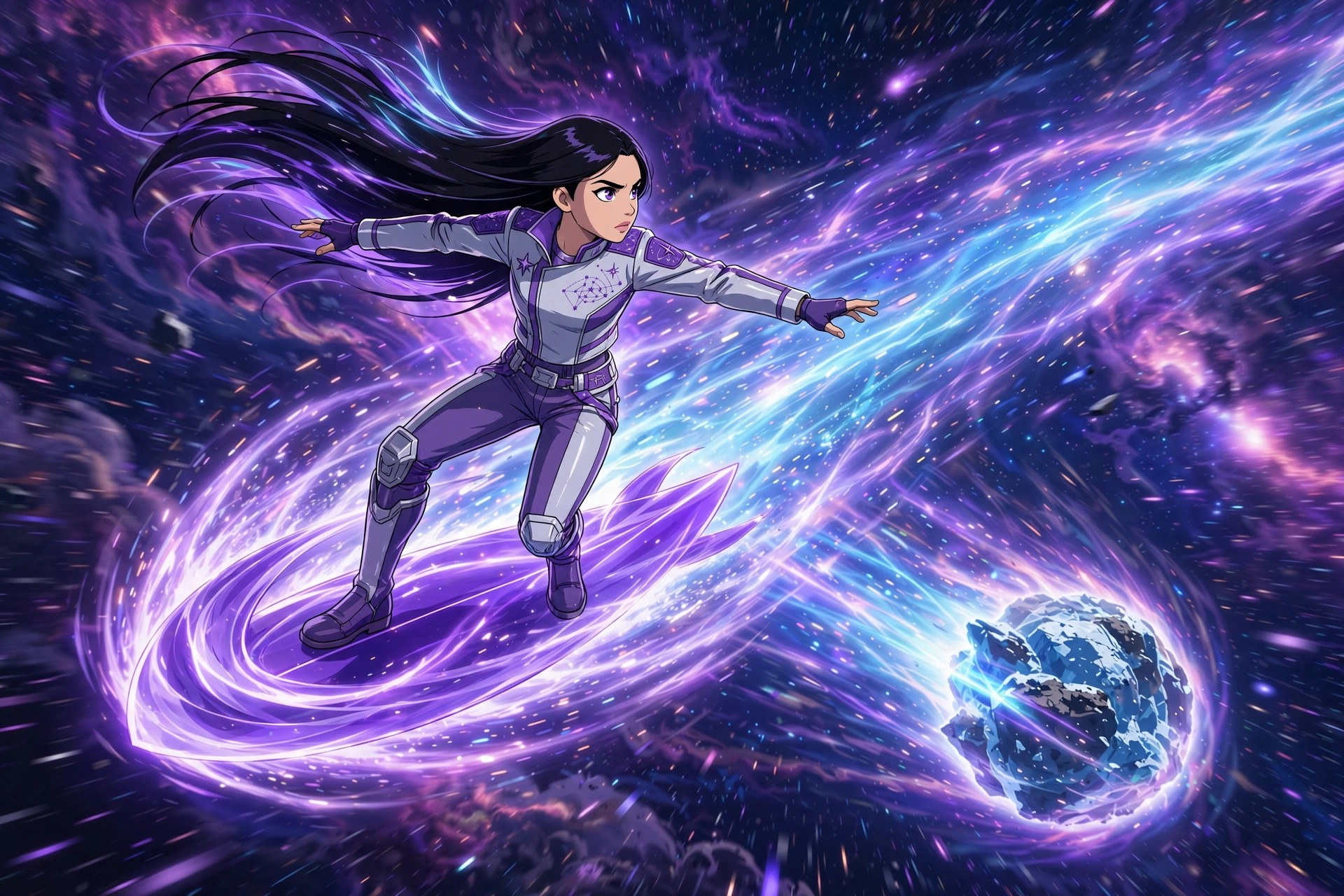
Comet-riding along the tail of Comet Liora. AI-generated dramatization art — an illustration of a fictional character, not a real person.
Abilities, Explained
The in-world mechanics — how star-sense, void-skipping, and comet-riding actually work in Amara's universe, and where each one breaks down. All invented fan lore.
Star-sense: the living sky
The mechanism
In the StarTeam universe, star-sense is treated as a rare neurological trait: an eidetic, three-dimensional spatial memory specialized for point-light fields. A star-sense navigator doesn’t memorize a list of stars; she holds a model — tens of thousands of point lights in true relative position, rotatable, zoomable, and continuously updated by observation.
The model does three things instruments struggle with:
Instant orientation. Any clear view of the sky snaps to the model within seconds — no computation, just recognition. Amara describes it as “the sky clicking into place, like a key turning.”
Motion detection. Because the model holds where stars should be, anything that has moved stands out immediately — a new comet, a shifting nebula front, a ship running dark.
Light-lag intuition. Starlight is old; every photon left its star years ago. Star-sense navigators correct for light-lag instinctively, reading not where stars are but where they were — and steering by the history.
How it’s trained
Star-sense is innate but useless without training — an untrained natural just has very good eyes. The training (see Training Regimen) is years of naked-eye observation: the dome hour, the blind plot, the lying slate. The model is built one star at a time and maintained the same way. Amara’s model covers the inner relays, the Veil, the Reach, and the Road — and she is still, in STC 44, adding to it every clear night.
Where it breaks
No starlight, no star-sense — sealed holds and sensor-dead zones blind it completely. Fatigue blurs the model after about thirty-six hours. And it is always her sky: unknown regions must be learned slowly, which is why the Comet Road took a year of proving. Star-sense is the greatest navigation instrument in the universe, and it still needs the astrolabe’s cross-check. “The engine computes,” Amara says. “I navigate.”
Void-skip: throwing yourself at the dark
The mechanism
A void-skip uses a precise burn at the edge of a gravity well to “skip” a ship across a blind gap — space no chart covers — emerging on a plotted vector. The in-world framework is void-lattice theory: local gravity modeled as a lattice of curved paths, the skip as a throw along its sharpest edge.
The maneuver has four phases: the read (mapping the well’s edge to arcsecond precision), the promise (plotting the exit vector — a prediction, not a destination), the throw (the burn, committed and irreversible), and the catch (emergence, verification, and the long exhale). Amara’s “promise correction” — updating the lattice in flight from comet-tail pressure readings — is what makes her skips land where she says they will.
The cost
A skip cannot be chained: the drive needs hours to recover, the navigator longer. The distance is short by interstellar standards — a gap-crosser, not a road. And every skip is flown on incomplete information, which is why Amara’s rule is absolute: she never skips anywhere she hasn’t already imagined dying, so she can plan around it. Eleven combat skips. Eleven returns. The math holds because the nerve holds.
Comet-riding: getting in the river
The mechanism
A comet’s tail is a river — ionized gas and dust shaped by the stellar wind into currents, eddies, and shear zones. Comet-riding means sailing those currents: reading the pressure fronts, catching the fast water, avoiding the shear that can tear a rig apart. The tail-sail catches the plasma flow; the rider steers by shifting weight and sail trim, the way a sailor works wind.
The skill cannot be learned from outside the river. Simulations help, instruments help, but the currents are too fine-grained and too fast-changing for anything but a trained rider’s feel. Amara learned on Liora’s tail as a child — which is why she is the only navigator alive who has ridden all four great comets of the Road end to end.
The danger
Tails are violent and irradiated. The Lantern Twins’ braid cycle nearly killed her twice in STC 24. Even the calm tails demand a shielded rig and constant attention; a moment’s inattention in a shear zone ends the ride and possibly the rider. Her apprentice Neris, five years in, is rated for only the calmest tails — and Amara considers that fast progress.
Why three, and why her
The three abilities form a complete navigator: star-sense tells her where she is, void-skip gets her across the gaps, comet-riding lets her travel the currents. Any one of them would make a career. Together, in one navigator, they made the Comet Road possible — because the Road could only be surveyed from inside the comets’ tails, by someone who could orient without instruments and jump the gaps between. The discovery wasn’t luck. It was the only discovery Amara Cole could have made.
Source notes
All mechanics on this page are invented fan lore for the fictional StarTeam universe of Amara Cole, an original character from the Vizlings app — not official canon, and not real physics. Images are AI-generated dramatization art; see the image credits on this page.