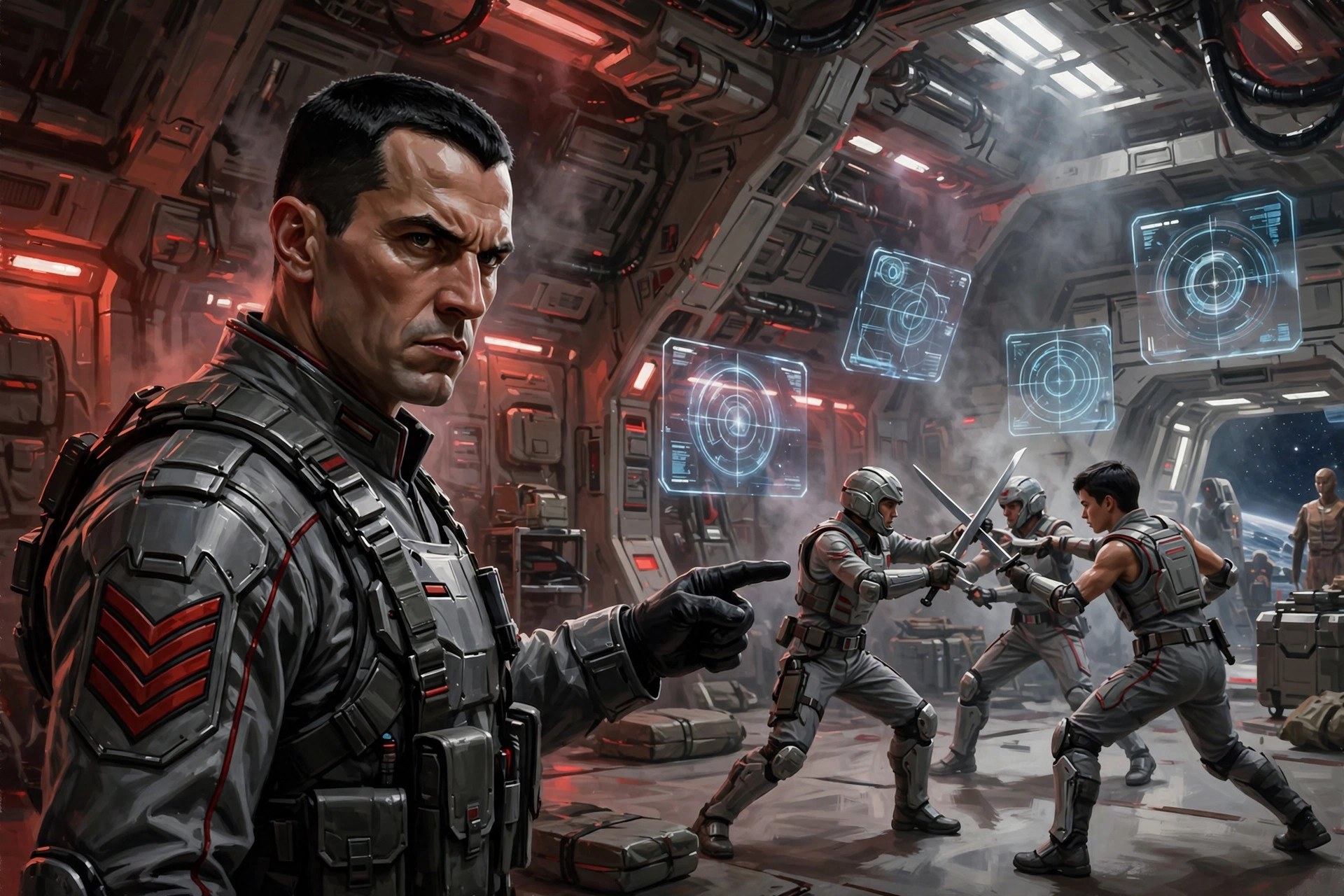
Training Regimen
How you build a tactician — the drills, habits, and rituals behind the Fleet Admiral.
The foundation: Cinderport habits
Aeron’s training began before he knew it was training. Loading freight on Veyra-3’s docks taught him weight, balance, and sequencing — which crate goes where so the lighter doesn’t list. Reading his mother’s signal manuals taught him to think in flows and patterns. He arrived at the Naval Academy with a foundry-worker’s body and a signal officer’s mind, and the academy’s job was mostly to give those raw materials military shape.
The Academy method
What the Academy actually drilled into him:
- War-games, constantly. Simulated fleet actions, three times a week, with the scenarios rigged against him. He learned to win outnumbered — which, as it turned out, was the only skill that mattered.
- After-action honesty. Cadets were required to write their own failures up in unsparing detail. Aeron’s reports from this period are preserved in the academy’s archives; they are famously brutal and famously useful. He still writes them the same way.
- The map room. Hours daily with charts, fleet dispositions, and logistics tables, until reading a theater of war became as natural as reading text. “Know the ground, even when the ground is vacuum.”
He graduated top of his class. The regimen never really stopped; it just changed venues.
The daily discipline (present day)
Fan lore is specific about Aeron’s routine, because fans love routine:
- 0400 — wakes. No alarm; he hasn’t needed one in thirty years.
- 0415 — reviews every active operation plan. All of them, every morning, “especially the ones going well.”
- 0600 — physical training. Sparring, mostly — he fences with Nyx twice a week and loses just often enough to keep it interesting.
- 0800 — the work of command: briefings, logistics, the Long Watch.
- Evening — letters. Hand-written, to the families of the fallen under his command. He has never missed a week.
He sleeps four hours a night, drinks his coffee black, and has never been seen to hurry. Hurrying, he says, is what people do when the plan was bad.
Training others
Aeron’s teaching philosophy is simple: train the judgment, not just the drill. His exercises always include a moment where the plan breaks — the comms go down, the intel was wrong, the enemy does something insane — and the grade depends on what the trainee does after the plan dies. “The plan is the starting point,” he tells every class. “You are the weapon.”
His signature exercise, still used at the Academy, is the Broken Chevron: a squadron-level war-game where, midway through, half the trainee’s forces are “destroyed” by umpire fiat. The lesson: fight the battle you have, not the battle you planned. Cadets hate it. Graduates swear by it.
The table ritual
With the StarTeam, training and planning merge into the ritual called “the table”: Aeron lays out the operation, each member stress-tests their part, Nyx tries to break the plan, Isla checks it against physics, and nothing launches until Jorenn — the youngest — says he understands his role. It is training disguised as briefing, and it means the team has rehearsed every operation before it happens.
What he can’t teach
Tactical Overwatch — the battle-sense — isn’t teachable, and Aeron is honest about that. “I can teach you the homework,” he says. “I can’t teach you to love doing it.” What he can teach, and does, is the discipline underneath the gift: the morning reviews, the honest after-actions, the map-room hours. The gift is his. The work ethic is available to anyone willing to pay for it.
Source notes
This regimen is fan-written world-building for a fictional character (see Methodology). The training image on this page is AI-generated dramatization art.