Abilities, Explained
How the legend supposedly works — the in-world mechanics of six abilities, with honest limits.
Fiction note: what follows is in-world speculation about a fictional character’s fictional capabilities — fan-written mechanics, not real science, not game rules, and not claims about any real person.
Tactical Overwatch: the mechanics
In fan lore, Tactical Overwatch is three things working together:
- The implant — a military holo-net receiver that streams fleet positions, sensor data, and logistics status directly to Aeron’s visual cortex. Standard flag-officer issue; what isn’t standard is what he does with it.
- The database — thirty years of battles, studied the way scholars study texts. He knows every major Maw engagement by heart: what they did, what worked, what the terrain allowed.
- The pattern engine — the part no one can replicate. Aeron’s mind assembles the feed and the history into a living model of the battlespace and runs it forward. Staff officers describe watching him reposition forces before enemy intentions become visible — “like watching someone answer a question before it’s asked.”
The limit: it fails against genuine randomness. An enemy who randomizes — who acts without doctrine, without pattern — is invisible to Overwatch. “Luck,” Aeron admits, “is the one doctrine I can’t out-think.” Kael Vorn has learned to seed chaos into his operations for exactly this reason.
Rift Step: the mechanics
The gauntlet device folds local vacuum — fan lore waves its hands here, as is traditional — displacing the wearer up to two hundred meters along line-of-sight. The hard rules: line-of-sight only, minutes of recharge between jumps, and a mass limit that barely covers Aeron in armor.
Tactically, it’s a repositioning tool, not an escape hatch. Aeron uses it to arrive: at the failing position, beside the wounded teammate, behind the enemy’s assumption. The most famous use was at Trelayne — nine minutes, forty boarders, and a tactician who kept appearing exactly where the breach was weakest. The security footage doesn’t show the blinks clearly. The Maw survivors’ testimony does: “He was everywhere.”
The limit: range, recharge — and Aeron’s own rule. He will not Rift Step out while his people are engaged. The device could save him; the man won’t let it.
The Chevron Protocol: the mechanics
Not technology but geometry: ships arranged in interlocking chevrons, each covering the blind arc of the next, the formation flexing around threats like a muscle. The innovation wasn’t the shape — chevron formations are ancient — but the drill: Aeron’s wings rehearse the flex until it happens at combat speed, without orders. The formation thinks.
The limit: it demands superb crews. A green squadron can’t hold the intervals; the protocol punishes hesitation. It’s a force multiplier for the excellent and a liability for the mediocre — which is why Aeron trains his people the way he does.
Iron Resolve: the mechanics
The least “mechanical” of the six and the most debated in-universe. Statisticians confirm the effect — lower panic rates, higher compliance under his direct command — but argue about the cause. The leading theory is unglamorous: Aeron’s orders are clear, his plans are sound, and his people know both, so they don’t panic. Calm is contagious when it’s earned.
The limit: it has a radius. Iron Resolve works on people who can see him, hear him, or know he’s in command. It doesn’t scale to a whole theater — which is why he puts himself where it matters.
Ironclad Riposte: the mechanics
The defensive doctrine: never meet strength with strength. Let the attacker commit, channel the breakthrough into prepared ground, then counterattack the overextension. Every Maw assault on an Aeron-held position has followed the same arc: initial success, growing overextension, sudden catastrophic reversal. “Attacking Skyrift is like punching a door that opens onto your own face.”
The limit: it requires something to defend. The Riposte is a positional doctrine; it doesn’t work in a meeting engagement or a pursuit. Aeron knows this, which is why he chooses his ground so carefully — “know the ground, even when the ground is vacuum.”
The Long Watch: the mechanics
Logistics as a weapon system. Aeron plans campaigns the way others plan battles: fuel, munitions, medical capacity, and maintenance cycles mapped to the hour and pre-positioned before the first shot. Operation Redoubt’s four-system strike was possible because everything the fleet needed was already waiting at the rendezvous points. The Maw’s intelligence never saw the buildup — because there wasn’t one. There was just… readiness.
The limit: it’s slow to build and brittle to disruption. The Long Watch assumes secure supply lines; cut them, and the whole edifice wobbles. Protecting those lines is why the 7th Expeditionary Wing spent two years as glorified convoy escorts — the least glamorous, most important posting of Aeron’s career.
The whole, briefly
Overwatch sees the battle. The Protocol shapes it. The Riposte punishes mistakes. The Long Watch makes it all possible. The Rift Step puts him where he’s needed. And Iron Resolve holds everyone together while it happens. Six abilities, one character: the man who does the homework.
Source notes
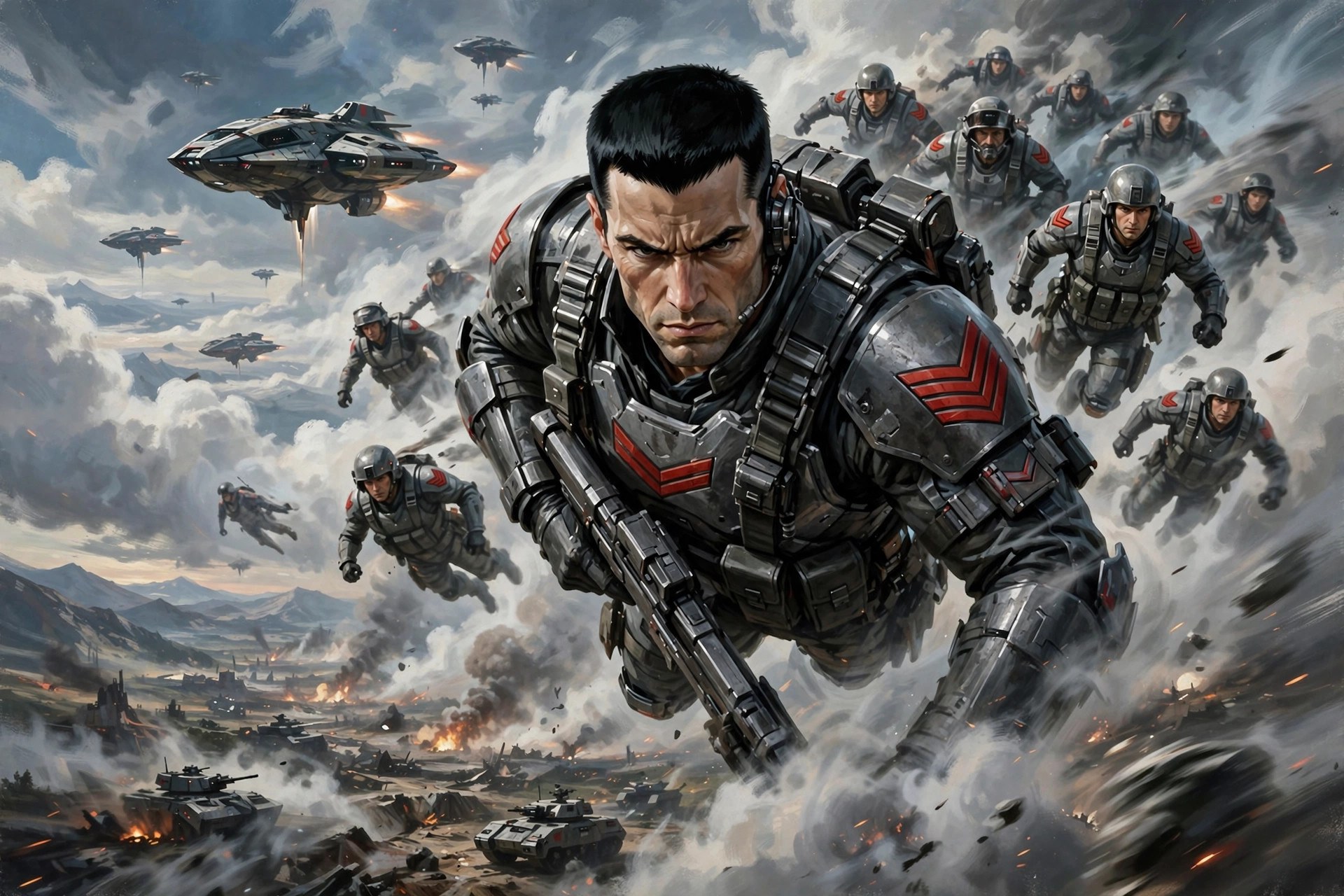
These mechanics are fan-written world-building for a fictional character (see Methodology) — not real science. The drop image on this page is AI-generated dramatization art.