Wartime Leadership
The decisions and moments of the wartime presidency, reported soberly and factually.
24 February 2022: staying in Kyiv
When Russia launched its full-scale invasion on 24 February 2022, Zelenskyy declared martial law and general mobilization — and stayed in Kyiv as Russian forces advanced toward the capital. Two days later he posted the selfie video from Bankova Street — “Ми тут,” “We are here” — flanked by senior officials. The decision to remain, and to communicate it on camera, became the foundation of his wartime public standing. (On the famous unconfirmed remark attributed to this period, see Public Record.)
The address as an instrument
From the invasion’s first days, Zelenskyy spoke to Ukrainians in regular — often nightly — video addresses, usually filmed simply: a phone camera, an olive-drab shirt, the Ukrainian flag. The format was deliberate in its plainness, and it became the war’s most consistent public record from the Ukrainian side. The major set-piece speeches are covered on Wartime Addresses.
Front-line and liberated-area visits
Zelenskyy made a practice of visiting front-line and recently liberated areas, with visits documented by the presidency and international press: Bucha in April 2022 after the Russian withdrawal; Kharkiv region in 2022; Kherson in November 2022 after its liberation; Bakhmut in December 2022, days before his Washington trip. Each visit was both a morale gesture and a documented assertion of Ukrainian control.
Key wartime decisions
- Martial law and mobilization (February 2022, repeatedly extended by the Rada since) — the legal framework of the entire war effort. See Wartime Governance.
- The 10-point peace formula (November 2022) — Ukraine’s diplomatic terms for ending the war. See Peace Formula.
- Command changes — the February 2024 replacement of Valerii Zaluzhny with Oleksandr Syrsky as Commander-in-Chief, the most significant wartime military personnel decision.
- The Victory Plan (October 2024) — a five-point program presented to parliament covering NATO invitation, defense, deterrence, economic partnership, and post-war security.
The 2025 diplomacy
After Donald Trump’s return to the U.S. presidency in January 2025, Zelenskyy engaged in direct diplomacy with the new administration. A 28 February 2025 Oval Office meeting with Trump and Vice President JD Vance ended in a public disagreement, widely reported worldwide; subsequent months saw continued negotiation over ceasefire proposals and security arrangements. This site records the events without characterizing the diplomacy. See International Diplomacy.
Leadership style, described not praised
The observable facts of Zelenskyy’s wartime leadership style: direct-to-camera communication, frequent travel to front-line areas, intensive personal diplomacy with allied leaders, and centralized decision-making through the Office of the President. Assessments of its effectiveness belong to analysts and historians; this reference records what happened.
Source notes
- 24 February 2022: Ukrainian presidency decrees (martial law, mobilization); international press.
- “We are here”: official video, 26 February 2022.
- Front-line visits: Ukrainian presidency; Reuters, AP, BBC, 2022.
- Peace formula: G20 Bali address, 15 November 2022.
- Zaluzhny/Syrsky: presidential decree, 8 February 2024.
- Victory Plan: Verkhovna Rada address, 16 October 2024.
- 28 February 2025 meeting: White House; international press.
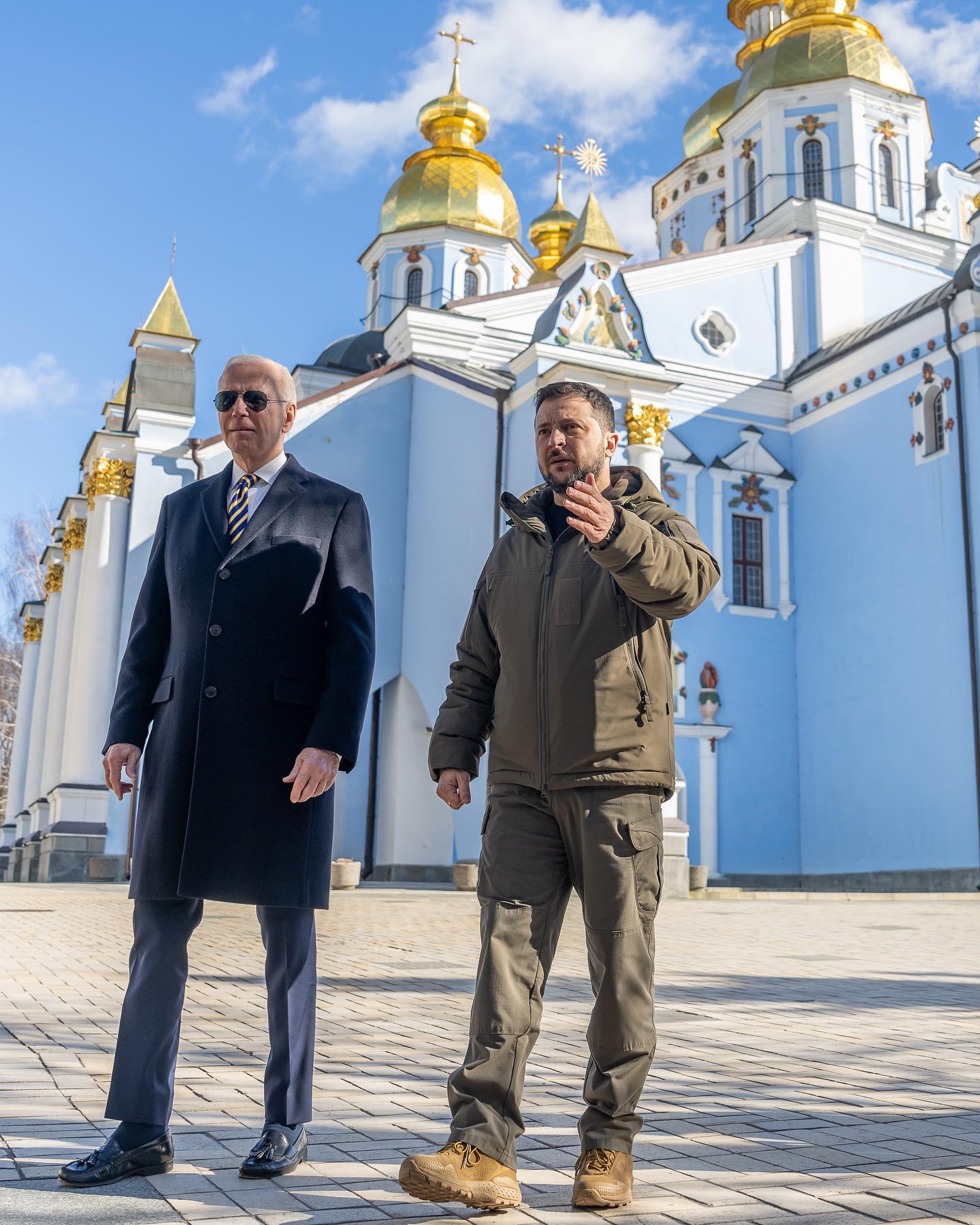
- Photograph: Joe Biden with Zelenskyy in Kyiv, 20 February 2023 (public domain, U.S. government); see sources.